







Question: Old MathJax webview (10 Marks) QUESTION 2 2.2 2.3 REQUIRED Use the information provided in Question 1 to calculate the following ratios for 2019 (answers
Old MathJax webview
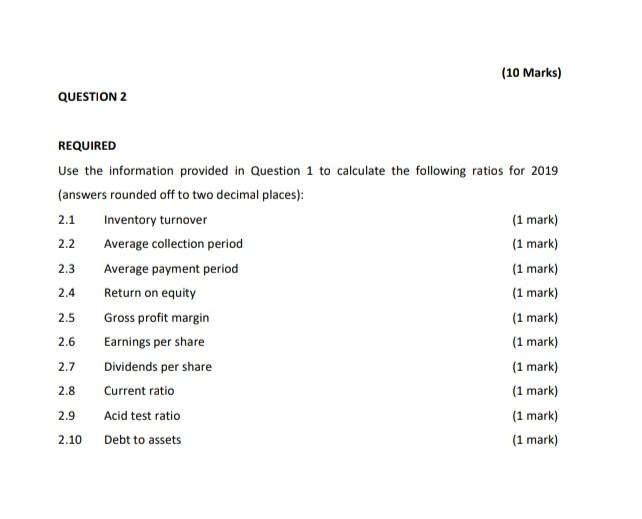
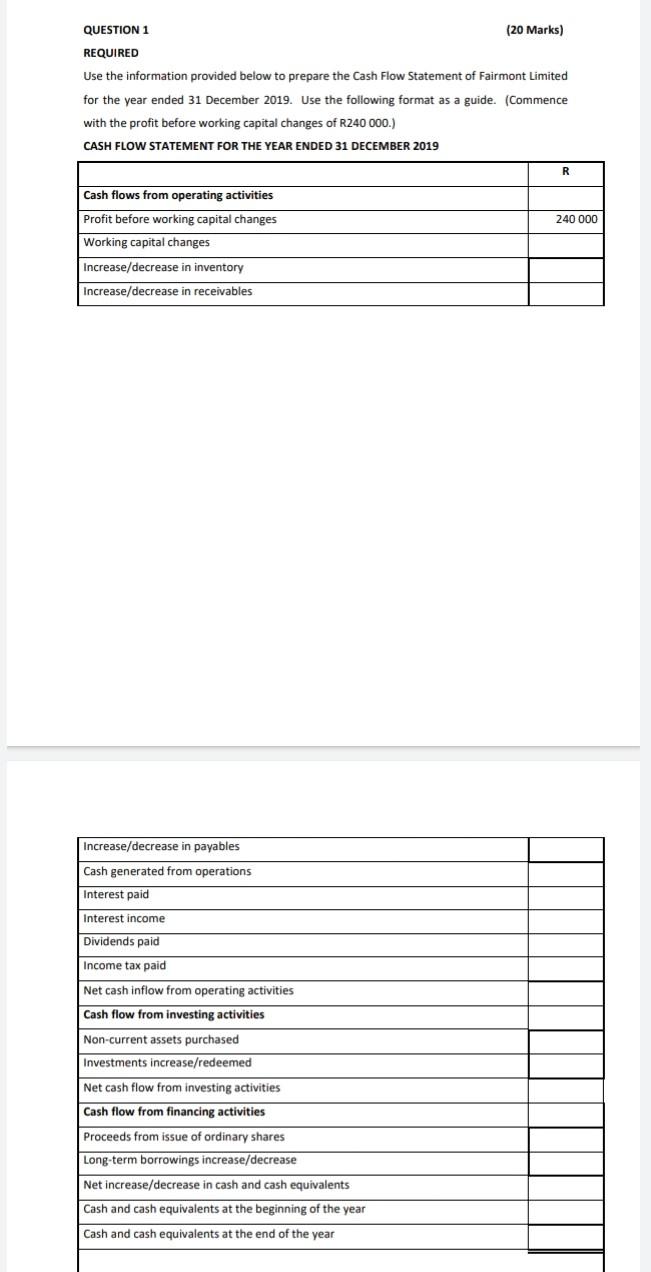
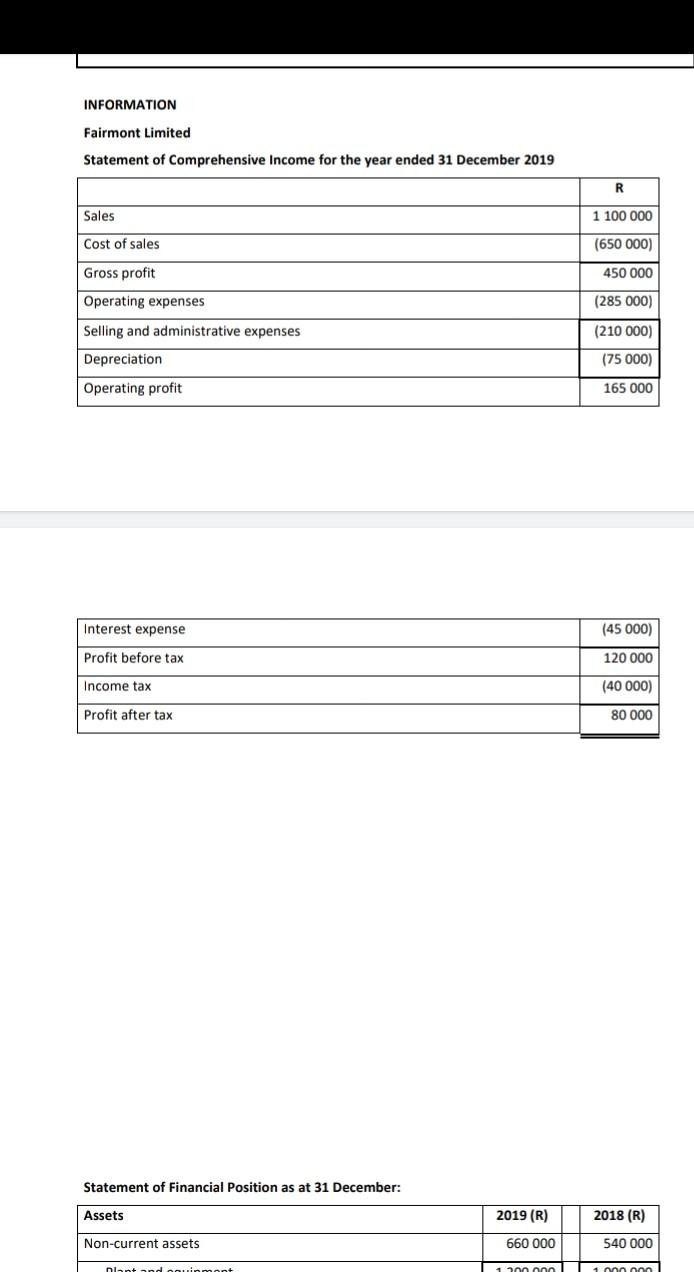
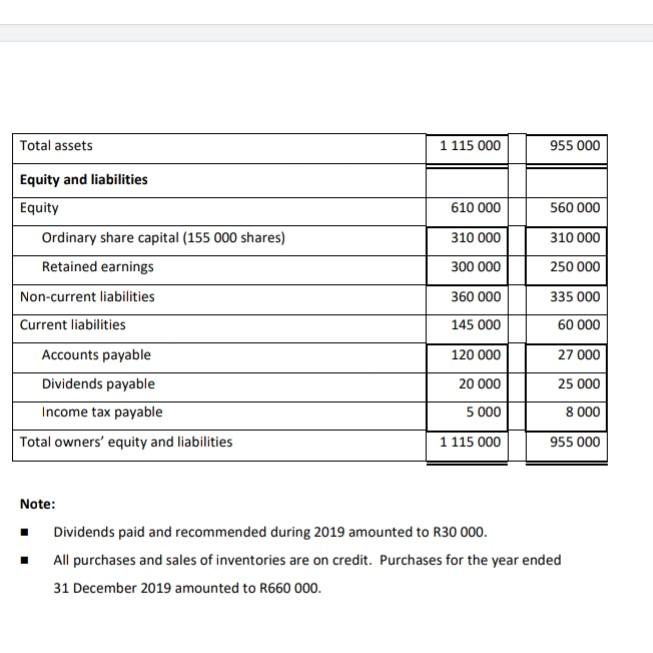
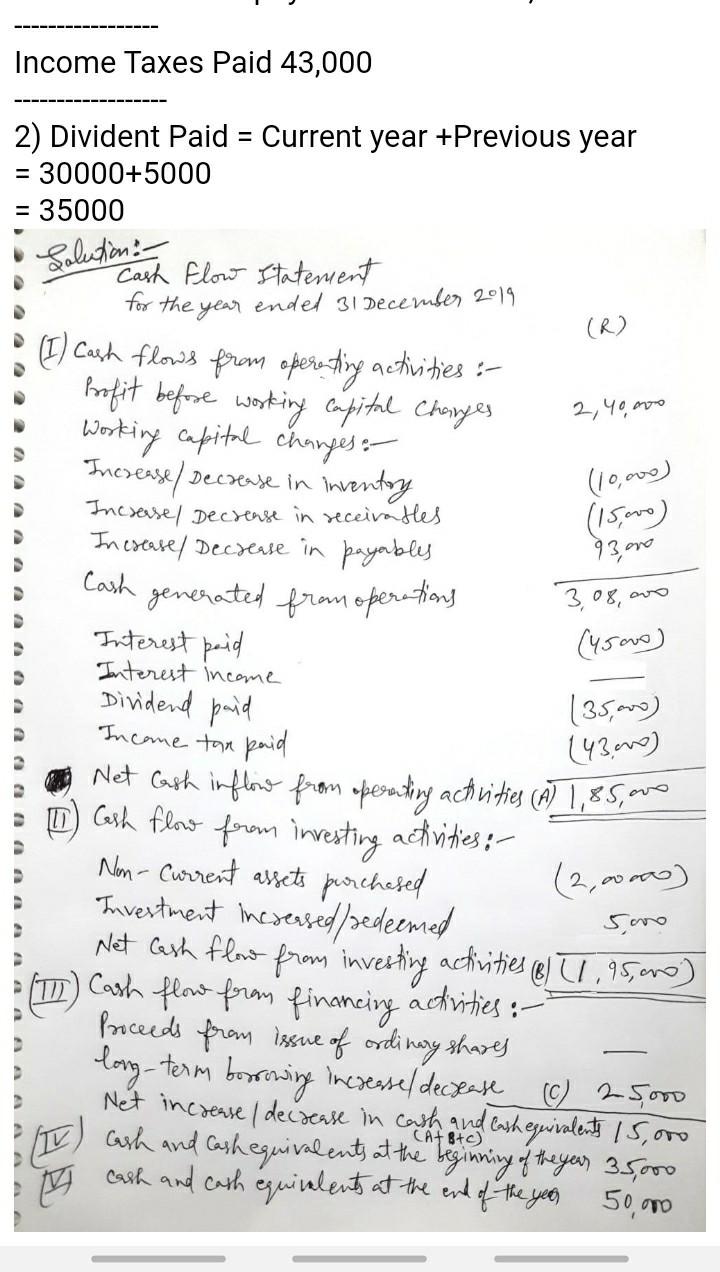
(10 Marks) QUESTION 2 2.2 2.3 REQUIRED Use the information provided in Question 1 to calculate the following ratios for 2019 (answers rounded off to two decimal places): 2.1 Inventory turnover (1 mark) Average collection period (1 mark) Average payment period (1 mark) Return on equity (1 mark) Gross profit margin (1 mark) Earnings per share (1 mark) 2.7 Dividends per share (1 mark) 2.8 Current ratio (1 mark) Acid test ratio (1 mark) Debt to assets (1 mark) 2.4 2.5 2.6 2.9 2.10 QUESTION 1 (20 Marks) REQUIRED Use the information provided below to prepare the Cash Flow Statement of Fairmont Limited for the year ended 31 December 2019. Use the following format as a guide. (Commence with the profit before working capital changes of R240 000.) CASH FLOW STATEMENT FOR THE YEAR ENDED 31 DECEMBER 2019 R Cash flows from operating activities Profit before working capital changes 240 000 Working capital changes Increase/decrease in inventory Increase/decrease in receivables Increase/decrease in payables Cash generated from operations Interest paid Interest income Dividends paid Income tax paid Net cash inflow from operating activities Cash flow from investing activities Non-current assets purchased Investments increase/redeemed Net cash flow from investing activities Cash flow from financing activities Proceeds from issue of ordinary shares Long-term borrowings increase/decrease Net increase/decrease in cash and cash equivalents Cash and cash equivalents at the beginning of the year Cash and cash equivalents at the end of the year INFORMATION Fairmont Limited Statement of Comprehensive Income for the year ended 31 December 2019 R Sales 1 100 000 Cost of sales (650 000) Gross profit 450 000 Operating expenses (285 000) (210 000) Selling and administrative expenses Depreciation Operating profit (75 000) 165 000 Interest expense (45 000) Profit before tax 120 000 Income tax (40 000) Profit after tax 80 000 Statement of Financial Position as at 31 December: Assets 2019 (R) 2018 (R) Non-current assets 660 000 540 000 nlant and nominmont Total assets 1 115 000 955 000 610 000 560 000 310 000 310 000 300 000 250 000 360 000 335 000 Equity and liabilities Equity Ordinary share capital (155 000 shares) Retained earnings Non-current liabilities Current liabilities Accounts payable Dividends payable Income tax payable Total owners' equity and liabilities 145 000 60 000 120 000 27 000 20 000 25 000 5 000 8 000 1 115 000 955 000 Note: . Dividends paid and recommended during 2019 amounted to R30 000 . All purchases and sales of inventories are on credit. Purchases for the year ended 31 December 2019 amounted to R660 000. Income Taxes Paid 43,000 2) Divident Paid = Current year +Previous year = 30000+5000 = 35000 Solution: Cash Flow Statement for the year ended 31 December 2019 (R) 2, 40,00 (10,000) (150) 93, ore 3,08, ano (usovo) Interest income > (I) Cash flows from operenting activities : rofit before working capital Changes Working capital changes & Increase / Decrease in inventory Increase/ Decrease in receivatles Increase / Decrease in payables Cash generated from operations Interest paid Dividend paid Income tax paid Net Cash inflow from operating activities (A) 1,85,000 D) Cash flow from investing activities: Nom- Current assets purchased Investment meressed redeemed Net cash flow from investing activities (6) 1,95,000) (177) Cash flow from financing activities: Proceeds from issue of ordinary shares long-term borrowing increase/ decrease (C) 25,000 Net increase / decrease in cash and cash equivalents 15,000 (I) Cash and cash equivalents at the beginning of the year 35,000 cash and cash equivalents at the end of the years 50,000 (35,00) (4300) (2,00) Sono (10 Marks) QUESTION 2 2.2 2.3 REQUIRED Use the information provided in Question 1 to calculate the following ratios for 2019 (answers rounded off to two decimal places): 2.1 Inventory turnover (1 mark) Average collection period (1 mark) Average payment period (1 mark) Return on equity (1 mark) Gross profit margin (1 mark) Earnings per share (1 mark) 2.7 Dividends per share (1 mark) 2.8 Current ratio (1 mark) Acid test ratio (1 mark) Debt to assets (1 mark) 2.4 2.5 2.6 2.9 2.10 QUESTION 1 (20 Marks) REQUIRED Use the information provided below to prepare the Cash Flow Statement of Fairmont Limited for the year ended 31 December 2019. Use the following format as a guide. (Commence with the profit before working capital changes of R240 000.) CASH FLOW STATEMENT FOR THE YEAR ENDED 31 DECEMBER 2019 R Cash flows from operating activities Profit before working capital changes 240 000 Working capital changes Increase/decrease in inventory Increase/decrease in receivables Increase/decrease in payables Cash generated from operations Interest paid Interest income Dividends paid Income tax paid Net cash inflow from operating activities Cash flow from investing activities Non-current assets purchased Investments increase/redeemed Net cash flow from investing activities Cash flow from financing activities Proceeds from issue of ordinary shares Long-term borrowings increase/decrease Net increase/decrease in cash and cash equivalents Cash and cash equivalents at the beginning of the year Cash and cash equivalents at the end of the year INFORMATION Fairmont Limited Statement of Comprehensive Income for the year ended 31 December 2019 R Sales 1 100 000 Cost of sales (650 000) Gross profit 450 000 Operating expenses (285 000) (210 000) Selling and administrative expenses Depreciation Operating profit (75 000) 165 000 Interest expense (45 000) Profit before tax 120 000 Income tax (40 000) Profit after tax 80 000 Statement of Financial Position as at 31 December: Assets 2019 (R) 2018 (R) Non-current assets 660 000 540 000 nlant and nominmont Total assets 1 115 000 955 000 610 000 560 000 310 000 310 000 300 000 250 000 360 000 335 000 Equity and liabilities Equity Ordinary share capital (155 000 shares) Retained earnings Non-current liabilities Current liabilities Accounts payable Dividends payable Income tax payable Total owners' equity and liabilities 145 000 60 000 120 000 27 000 20 000 25 000 5 000 8 000 1 115 000 955 000 Note: . Dividends paid and recommended during 2019 amounted to R30 000 . All purchases and sales of inventories are on credit. Purchases for the year ended 31 December 2019 amounted to R660 000. Income Taxes Paid 43,000 2) Divident Paid = Current year +Previous year = 30000+5000 = 35000 Solution: Cash Flow Statement for the year ended 31 December 2019 (R) 2, 40,00 (10,000) (150) 93, ore 3,08, ano (usovo) Interest income > (I) Cash flows from operenting activities : rofit before working capital Changes Working capital changes & Increase / Decrease in inventory Increase/ Decrease in receivatles Increase / Decrease in payables Cash generated from operations Interest paid Dividend paid Income tax paid Net Cash inflow from operating activities (A) 1,85,000 D) Cash flow from investing activities: Nom- Current assets purchased Investment meressed redeemed Net cash flow from investing activities (6) 1,95,000) (177) Cash flow from financing activities: Proceeds from issue of ordinary shares long-term borrowing increase/ decrease (C) 25,000 Net increase / decrease in cash and cash equivalents 15,000 (I) Cash and cash equivalents at the beginning of the year 35,000 cash and cash equivalents at the end of the years 50,000 (35,00) (4300) (2,00) Sono
Step by Step Solution
There are 3 Steps involved in it

Get step-by-step solutions from verified subject matter experts
 Study Help