







Question: Old MathJax webview As a separate project (Project P), you are considering sponsoring a pavilion at the upcoming Worlds Fair. The pavilion would cost $800,000,
Old MathJax webview
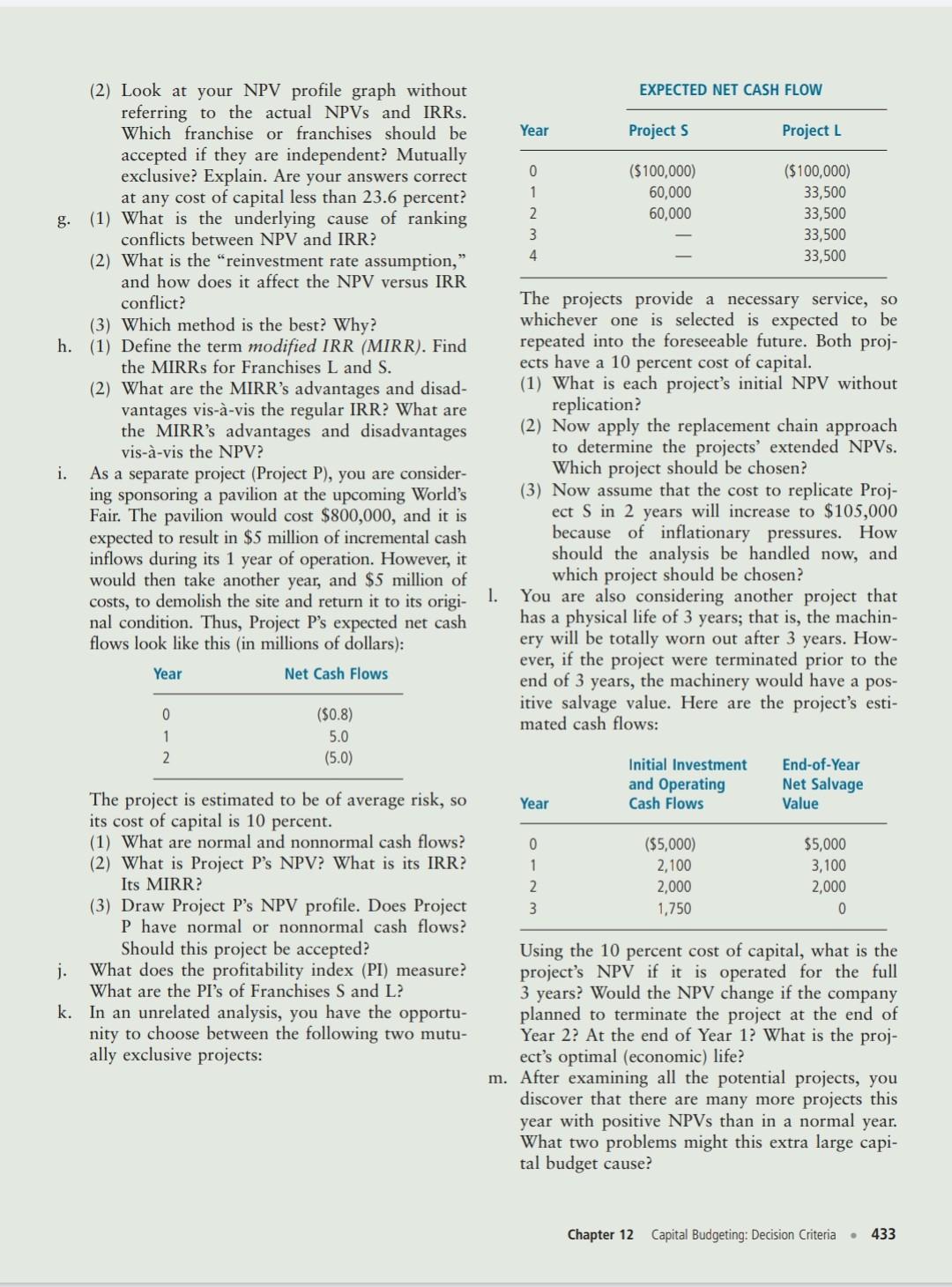
As a separate project (Project P), you are considering sponsoring a pavilion at the upcoming Worlds Fair. The pavilion would cost $800,000, and it is expected to result in $5 million of incremental cash inflows during its 1 year of operation. However, it would then take another year, and $5 million of costs, to demolish the site and return it to its original condition. Thus, Project Ps expected net cash flows look like this (in millions of dollars):
Year Net Cash Flow
0 ($0.8)
1 5.0
2 (5.0)
What is Project Ps NPV? What is its IRR? Its MIRR?
Pls help me to solve question i(2)

minicase c. You have just graduated from the MBA program of a Depreciation, salvage values, net working capital large university, and one of your favorite courses was requirements, and tax effects are all included in these "Today's Entrepreneurs. In fact, you enjoyed it so cash flows. much you have decided you want to be your own You also have made subjective risk assessments boss." While you were in the master's program, your of each franchise, and concluded that both fran- grandfather died and left you $1 million to do with chises have risk characteristics that require a return as you please. You are not an inventor, and you do of 10 percent. You must now determine whether one not have a trade skill that you can market; however, or both of the franchises should be accepted. you have decided that you would like to purchase at a. What is capital budgeting? least one established franchise in the fast-foods area, b. What is the difference between independent and maybe two (if profitable). The problem is that you have never been one to stay with any project for too mutually exclusive projects? (1) What is the payback period? Find the pay- long, so you figure that your time frame is 3 years. backs for Franchises L and S. After 3 years you will go on to something else. (2) What is the rationale for the payback method? You have narrowed your selection down to two choices: (1) Franchise L, Lisa's Soups, Salads, & According to the payback criterion, which franchise or franchises should be accepted if Stuff, and (2) Franchise S, Sam's Wonderful Fried the firm's maximum acceptable payback is Chicken. The net cash flows shown below include 2 years, and if Franchises L and S are inde- the price you would receive for selling the franchise pendent? If they are mutually exclusive? in Year 3 and the forecast of how each franchise will (3) What is the difference between the regular do over the 3-year period. Franchise L's cash flows and discounted payback periods? will start off slowly but will increase rather quickly (4) What is the main disadvantage of discounted as people become more health conscious, while payback? Is the payback method of any real Franchise S's cash flows will start off high but will usefulness in capital budgeting decisions? trail off as other chicken competitors enter the mar- d. (1) Define the term net present value (NPV). ketplace and as people become more health con- What is each franchise's NPV? scious and avoid fried foods. Franchise L serves (2) What is the rationale behind the NPV breakfast and lunch, while Franchise S serves only method? According to NPV, which franchise dinner, so it is possible for you to invest both or franchises should be accepted if they are franchises. You see these franchises as perfect com- independent? Mutually exclusive? plements to one another: You could attract both the (3) Would the NPVs change if the cost of capi- lunch and dinner crowds and the health conscious tal changed? and not so health conscious crowds without the (1) Define the term internal rate of return franchises directly competing against one another. (IRR). What is each franchise's IRR? Here are the net cash flows (in thousands of (2) How is the IRR on a project related to the dollars): YTM on a bond? (3) What is the logic behind the IRR method? EXPECTED NET CASH FLOW According to IRR, which franchises should be accepted if they are independent? Mutu- Year Franchise L Franchise s ally exclusive? 0 ($100) ($100) (4) Would the franchises' IRRs change if the 1 10 70 cost of capital changed? f. 2 60 50 (1) Draw NPV profiles for Franchises L and S. At what discount rate do the profiles cross? 3 80 20 e. 432 Part 3 Project Valuation EXPECTED NET CASH FLOW Year Projects Project L 0 1 ($100,000) 60,000 60,000 2 ($100,000) 33,500 33,500 33,500 33,500 3 (2) Look at your NPV profile graph without referring to the actual NPVs and IRRs. Which franchise or franchises should be accepted if they are independent? Mutually exclusive? Explain. Are your answers correct at any cost of capital less than 23.6 percent? g. (1) What is the underlying cause of ranking conflicts between NPV and IRR? (2) What is the "reinvestment rate assumption, and how does it affect the NPV versus IRR conflict? (3) Which method is the best? Why? h. (1) Define the term modified IRR (MIRR). Find the MIRRs for Franchises L and S. (2) What are the MIRR s advantages and disad vantages vis--vis the regular IRR? What are the MIRR's advantages and disadvantages 4 The projects provide a necessary service, so whichever one is selected is expected to be repeated into the foreseeable future. Both proj- ects have a 10 percent cost of capital. (1) What is each project's initial NPV without replication? (2) Now apply the replacement chain approach EXPECTED NET CASH FLOW Year Projects Project L 0 1 ($100,000) 60,000 60,000 2 ($100,000) 33,500 33,500 33,500 33,500 3 4 (2) Look at your NPV profile graph without referring to the actual NPVs and IRRs. Which franchise or franchises should be accepted if they are independent? Mutually exclusive? Explain. Are your answers correct at any cost of capital less than 23.6 percent? g. (1) What is the underlying cause of ranking conflicts between NPV and IRR? (2) What is the "reinvestment rate assumption," and how does it affect the NPV versus IRR conflict? (3) Which method is the best? Why? h. (1) Define the term modified IRR (MIRR). Find the MIRRs for Franchises L and S. (2) What are the MIRR's advantages and disad- vantages vis--vis the regular IRR? What are the MIRR's advantages and disadvantages vis--vis the NPV? i. As a separate project (Project P), you are consider- ing sponsoring a pavilion at the upcoming World's Fair. The pavilion would cost $800,000, and it is expected to result in $5 million of incremental cash inflows during its 1 year of operation. However, it would then take another year, and $5 million of costs, to demolish the site and return it to its origi- nal condition. Thus, Project P's expected net cash flows look like this (in millions of dollars): The projects provide a necessary service, so whichever one is selected is expected to be repeated into the foreseeable future. Both proj- ects have a 10 percent cost of capital. (1) What is each project's initial NPV without replication? (2) Now apply the replacement chain approach to determine the projects' extended NPVs. Which project should be chosen? (3) Now assume that the cost to replicate Proj- ect S in 2 years will increase to $105,000 because of inflationary pressures. How should the analysis be handled now, and which project should be chosen? You are also considering another project that has a physical life of 3 years; that is, the machin- ery will be totally worn out after 3 years. How- ever, if the project were terminated prior to the end of 3 years, the machinery would have a pos- itive salvage value. Here are the project's esti- mated cash flows: 1. Year Net Cash Flows 0 ($0.8) 5.0 1 2 (5.0) Initial Investment and Operating Cash Flows End-of-Year Net Salvage Value Year 0 1 ($5,000) 2,100 2,000 1,750 $5,000 3,100 2,000 2 3 0 The project is estimated to be of average risk, so its cost of capital is 10 percent. (1) What are normal and nonnormal cash flows? (2) What is Project P's NPV? What is its IRR? Its MIRR? (3) Draw Project P's NPV profile. Does Project P have normal or nonnormal cash flows? Should this project be accepted? j. What does the profitability index (PI) measure? What are the PI's of Franchises S and L? k. In an unrelated analysis, you have the opportu- nity to choose between the following two mutu- ally exclusive projects: Using the 10 percent cost of capital, what is the project's NPV if it is operated for the full 3 years? Would the NPV change if the company planned to terminate the project at the end of Year 2? At the end of Year 1? What is the proj- ect's optimal (economic) life? m. After examining all the potential projects, you discover that there are many more projects this year with positive NPVs than in a normal year. What two problems might this extra large capi- tal budget cause? Chapter 12 Capital Budgeting: Decision Criteria 433
Step by Step Solution
There are 3 Steps involved in it

Get step-by-step solutions from verified subject matter experts
 Study Help