







Question: Old MathJax webview need answer for question 1 and 2 .. Thanks list of rights from chapter 1 THINKING ETHICALLY SHOULD WORKERS GET HAZARD PAY
Old MathJax webview
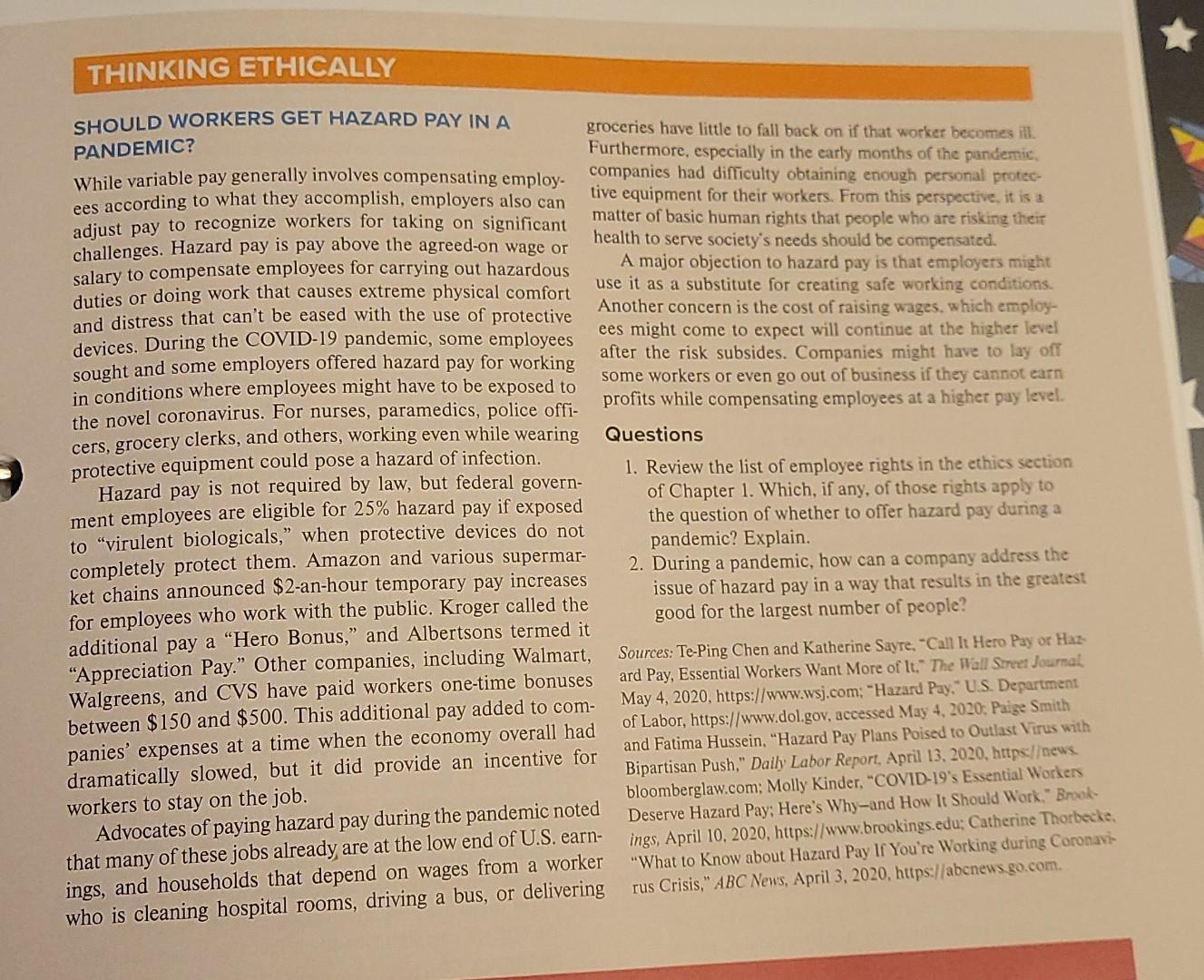
need answer for question 1 and 2 ..Thanks
list of rights from chapter 1
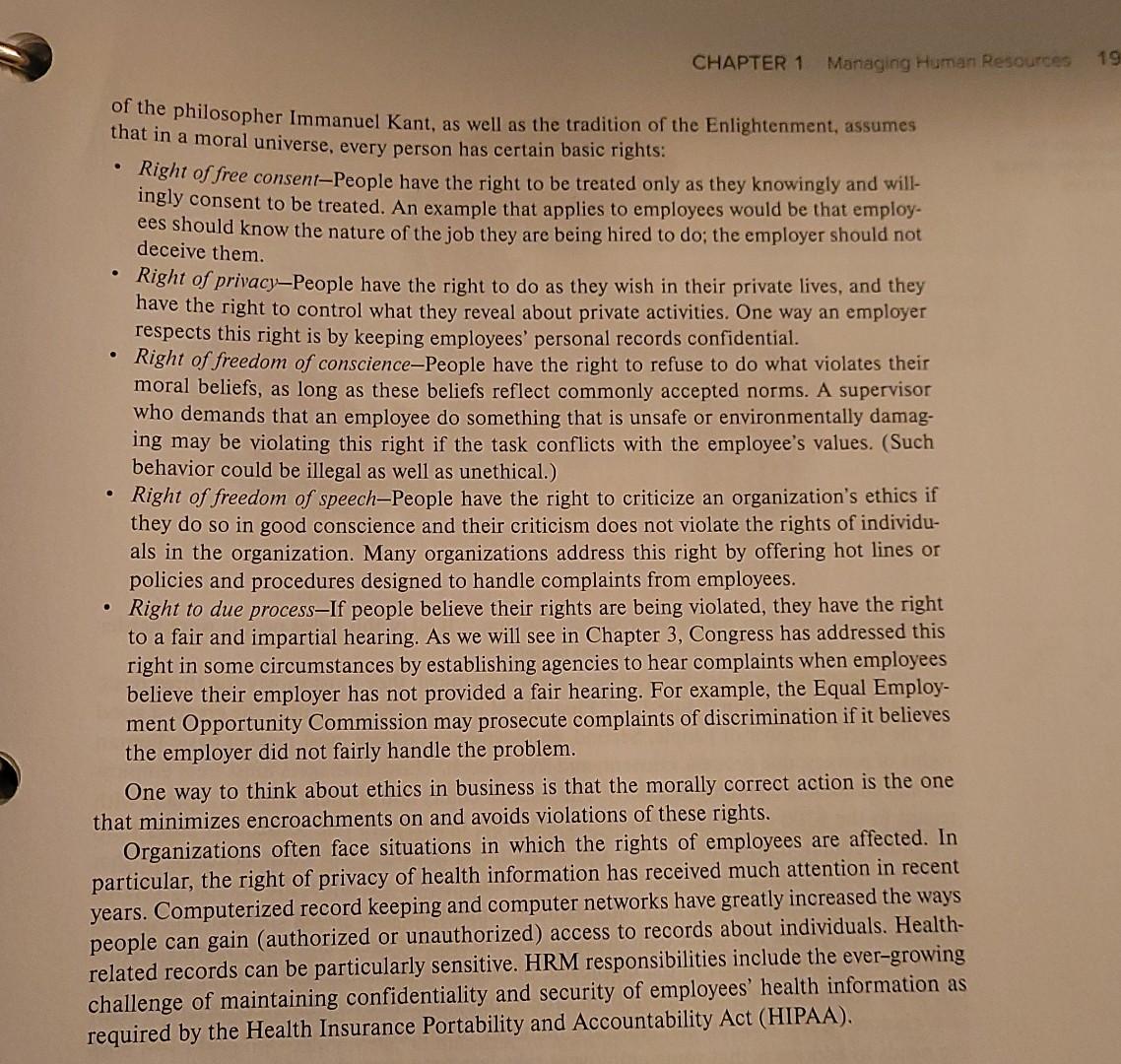
THINKING ETHICALLY SHOULD WORKERS GET HAZARD PAY IN A groceries have little to fall back on if that worker becomes ill. PANDEMIC? Furthermore, especially in the early months of the pandemic While variable pay generally involves compensating employ- companies had difficulty obtaining enough personal protec- ees according to what they accomplish, employers also can tive equipment for their workers. From this perspective, it is a adjust pay to recognize workers for taking on significant matter of basic human rights that people who are risking their challenges. Hazard pay is pay above the agreed-on wage or health to serve society's needs should be compensated. salary to compensate employees for carrying out hazardous A major objection to hazard pay is that employers might duties or doing work that causes extreme physical comfort use it as a substitute for creating safe working conditions. and distress that can't be eased with the use of protective Another concern is the cost of raising wages, which employ- devices. During the COVID-19 pandemic, some employees ees might come to expect will continue at the higher level sought and some employers offered hazard pay for working after the risk subsides. Companies might have to lay off in conditions where employees might have to be exposed to some workers or even go out of business if they cannot earn the novel coronavirus. For nurses, paramedics, police offi- profits while compensating employees at a higher pay level. cers, grocery clerks, and others, working even while wearing Questions protective equipment could pose a hazard of infection. 1. Review the list of employee rights in the ethics section Hazard pay is not required by law, but federal govern- of Chapter 1. Which, if any, of those rights apply to ment employees are eligible for 25% hazard pay if exposed the question of whether to offer hazard pay during a to "virulent biologicals, when protective devices do not pandemic? Explain. completely protect them. Amazon and various supermar- 2. During a pandemic, how can a company address the ket chains announced $2-an-hour temporary pay increases issue of hazard pay in a way that results in the greatest for employees who work with the public. Kroger called the good for the largest number of people? additional pay a "Hero Bonus," and Albertsons termed it "Appreciation Pay. Other companies, including Walmart, Sources: Te-Ping Chen and Katherine Sayre. "Call It Hero Pay or Hars ard Pay, Essential Workers Want More of it." The Wall Street Journal Walgreens, and CVS have paid workers one-time bonuses between $150 and $500. This additional pay added to com- May 4, 2020, https://www.wsj.com: "Hazard Pay." U.S. Department of Labor, https://www.dol.gov, accessed May 4, 2020: Paige Smith panies' expenses at a time when the economy overall had and Fatima Hussein, "Hazard Pay Plans Poised to Outlast Virus with dramatically slowed, but it did provide an incentive for Bipartisan Push," Daily Labor Report, April 13, 2020. https/ews. workers to stay on the job. bloomberglaw.com: Molly Kinder, "COVID-19's Essential Workers Advocates of paying hazard pay during the pandemic noted Deserve Hazard Pay; Here's Why-and How It Should Work." Brook that many of these jobs already are at the low end of U.S. earn- ings, April 10, 2020, https://www.brookings.edu: Catherine Thorbecke, "What to know about Hazard Pay If You're Working during Coronavi- ings, and households that depend on wages from a worker rus Crisis," ABC News, April 3, 2020, https://abcnews.go.com. who is cleaning hospital rooms, driving a bus, or delivering CHAPTER 1 Managing Human Resources 19 of the philosopher Immanuel Kant, as well as the tradition of the Enlightenment, assumes that in a moral universe, every person has certain basic rights: Right of free consent-People have the right to be treated only as they knowingly and will- ingly consent to be treated. An example that applies to employees would be that employ- ees should know the nature of the job they are being hired to do the employer should not deceive them. Right of privacy-People have the right to do as they wish in their private lives, and they have the right to control what they reveal about private activities. One way an employer respects this right is by keeping employees' personal records confidential. Right of freedom of conscience-People have the right to refuse to do what violates their moral beliefs, as long as these beliefs reflect commonly accepted norms. A supervisor who demands that an employee do something that is unsafe or environmentally damag- ing may be violating this right if the task conflicts with the employee's values. (Such behavior could be illegal as well as unethical.) Right of freedom of speech-People have the right to criticize an organization's ethics if they do so in good conscience and their criticism does not violate the rights of individu- als in the organization. Many organizations address this right by offering hot lines or policies and procedures designed to handle complaints from employees. Right to due process-If people believe their rights are being violated, they have the right to a fair and impartial hearing. As we will see in Chapter 3, Congress has addressed this right in some circumstances by establishing agencies to hear complaints when employees believe their employer has not provided a fair hearing. For example, the Equal Employ- ment Opportunity Commission may prosecute complaints of discrimination if it believes the employer did not fairly handle the problem. One way to think about ethics in business is that the morally correct action is the one that minimizes encroachments on and avoids violations of these rights. Organizations often face situations in which the rights of employees are affected. In particular, the right of privacy of health information has received much attention in recent years. Computerized record keeping and computer networks have greatly increased the ways people can gain (authorized or unauthorized) access to records about individuals. Health- related records can be particularly sensitive. HRM responsibilities include the ever-growing challenge of maintaining confidentiality and security of employees' health information as required by the Health Insurance Portability and Accountability Act (HIPAA). . THINKING ETHICALLY SHOULD WORKERS GET HAZARD PAY IN A groceries have little to fall back on if that worker becomes ill. PANDEMIC? Furthermore, especially in the early months of the pandemic While variable pay generally involves compensating employ- companies had difficulty obtaining enough personal protec- ees according to what they accomplish, employers also can tive equipment for their workers. From this perspective, it is a adjust pay to recognize workers for taking on significant matter of basic human rights that people who are risking their challenges. Hazard pay is pay above the agreed-on wage or health to serve society's needs should be compensated. salary to compensate employees for carrying out hazardous A major objection to hazard pay is that employers might duties or doing work that causes extreme physical comfort use it as a substitute for creating safe working conditions. and distress that can't be eased with the use of protective Another concern is the cost of raising wages, which employ- devices. During the COVID-19 pandemic, some employees ees might come to expect will continue at the higher level sought and some employers offered hazard pay for working after the risk subsides. Companies might have to lay off in conditions where employees might have to be exposed to some workers or even go out of business if they cannot earn the novel coronavirus. For nurses, paramedics, police offi- profits while compensating employees at a higher pay level. cers, grocery clerks, and others, working even while wearing Questions protective equipment could pose a hazard of infection. 1. Review the list of employee rights in the ethics section Hazard pay is not required by law, but federal govern- of Chapter 1. Which, if any, of those rights apply to ment employees are eligible for 25% hazard pay if exposed the question of whether to offer hazard pay during a to "virulent biologicals, when protective devices do not pandemic? Explain. completely protect them. Amazon and various supermar- 2. During a pandemic, how can a company address the ket chains announced $2-an-hour temporary pay increases issue of hazard pay in a way that results in the greatest for employees who work with the public. Kroger called the good for the largest number of people? additional pay a "Hero Bonus," and Albertsons termed it "Appreciation Pay. Other companies, including Walmart, Sources: Te-Ping Chen and Katherine Sayre. "Call It Hero Pay or Hars ard Pay, Essential Workers Want More of it." The Wall Street Journal Walgreens, and CVS have paid workers one-time bonuses between $150 and $500. This additional pay added to com- May 4, 2020, https://www.wsj.com: "Hazard Pay." U.S. Department of Labor, https://www.dol.gov, accessed May 4, 2020: Paige Smith panies' expenses at a time when the economy overall had and Fatima Hussein, "Hazard Pay Plans Poised to Outlast Virus with dramatically slowed, but it did provide an incentive for Bipartisan Push," Daily Labor Report, April 13, 2020. https/ews. workers to stay on the job. bloomberglaw.com: Molly Kinder, "COVID-19's Essential Workers Advocates of paying hazard pay during the pandemic noted Deserve Hazard Pay; Here's Why-and How It Should Work." Brook that many of these jobs already are at the low end of U.S. earn- ings, April 10, 2020, https://www.brookings.edu: Catherine Thorbecke, "What to know about Hazard Pay If You're Working during Coronavi- ings, and households that depend on wages from a worker rus Crisis," ABC News, April 3, 2020, https://abcnews.go.com. who is cleaning hospital rooms, driving a bus, or delivering CHAPTER 1 Managing Human Resources 19 of the philosopher Immanuel Kant, as well as the tradition of the Enlightenment, assumes that in a moral universe, every person has certain basic rights: Right of free consent-People have the right to be treated only as they knowingly and will- ingly consent to be treated. An example that applies to employees would be that employ- ees should know the nature of the job they are being hired to do the employer should not deceive them. Right of privacy-People have the right to do as they wish in their private lives, and they have the right to control what they reveal about private activities. One way an employer respects this right is by keeping employees' personal records confidential. Right of freedom of conscience-People have the right to refuse to do what violates their moral beliefs, as long as these beliefs reflect commonly accepted norms. A supervisor who demands that an employee do something that is unsafe or environmentally damag- ing may be violating this right if the task conflicts with the employee's values. (Such behavior could be illegal as well as unethical.) Right of freedom of speech-People have the right to criticize an organization's ethics if they do so in good conscience and their criticism does not violate the rights of individu- als in the organization. Many organizations address this right by offering hot lines or policies and procedures designed to handle complaints from employees. Right to due process-If people believe their rights are being violated, they have the right to a fair and impartial hearing. As we will see in Chapter 3, Congress has addressed this right in some circumstances by establishing agencies to hear complaints when employees believe their employer has not provided a fair hearing. For example, the Equal Employ- ment Opportunity Commission may prosecute complaints of discrimination if it believes the employer did not fairly handle the problem. One way to think about ethics in business is that the morally correct action is the one that minimizes encroachments on and avoids violations of these rights. Organizations often face situations in which the rights of employees are affected. In particular, the right of privacy of health information has received much attention in recent years. Computerized record keeping and computer networks have greatly increased the ways people can gain (authorized or unauthorized) access to records about individuals. Health- related records can be particularly sensitive. HRM responsibilities include the ever-growing challenge of maintaining confidentiality and security of employees' health information as required by the Health Insurance Portability and Accountability Act (HIPAA)
Step by Step Solution
There are 3 Steps involved in it
1 Expert Approved Answer
Step: 1 Unlock

Question Has Been Solved by an Expert!
Get step-by-step solutions from verified subject matter experts
Step: 2 Unlock
Step: 3 Unlock
 Study Help