







Question: Old MathJax webview Old MathJax webview it's just based on the text! you analyze it based on the information given Alibaba (Alibaba Group Holdings), which
Old MathJax webview
it's just based on the text! you analyze it based on the information given
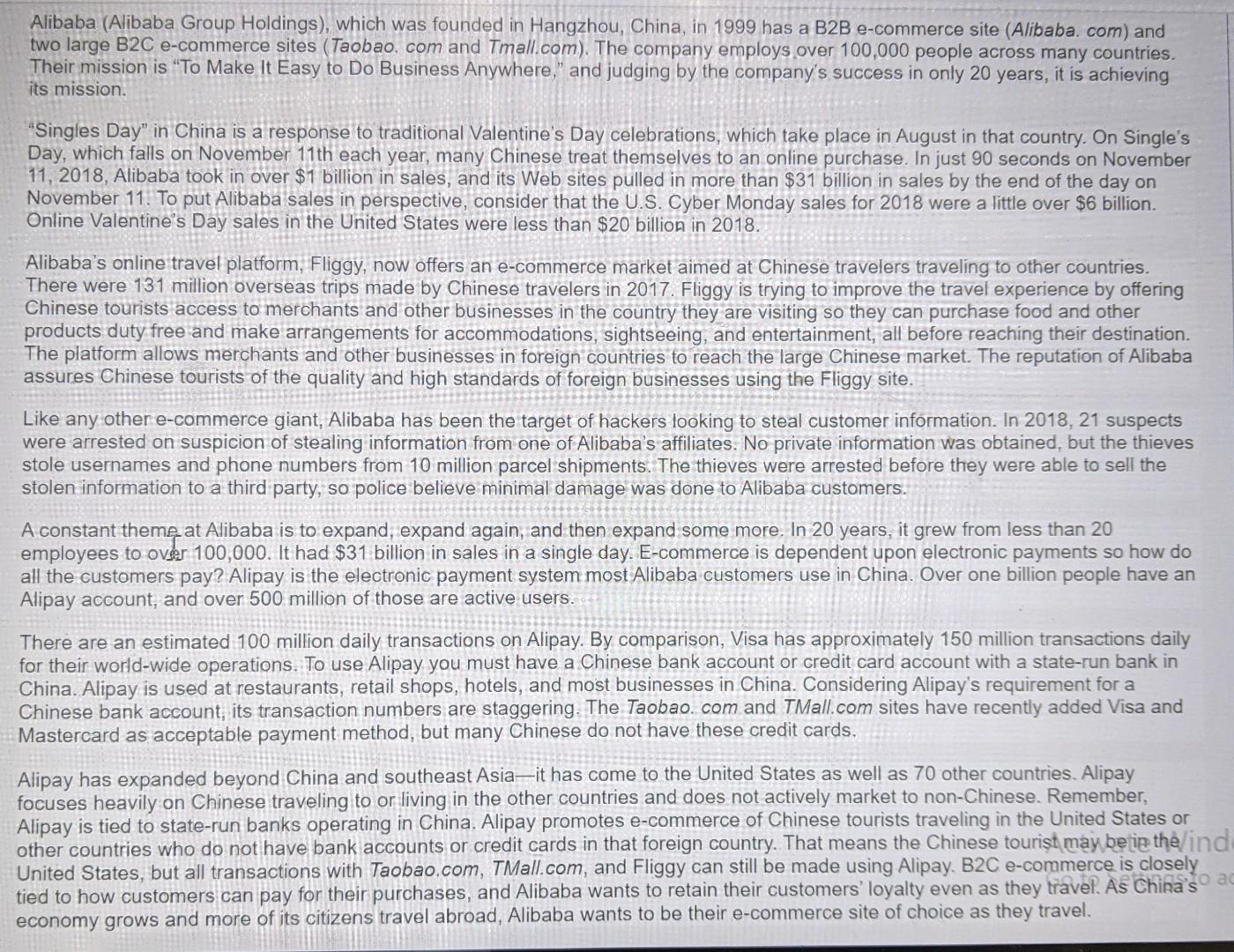
Alibaba (Alibaba Group Holdings), which was founded in Hangzhou, China, in 1999 has a B2B e-commerce site (Alibaba. com) and two large B2C e-commerce sites (Taobao. com and Tmall.com). The company employs over 100,000 people across many countries. Their mission is To Make It Easy to Do Business Anywhere, and judging by the companys success in only 20 years, it is achieving its mission.
Singles Day in China is a response to traditional Valentines Day celebrations, which take place in August in that country. On Singles Day, which falls on November 11th each year, many Chinese treat themselves to an online purchase. In just 90 seconds on November 11, 2018, Alibaba took in over $1 billion in sales, and its Web sites pulled in more than $31 billion in sales by the end of the day on November 11. To put Alibaba sales in perspective, consider that the U.S. Cyber Monday sales for 2018 were a little over $6 billion. Online Valentines Day sales in the United States were less than $20 billion in 2018.
Alibabas online travel platform, Fliggy, now offers an e-commerce market aimed at Chinese travelers traveling to other countries. There were 131 million overseas trips made by Chinese travelers in 2017. Fliggy is trying to improve the travel experience by offering Chinese tourists access to merchants and other businesses in the country they are visiting so they can purchase food and other products duty free and make arrangements for accommodations, sightseeing, and entertainment, all before reaching their destination. The platform allows merchants and other businesses in foreign countries to reach the large Chinese market. The reputation of Alibaba assures Chinese tourists of the quality and high standards of foreign businesses using the Fliggy site.
Like any other e-commerce giant, Alibaba has been the target of hackers looking to steal customer information. In 2018, 21 suspects were arrested on suspicion of stealing information from one of Alibabas affiliates. No private information was obtained, but the thieves stole usernames and phone numbers from 10 million parcel shipments. The thieves were arrested before they were able to sell the stolen information to a third party, so police believe minimal damage was done to Alibaba customers.
A constant theme at Alibaba is to expand, expand again, and then expand some more. In 20 years, it grew from less than 20 employees to over 100,000. It had $31 billion in sales in a single day. E-commerce is dependent upon electronic payments so how do all the customers pay? Alipay is the electronic payment system most Alibaba customers use in China. Over one billion people have an Alipay account, and over 500 million of those are active users.
There are an estimated 100 million daily transactions on Alipay. By comparison, Visa has approximately 150 million transactions daily for their world-wide operations. To use Alipay you must have a Chinese bank account or credit card account with a state-run bank in China. Alipay is used at restaurants, retail shops, hotels, and most businesses in China. Considering Alipays requirement for a Chinese bank account, its transaction numbers are staggering. The Taobao. com and TMall.com sites have recently added Visa and Mastercard as acceptable payment method, but many Chinese do not have these credit cards.
Alipay has expanded beyond China and southeast Asiait has come to the United States as well as 70 other countries. Alipay focuses heavily on Chinese traveling to or living in the other countries and does not actively market to non-Chinese. Remember, Alipay is tied to state-run banks operating in China. Alipay promotes e-commerce of Chinese tourists traveling in the United States or other countries who do not have bank accounts or credit cards in that foreign country. That means the Chinese tourist may be in the United States, but all transactions with Taobao.com, TMall.com, and Fliggy can still be made using Alipay. B2C e-commerce is closely tied to how customers can pay for their purchases, and Alibaba wants to retain their customers loyalty even as they travel. As Chinas economy grows and more of its citizens travel abroad, Alibaba wants to be their e-commerce site of choice as they travel.
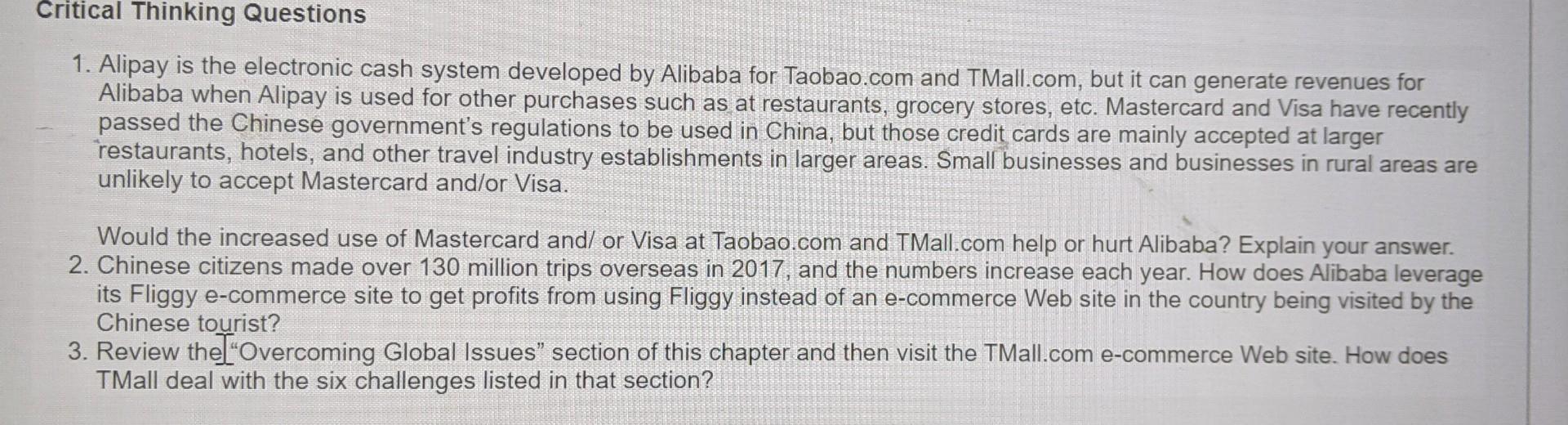
Critical Thinking Questions
Alipay is the electronic cash system developed by Alibaba for Taobao.com and TMall.com, but it can generate revenues for Alibaba when Alipay is used for other purchases such as at restaurants, grocery stores, etc. Mastercard and Visa have recently passed the Chinese governments regulations to be used in China, but those credit cards are mainly accepted at larger restaurants, hotels, and other travel industry establishments in larger areas. Small businesses and businesses in rural areas are unlikely to accept Mastercard and/or Visa.
Would the increased use of Mastercard and/ or Visa at Taobao.com and TMall.com help or hurt Alibaba? Explain your answer.
Chinese citizens made over 130 million trips overseas in 2017, and the numbers increase each year. How does Alibaba leverage its Fliggy e-commerce site to get profits from using Fliggy instead of an e-commerce Web site in the country being visited by the Chinese tourist?
Review the Overcoming Global Issues section of this chapter and then visit the TMall.com e-commerce Web site. How does TMall deal with the six challenges listed in that section?
Alibaba (Alibaba Group Holdings), which was founded in Hangzhou, China, in 1999 has a B2B e-commerce site (Alibaba.com) and two large B2C e-commerce sites (Taobao, com and Tmall.com). The company employs over 100,000 people across many countries. Their mission is "To Make It Easy to Do Business Anywhere," and judging by the company's success in only 20 years, it is achieving its mission. "Singles Day" in China is a response to traditional Valentine's Day celebrations, which take place in August in that country. On Single's Day, which falls on November 11th each year, many Chinese treat themselves to an online purchase. In just 90 seconds on November 11, 2018, Alibaba took in over $1 billion in sales, and its Web sites pulled in more than $31 billion in sales by the end of the day on November 11. To put Alibaba sales in perspective, consider that the U.S. Cyber Monday sales for 2018 were a little over $6 billion. Online Valentine's Day sales in the United States were less than $20 billion in 2018. Alibaba's online travel platform, Fliggy, now offers an e-commerce market aimed at Chinese travelers traveling to other countries. There were 131 million overseas trips made by Chinese travelers in 2017. Fliggy is trying to improve the travel experience by offering Chinese tourists access to merchants and other businesses in the country they are visiting so they can purchase food and other products duty free and make arrangements for accommodations, sightseeing, and entertainment, all before reaching their destination. The platform allows merchants and other businesses in foreign countries to reach the large Chinese market. The reputation of Alibaba assures Chinese tourists of the quality and high standards of foreign businesses using the Fliggy site. Like any other e-commerce giant, Alibaba has been the target of hackers looking to steal customer information. In 2018, 21 suspects were arrested on suspicion of stealing information from one of Alibaba's affiliates. No private information was obtained, but the thieves stole usernames and phone numbers from 10 million parcel shipments. The thieves were arrested before they were able to sell the stolen information to a third party, so police believe minimal damage was done to Alibaba customers. A constant them at Alibaba is to expand, expand again, and then expand some more. In 20 years, it grew from less than 20 employees to over 100,000. It had $31 billion in sales in a single day. E-commerce is dependent upon electronic payments so how do all the customers pay? Alipay is the electronic payment system most Alibaba customers use in China. Over one billion people have an Alipay account, and over 500 million of those are active users. There are an estimated 100 million daily transactions on Alipay. By comparison, Visa has approximately 150 million transactions daily for their world-wide operations. To use Alipay you must have a Chinese bank account or credit card account with a state-run bank in China. Alipay is used at restaurants, retail shops, hotels, and most businesses in China. Considering Alipay's requirement for a Chinese bank account, its transaction numbers are staggering. The Taobao.com and TMall.com sites have recently added Visa and Mastercard as acceptable payment method, but many Chinese do not have these credit cards, Alipay has expanded beyond China and southeast Asia-it has come to the United States as well as 70 other countries. Alipay focuses heavily on Chinese traveling to or living in the other countries and does not actively market to non-Chinese. Remember, Alipay is tied to state-run banks operating in China. Alipay promotes e-commerce of Chinese tourists traveling in the United States or other countries who do not have bank accounts or credit cards in that foreign country. That means the Chinese tourist may betip the ind United States, but all transactions with Taobao.com, TMall.com, and Fliggy can still be made using Alipay. B2C e-commerce is closely tied to how customers can pay for their purchases, and Alibaba wants to retain their customers' loyalty even as they travel. As China's ac economy grows and more of its citizens travel abroad, Alibaba wants to be their e-commerce site of choice as they travel. Critical Thinking Questions 1. Alipay is the electronic cash system developed by Alibaba for Taobao.com and TMall.com, but it can generate revenues for Alibaba when Alipay is used for other purchases such as at restaurants, grocery stores, etc. Mastercard and Visa have recently passed the Chinese government's regulations to be used in China, but those credit cards are mainly accepted at larger restaurants, hotels, and other travel industry establishments in larger areas. Small businesses and businesses in rural areas are unlikely to accept Mastercard and/or Visa. Would the increased use of Mastercard and/ or Visa at Taobao.com and TMall.com help or hurt Alibaba? Explain your answer. 2. Chinese citizens made over 130 million trips overseas in 2017, and the numbers increase each year. How does Alibaba leverage its Fliggy e-commerce site to get profits from using Fliggy instead of an e-commerce Web site in the country being visited by the Chinese tourist? 3. Review the l'Overcoming Global Issues" section of this chapter and then visit the TMall.com e-commerce Web site. How does TMall deal with the six challenges listed in thatStep by Step Solution
There are 3 Steps involved in it

Get step-by-step solutions from verified subject matter experts
 Study Help