







Question: Old MathJax webview Old MathJax webview The exercise parallels the machine-purchase decision for the Mendoza Company that is discussed in the body of the chapter.
Old MathJax webview
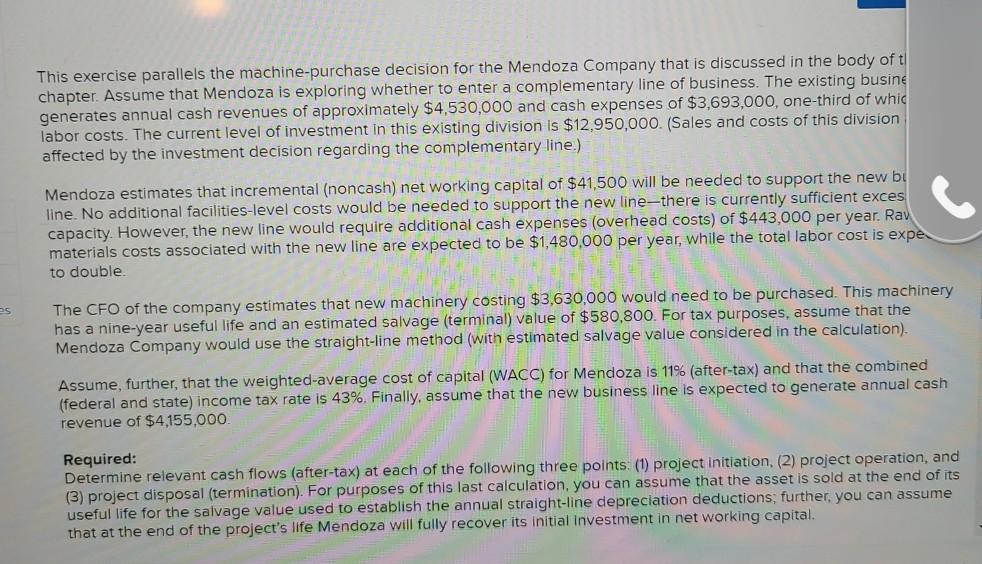
The exercise parallels the machine-purchase decision for the Mendoza Company that is discussed in the body of the chapter. Assume that Mendoza is exploring whether to enter a complimentary line of business. The existing business line generates actual cash revenues of approx. $4,530,000 and cash expenses of 3,693,000, one-third of which are labor costs. The current level of investment in this existing division is $12,950,000 (Sales and costs of this division are not affected by the investment decision regarding the complimentary line.)
Mendoza estimates that incremental (noncash) net working capital of $41,500 will be needed to support the new business line. No additional facilities-level costs would be needed to support the new line--There is currently sufficient excess capacity. However, the new line would require additional cash expenses (overhead costs) of $443,000 per year. Raw materials associated with the new line are expected to be $1,480,000 per year, while the total labor cost is expected to double.
The CFO of the company estimates that new machinery costing $3,630,000 would need to be purchased. This machinery has a nine-year useful life and an estimated salvage (terminal) value of $580,800. For tax purposes, assume that the Mendoza Company would use the straight-line method (with estimated value considered in the calculation).
Assume, further, that the weighted-average cost of capital (WACC) for Mendoza is 11% (after-tax) and that the combined (federal and state) income tax rate is 43%. Finally, assume that the new business line is expected to generate annual cash revenue of $4,155,000.
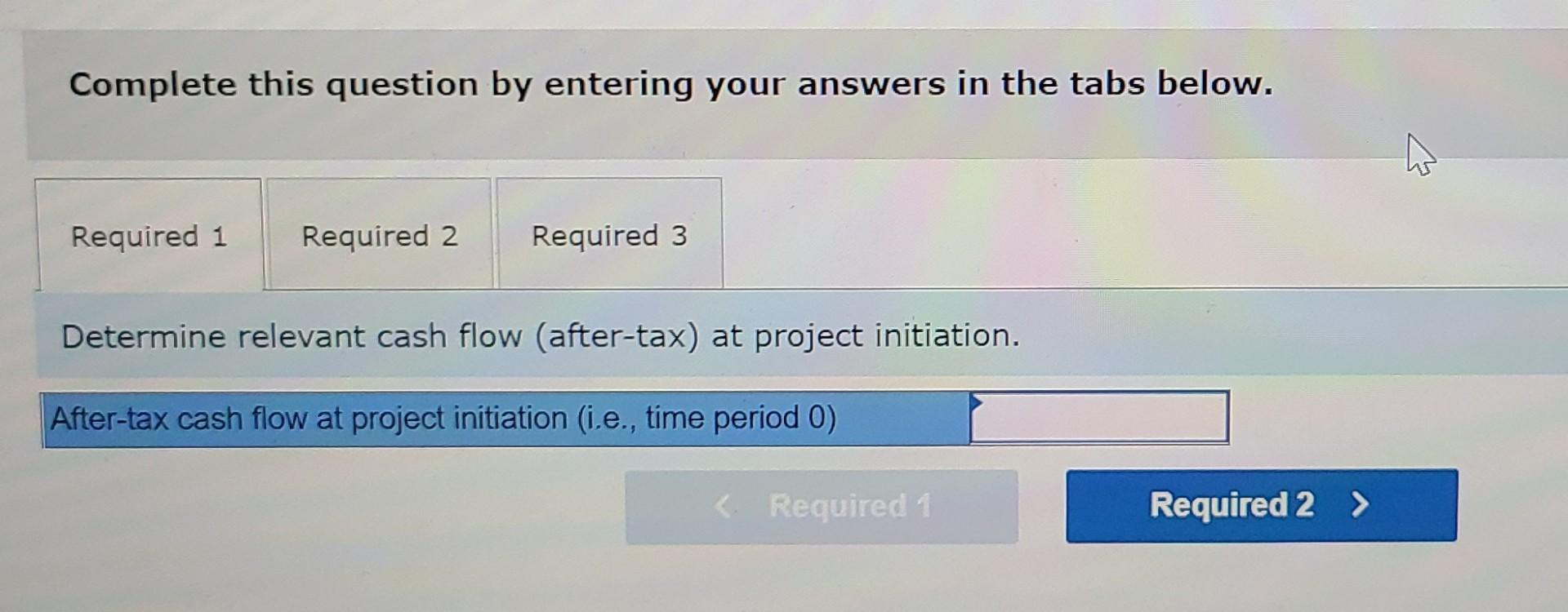
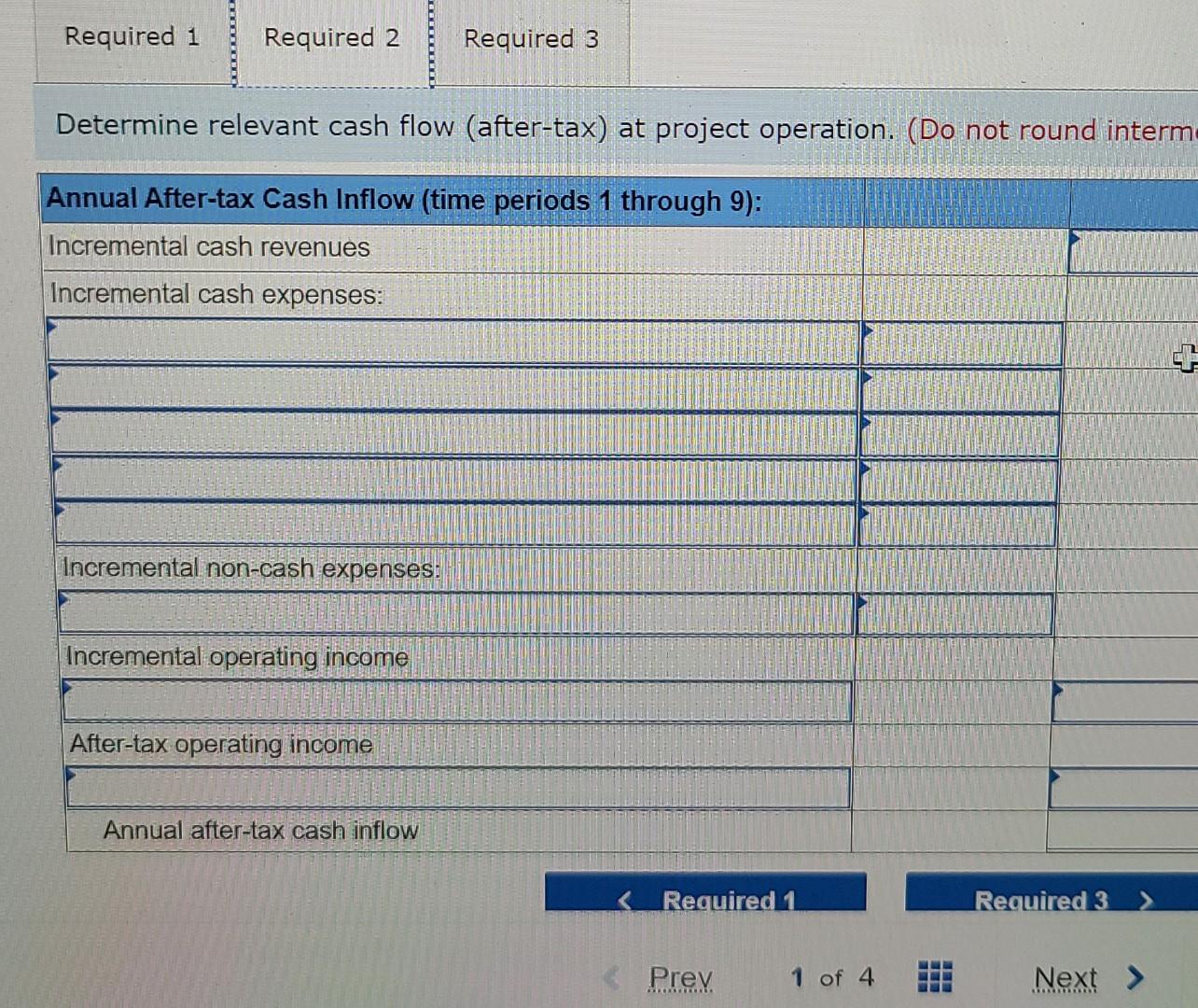
This exercise parallels the machine-purchase decision for the Mendoza Company that is discussed in the body of t chapter. Assume that Mendoza is exploring whether to enter a complementary line of business. The existing busine generates annual cash revenues of approximately $4,530,000 and cash expenses of $3,693,000, one-third of whic labor costs. The current level of investment in this existing division Is $12,950,000. (Sales and costs of this division affected by the investment decision regarding the complementary line.) Mendoza estimates that incremental (noncash) net working capital of $41,500 will be needed to support the new bu line. No additional facilities-level costs would be needed to support the new line-there is currently sufficient exces capacity. However, the new line would require additional cash expenses (overhead costs) of $443,000 per year. Ray materials costs associated with the new line are expected to be $1,480,000 per year, while the total labor cost is expe to double The CFO of the company estimates that new machinery costing $3,630,000 would need to be purchased. This machinery has a nine-year useful life and an estimated salvage (terminal) value of $580,800. For tax purposes, assume that the Mendoza Company would use the straight-line method (with estimated salvage value considered in the calculation). Assume, further, that the weighted average cost of capital (WACC) for Mendoza is 11% (after-tax) and that the combined (federal and state) income tax rate is 43%. Finally, assume that the new business line is expected to generate annual cash revenue of $4,155,000 Required: Determine relevant cash flows (after-tax) at each of the following three points: (1) project initiation, (2) project operation, and (3) project disposal (termination). For purposes of this last calculation, you can assume that the asset is sold at the end of its useful life for the salvage value used to establish the annual straight-line depreciation deductions, further, you can assume that at the end of the project's life Mendoza will fully recover its initial Investment in net working capital. Complete this question by entering your answers in the tabs below. Required 1 Required 2 Required 3 Determine relevant cash flow (after-tax) at project initiation. After-tax cash flow at project initiation (i.e., time period 0) <. required> Required 1 Required 2 Required 3 Determine relevant cash flow (after-tax) at project operation. (Do not round interm Annual After-tax Cash Inflow (time periods 1 through 9): Incremental cash revenues Incremental cash expenses: Incremental non-cash expenses: Incremental operating income After-tax operating income Annual after-tax cash inflow Required 1 Required 3 > Prev 1 of 4 Next > . This exercise parallels the machine-purchase decision for the Mendoza Company that is discussed in the body of t chapter. Assume that Mendoza is exploring whether to enter a complementary line of business. The existing busine generates annual cash revenues of approximately $4,530,000 and cash expenses of $3,693,000, one-third of whic labor costs. The current level of investment in this existing division Is $12,950,000. (Sales and costs of this division affected by the investment decision regarding the complementary line.) Mendoza estimates that incremental (noncash) net working capital of $41,500 will be needed to support the new bu line. No additional facilities-level costs would be needed to support the new line-there is currently sufficient exces capacity. However, the new line would require additional cash expenses (overhead costs) of $443,000 per year. Ray materials costs associated with the new line are expected to be $1,480,000 per year, while the total labor cost is expe to double The CFO of the company estimates that new machinery costing $3,630,000 would need to be purchased. This machinery has a nine-year useful life and an estimated salvage (terminal) value of $580,800. For tax purposes, assume that the Mendoza Company would use the straight-line method (with estimated salvage value considered in the calculation). Assume, further, that the weighted average cost of capital (WACC) for Mendoza is 11% (after-tax) and that the combined (federal and state) income tax rate is 43%. Finally, assume that the new business line is expected to generate annual cash revenue of $4,155,000 Required: Determine relevant cash flows (after-tax) at each of the following three points: (1) project initiation, (2) project operation, and (3) project disposal (termination). For purposes of this last calculation, you can assume that the asset is sold at the end of its useful life for the salvage value used to establish the annual straight-line depreciation deductions, further, you can assume that at the end of the project's life Mendoza will fully recover its initial Investment in net working capital. Complete this question by entering your answers in the tabs below. Required 1 Required 2 Required 3 Determine relevant cash flow (after-tax) at project initiation. After-tax cash flow at project initiation (i.e., time period 0) <. required> Required 1 Required 2 Required 3 Determine relevant cash flow (after-tax) at project operation. (Do not round interm Annual After-tax Cash Inflow (time periods 1 through 9): Incremental cash revenues Incremental cash expenses: Incremental non-cash expenses: Incremental operating income After-tax operating income Annual after-tax cash inflow Required 1 Required 3 > Prev 1 of 4 Next >
Step by Step Solution
There are 3 Steps involved in it

Get step-by-step solutions from verified subject matter experts
 Study Help