







Question: Old MathJax webview Q3. Consider the following production function Y = F(K,L). Assume w is the wage rate, while ris the interest rate and I
Old MathJax webview
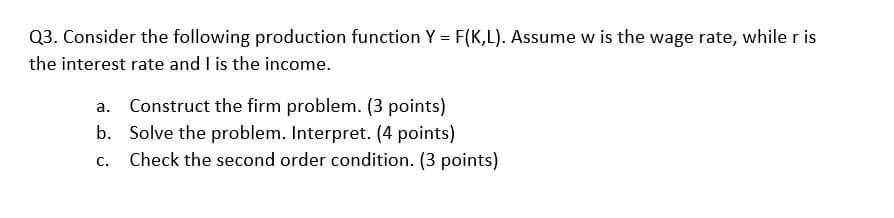
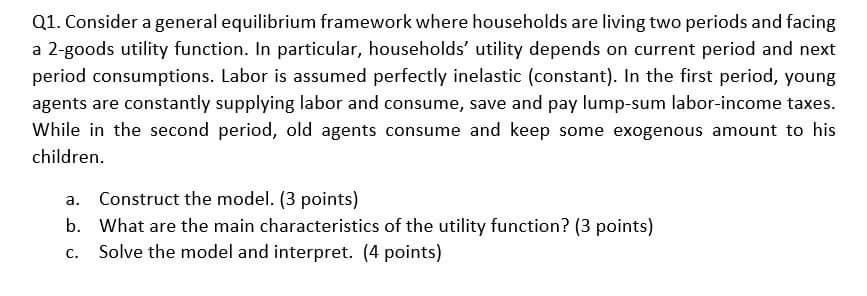
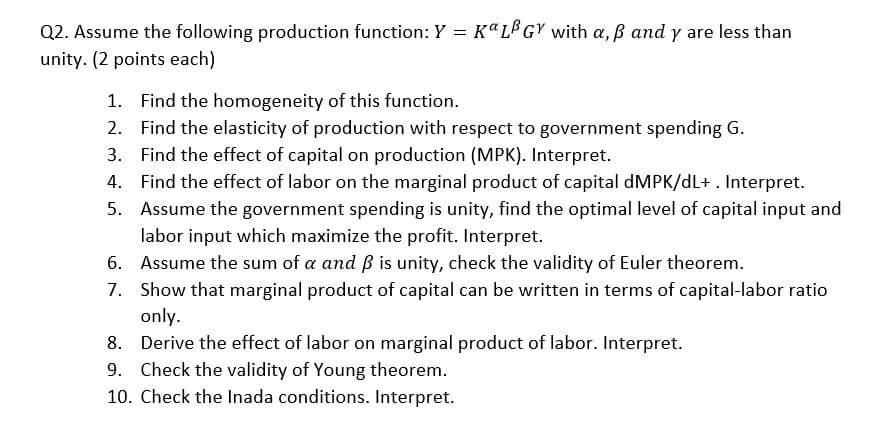
Q3. Consider the following production function Y = F(K,L). Assume w is the wage rate, while ris the interest rate and I is the income. Construct the firm problem. (3 points) b. Solve the problem. Interpret. (4 points) Check the second order condition. (3 points) Q1. Consider a general equilibrium framework where households are living two periods and facing a 2-goods utility function. In particular, households' utility depends on current period and next period consumptions. Labor is assumed perfectly inelastic (constant). In the first period, young agents are constantly supplying labor and consume, save and pay lump-sum labor-income taxes. While in the second period, old agents consume and keep some exogenous amount to his children. Construct the model. (3 points) b. What are the main characteristics of the utility function? (3 points) c. Solve the model and interpret. (4 points) Q2. Assume the following production function: Y = KLPGY with a, and y are less than unity. (2 points each) 1. Find the homogeneity of this function. 2. Find the elasticity of production with respect to government spending G. 3. Find the effect of capital on production (MPK). Interpret. 4. Find the effect of labor on the marginal product of capital dMPK/dL+ . Interpret. 5. Assume the government spending is unity, find the optimal level of capital input and labor input which maximize the profit. Interpret. 6. Assume the sum of a and B is unity, check the validity of Euler theorem. 7. Show that marginal product of capital can be written in terms of capital-labor ratio only. 8. Derive the effect of labor on marginal product of labor. Interpret. 9. Check the validity of Young theorem. 10. Check the Inada conditions. Interpret. Q3. Consider the following production function Y = F(K,L). Assume w is the wage rate, while ris the interest rate and I is the income. Construct the firm problem. (3 points) b. Solve the problem. Interpret. (4 points) Check the second order condition. (3 points) Q1. Consider a general equilibrium framework where households are living two periods and facing a 2-goods utility function. In particular, households' utility depends on current period and next period consumptions. Labor is assumed perfectly inelastic (constant). In the first period, young agents are constantly supplying labor and consume, save and pay lump-sum labor-income taxes. While in the second period, old agents consume and keep some exogenous amount to his children. Construct the model. (3 points) b. What are the main characteristics of the utility function? (3 points) c. Solve the model and interpret. (4 points) Q2. Assume the following production function: Y = KLPGY with a, and y are less than unity. (2 points each) 1. Find the homogeneity of this function. 2. Find the elasticity of production with respect to government spending G. 3. Find the effect of capital on production (MPK). Interpret. 4. Find the effect of labor on the marginal product of capital dMPK/dL+ . Interpret. 5. Assume the government spending is unity, find the optimal level of capital input and labor input which maximize the profit. Interpret. 6. Assume the sum of a and B is unity, check the validity of Euler theorem. 7. Show that marginal product of capital can be written in terms of capital-labor ratio only. 8. Derive the effect of labor on marginal product of labor. Interpret. 9. Check the validity of Young theorem. 10. Check the Inada conditions. Interpret
Step by Step Solution
There are 3 Steps involved in it

Get step-by-step solutions from verified subject matter experts
 Study Help