







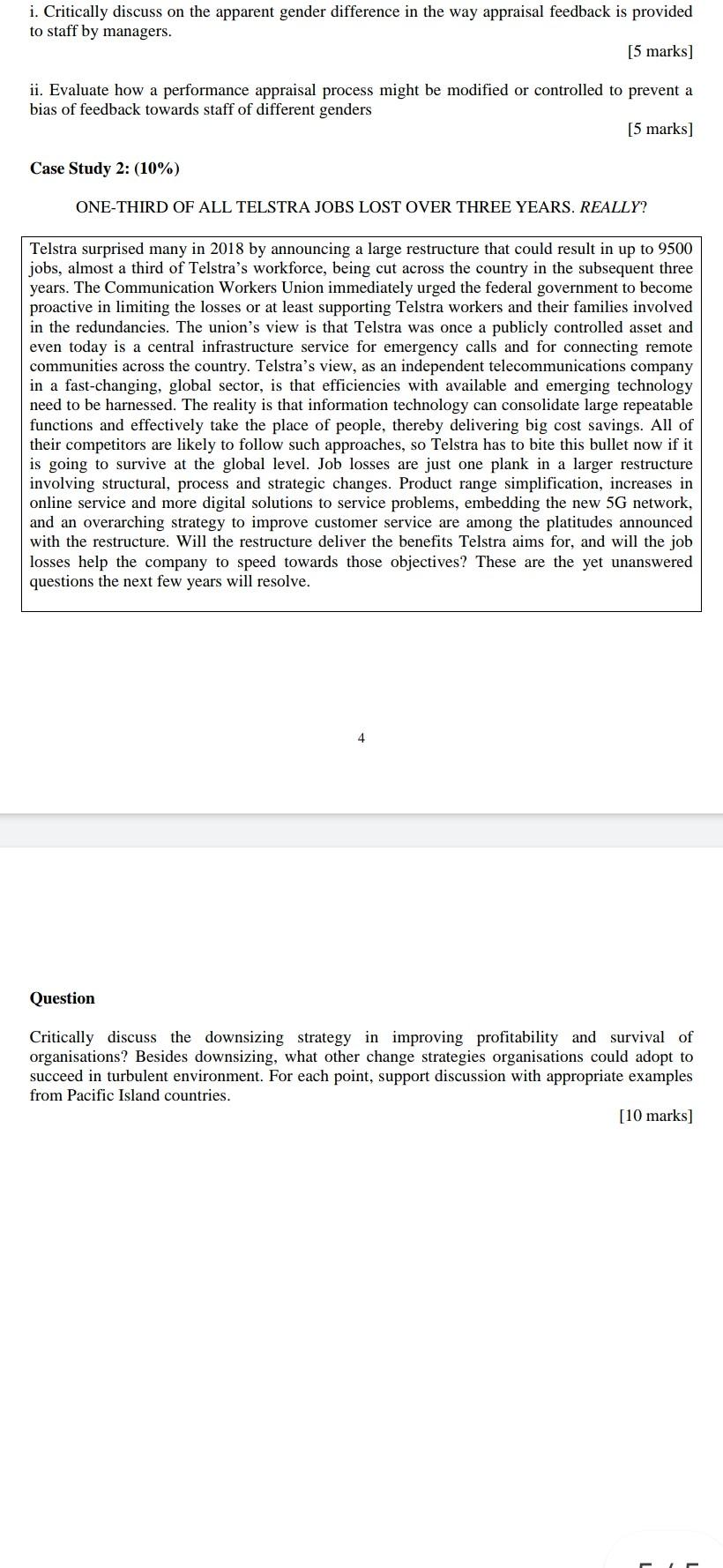
Question: Old MathJax webview Regards i. Critically discuss on the apparent gender difference in the way appraisal feedback is provided to staff by managers. [5 marks]
Old MathJax webview
Regards
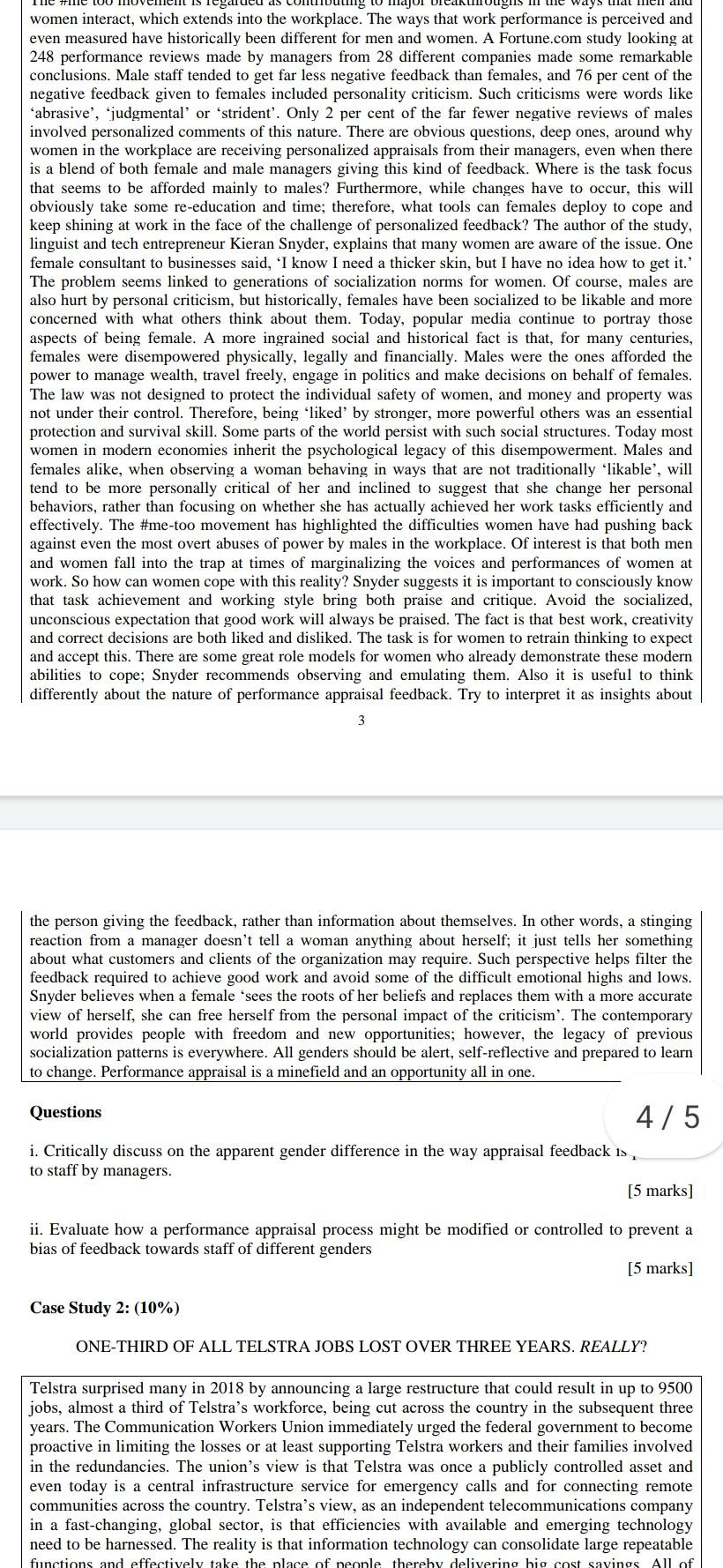
i. Critically discuss on the apparent gender difference in the way appraisal feedback is provided to staff by managers. [5 marks] ii. Evaluate how a performance appraisal process might be modified or controlled to prevent a bias of feedback towards staff of different genders [5 marks] Case Study 2: (10%) ONE-THIRD OF ALL TELSTRA JOBS LOST OVER THREE YEARS. REALLY? Telstra surprised many in 2018 by announcing a large restructure that could result in up to 9500 jobs, almost a third of Telstra's workforce, being cut across the country in the subsequent three years. The Communication Workers Union immediately urged the federal government to become proactive in limiting the losses or at least supporting Telstra workers and their families involved in the redundancies. The union's view is that Telstra was once a publicly controlled asset and even today is a central infrastructure service for emergency calls and for connecting remote communities across the country. Telstra's view, as an independent telecommunications company in a fast-changing, global sector, is that efficiencies with available and emerging technology need to be harnessed. The reality is that information technology can consolidate large repeatable functions and effectively take the place of people, thereby delivering big cost savings. All of their competitors are likely to follow such approaches, so Telstra has to bite this bullet now if it is going to survive at the global level. Job losses are just one plank in a larger restructure involving structural, process and strategic changes. Product range simplification, increases in online service and more digital solutions to service problems, embedding the new 5G network, and an overarching strategy to improve customer service are among the platitudes announced with the restructure. Will the restructure deliver the benefits Telstra aims for, and will the job losses help the company to speed towards those objectives? These are the yet unanswered questions the next few years will resolve. 4 Question Critically discuss the downsizing strategy in improving profitability and survival of organisations? Besides downsizing, what other change strategies organisations could adopt to succeed in turbulent environment. For each point, support discussion with appropriate examples from Pacific Island countries. [10 marks) Hajo no ways ulat mai women interact, which extends into the workplace. The ways that work performance is perceived and even measured have historically been different for men and women. A Fortune.com study looking at 248 performance reviews made by managers from 28 different companies made some remarkable conclusions. Male staff tended to get far less negative feedback than females, and 76 per cent of the negative feedback given to females included personality criticism. Such criticisms were words like 'abrasive', judgmental' or 'strident'. Only 2 per cent of the far fewer negative reviews of males involved personalized comments of this nature. There are obvious questions, deep ones, around why women in the workplace are receiving personalized appraisals from their managers, even when there is a blend of both female and male managers giving this kind of feedback. Where is the task focus that seems to be afforded mainly to males? Furthermore, while changes have to occur, this will obviously take some re-education and time; therefore, what tools can females deploy to cope and keep shining at work in the face of the challenge of personalized feedback? The author of the study, linguist and tech entrepreneur Kieran Snyder, explains that many women are aware of the issue. One female consultant to businesses said, 'I know I need a thicker skin, but I have no idea how to get it.' The problem seems linked to generations of socialization norms for women. Of course, males are also hurt by personal criticism, but historically, females have been socialized to be likable and more concerned with what others think about them. Today, popular media continue to portray those aspects of being female. A more ingrained social and historical fact is that, for many centuries, females were disempowered physically, legally and financially. Males were the ones afforded the power to manage wealth, travel freely, engage in politics and make decisions on behalf of females. The law was not designed to protect the individual safety of women, and money and property was not under their control. Therefore, being 'liked by stronger, more powerful others was an essential protection and survival skill. Some parts of the world persist with such social structures. Today most women in modern economies inherit the psychological legacy of this disempowerment. Males and females alike, when observing a woman behaving in ways that are not traditionally 'likable', will tend to be more personally critical of her and inclined to suggest that she change her personal behaviors, rather than focusing on whether she has actually achieved her work tasks efficiently and effectively. The #me-too movement has highlighted the difficulties women have had pushing back against even the most overt abuses of power by males in the workplace. Of interest is that both men and women fall into the trap at times of marginalizing the voices and performances of women at work. So how can women cope with this reality? Snyder suggests it is important to consciously know that task achievement and working style bring both praise and critique. Avoid the socialized, unconscious expectation that good work will always be praised. The fact is that best work, creativity and correct decisions are both liked and disliked. The task is for women to retrain thinking to expect and accept this. There are some great role models for women who already demonstrate these modern abilities to cope; Snyder recommends observing and emulating them. Also it is useful to think differently about the nature of performance appraisal feedback. Try to interpret it as insights about 3 the person giving the feedback, rather than information about themselves. In other words, a stinging reaction from a manager doesn't tell a woman anything about herself; it just tells her something about what customers and clients of the organization may require. Such perspective helps filter the feedback required to achieve good work and avoid some of the difficult emotional highs and lows. Snyder believes when a female 'sees the roots of her beliefs and replaces them with a more accurate view of herself, she can free herself from the personal impact of the criticism'. The contemporary world provides people with freedom and new opportunities; however, the legacy of previous socialization patterns is everywhere. All genders should be alert, self-reflective and prepared to learn to change. Performance appraisal is a minefield and an opportunity all in one. Questions 4/5 i. Critically discuss on the apparent gender difference in the way appraisal feedback is to staff by managers. [5 marks] ii. Evaluate how a performance appraisal process might be modified or controlled to prevent a bias of feedback towards staff of different genders [5 marks] Case Study 2: (10%) ONE-THIRD OF ALL TELSTRA JOBS LOST OVER THREE YEARS. REALLY? Telstra surprised many in 2018 by announcing a large restructure that could result in up to 9500 jobs, almost a third of Telstra's workforce, being cut across the country in the subsequent three years. The Communication Workers Union immediately urged the federal government to become proactive in limiting the losses or at least supporting Telstra workers and their families involved in the redundancies. The union's view is that Telstra was once a publicly controlled asset and even today is a central infrastructure service for emergency calls and for connecting remote communities across the country. Telstra's view, as an independent telecommunications company in a fast-changing, global sector, is that efficiencies with available and emerging technology need to be harnessed. The reality is that information technology can consolidate large repeatable functions and effectively take the place of people thereby delivering big cost savings All of
Step by Step Solution
There are 3 Steps involved in it
1 Expert Approved Answer
Step: 1 Unlock

Question Has Been Solved by an Expert!
Get step-by-step solutions from verified subject matter experts
Step: 2 Unlock
Step: 3 Unlock
 Study Help