







Question: Old MathJax webview subject organisations behavior 1. Case Study Ronit Rogosziniski, a financial planner, loses sleep because of her 5 a.m. wake-up call, so she
Old MathJax webview
subject organisations behavior
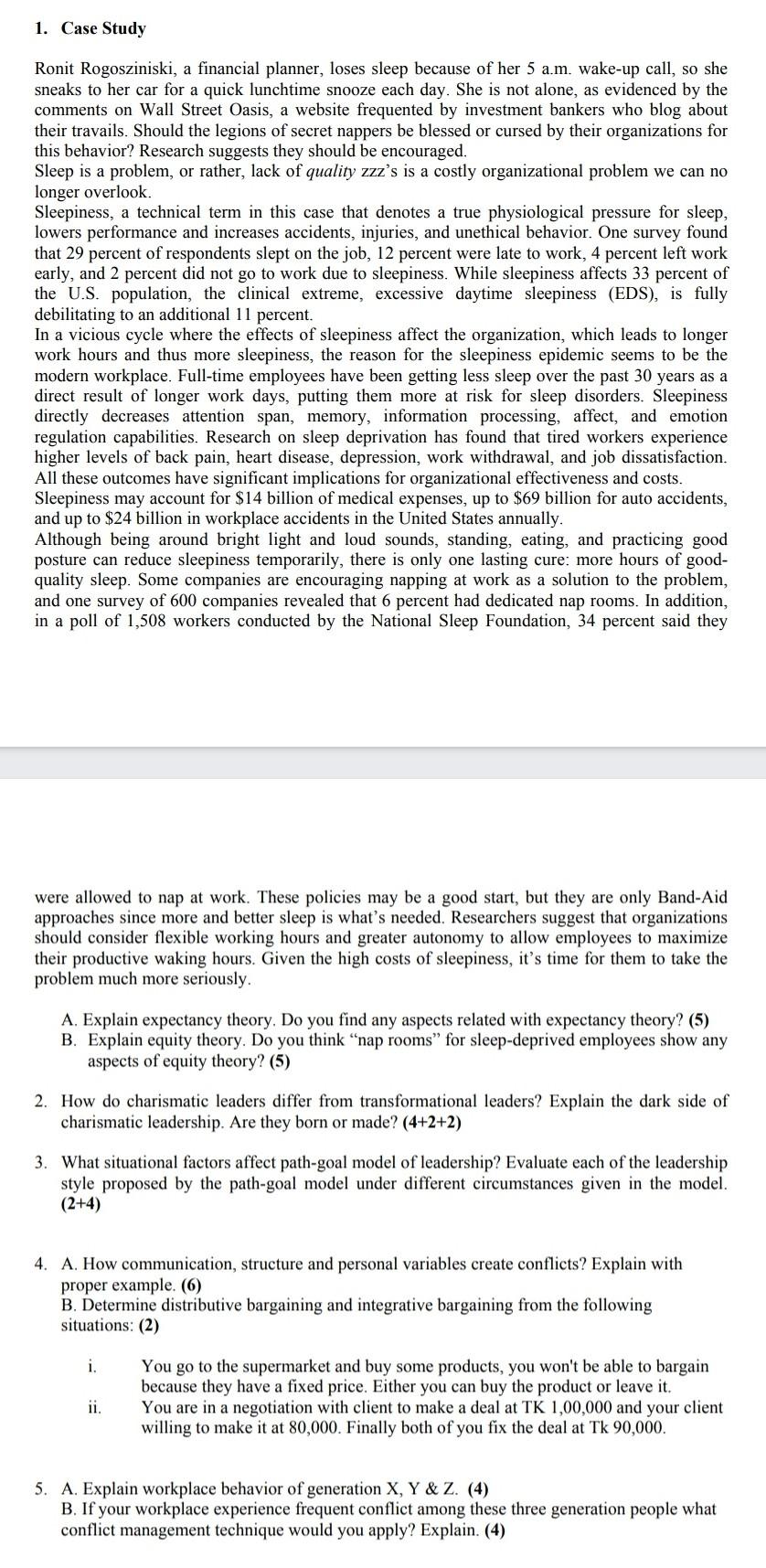
1. Case Study Ronit Rogosziniski, a financial planner, loses sleep because of her 5 a.m. wake-up call, so she sneaks to her car for a quick lunchtime snooze each day. She is not alone, as evidenced by the comments on Wall Street Oasis, a website frequented by investment bankers who blog about their travails. Should the legions of secret nappers be blessed or cursed by their organizations for this behavior? Research suggests they should be encouraged. Sleep is a problem, or rather, lack of quality zzz's is a costly organizational problem we can no longer overlook. Sleepiness, a technical term in this case that denotes a true physiological pressure for sleep, lowers performance and increases accidents, injuries, and unethical behavior. One survey found that 29 percent of respondents slept on the job, 12 percent were late to work, 4 percent left work early, and 2 percent did not go to work due to sleepiness. While sleepiness affects 33 percent of the U.S. population, the clinical extreme, excessive daytime sleepiness (EDS), is fully debilitating to an additional 11 percent. In a vicious cycle where the effects of sleepiness affect the organization, which leads to longer work hours and thus more sleepiness, the reason for the sleepiness epidemic seems to be the modern workplace. Full-time employees have been getting less sleep over the past 30 years as a direct result of longer work days, putting them more at risk for sleep disorders. Sleepiness directly decreases attention span, memory, information processing, affect, and emotion regulation capabilities. Research on sleep deprivation has found that tired workers experience higher levels of back pain, heart disease, depression, work withdrawal, and job dissatisfaction. All these outcomes have significant implications for organizational effectiveness and costs. Sleepiness may account for $14 billion of medical expenses, up to $69 billion for auto accidents, and up to $24 billion in workplace accidents in the United States annually. Although being around bright light and loud sounds, standing, eating, and practicing good posture can reduce sleepiness temporarily, there is only one lasting cure: more hours of good- quality sleep. Some companies are encouraging napping at work as a solution to the problem, and one survey of 600 companies revealed that 6 percent had dedicated nap rooms. In addition, in a poll of 1,508 workers conducted by the National Sleep Foundation, 34 percent said they were allowed to nap at work. These policies may be a good start, but they are only Band-Aid approaches since more and better sleep is what's needed. Researchers suggest that organizations should consider flexible working hours and greater autonomy to allow employees to maximize their productive waking hours. Given the high costs of sleepiness, it's time for them to take the problem much more seriously. A. Explain expectancy theory. Do you find any aspects related with expectancy theory? (5) B. Explain equity theory. Do you think nap rooms for sleep-deprived employees show any aspects of equity theory? (5) 2. How do charismatic leaders differ from transformational leaders? Explain the dark side of charismatic leadership. Are they born or made? (4+2+2) 3. What situational factors affect path-goal model of leadership? Evaluate each of the leadership style proposed by the path-goal model under different circumstances given in the model. (2+4) 4. A. How communication, structure and personal variables create conflicts? Explain with proper example. (6) B. Determine distributive bargaining and integrative bargaining from the following situations: (2) i You go to the supermarket and buy some products, you won't be able to bargain because they have a fixed price. Either you can buy the product or leave it. You are in a negotiation with client to make a deal at TK 1,00,000 and your client willing to make it at 80,000. Finally both of you fix the deal at Tk 90,000. ii. 5. A. Explain workplace behavior of generation X, Y & Z. (4) B. If your workplace experience frequent conflict among these three generation people what conflict management technique would you apply? Explain. (4)Step by Step Solution
There are 3 Steps involved in it
1 Expert Approved Answer
Step: 1 Unlock

Question Has Been Solved by an Expert!
Get step-by-step solutions from verified subject matter experts
Step: 2 Unlock
Step: 3 Unlock
 Study Help