







Question: On 1 September 20.18 Lloyd Traders received a prepayment for an amount of R82 433 from a client that is currently occupying part of Lloyd's
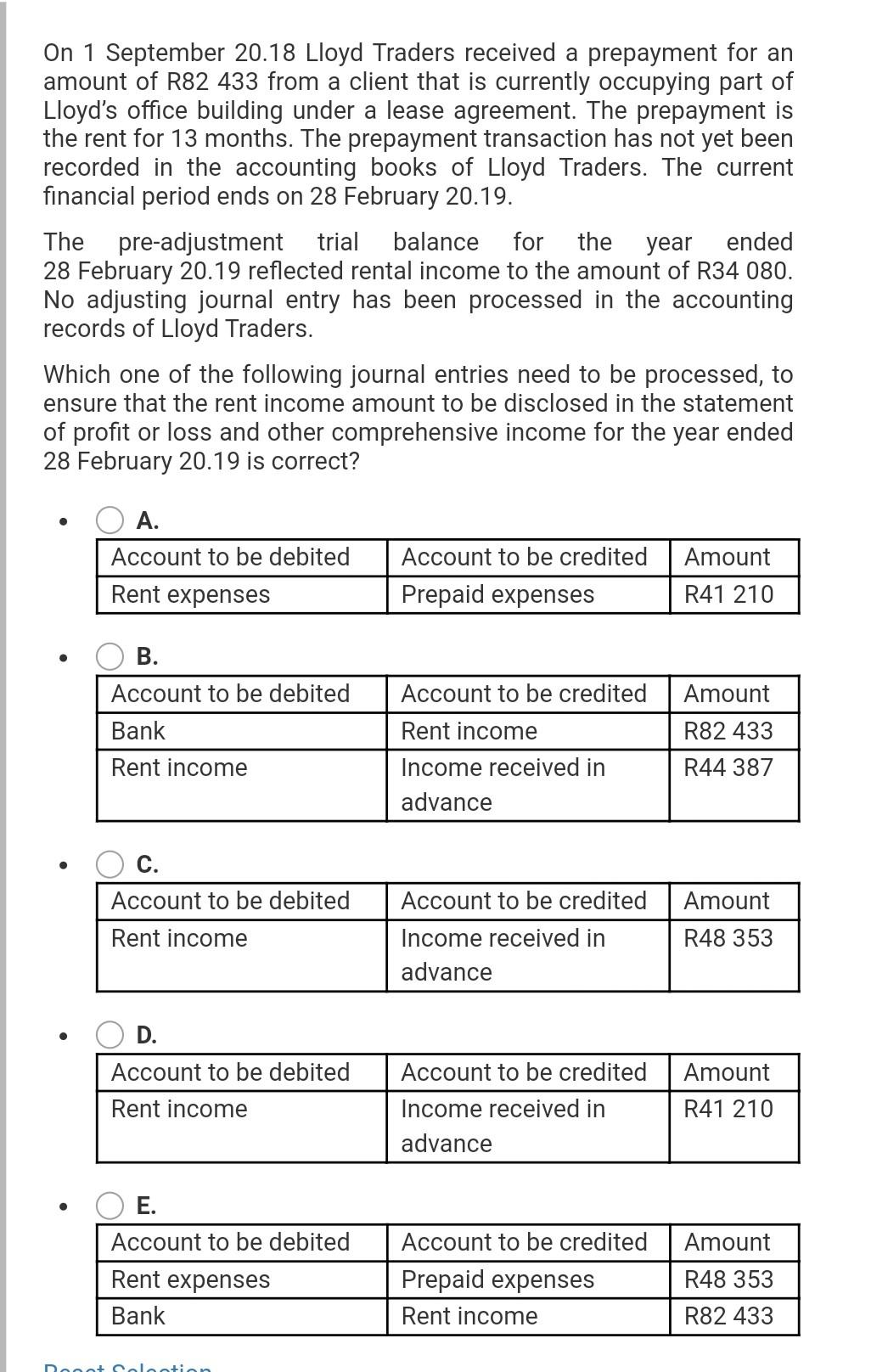
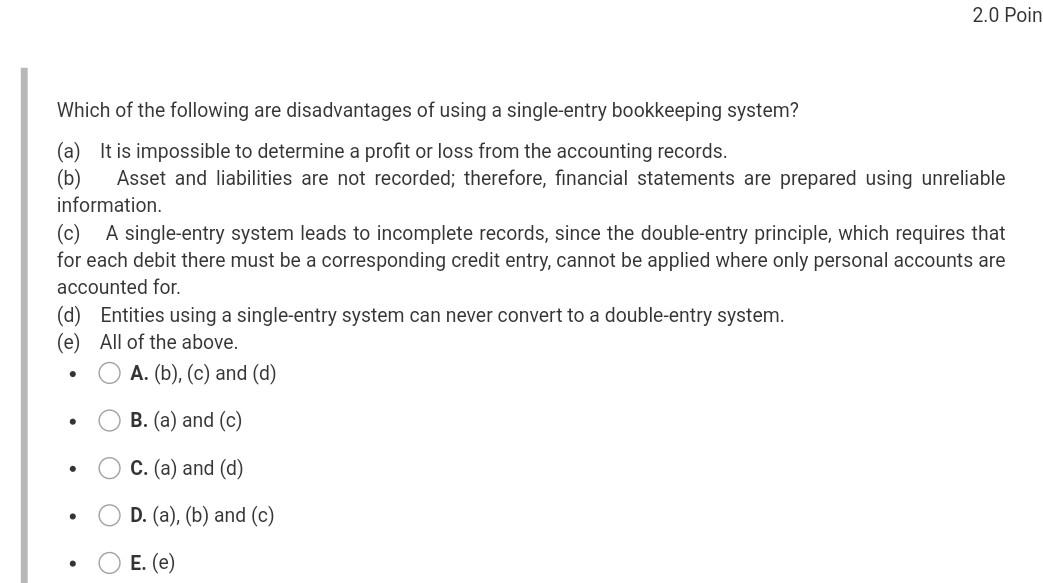
On 1 September 20.18 Lloyd Traders received a prepayment for an amount of R82 433 from a client that is currently occupying part of Lloyd's office building under a lease agreement. The prepayment is the rent for 13 months. The prepayment transaction has not yet been recorded in the accounting books of Lloyd Traders. The current financial period ends on 28 February 20.19. The pre-adjustment trial balance for the year ended 28 February 20.19 reflected rental income to the amount of R34 080. No adjusting journal entry has been processed in the accounting records of Lloyd Traders. Which one of the following journal entries need to be processed, to ensure that the rent income amount to be disclosed in the statement of profit or loss and other comprehensive income for the year ended 28 February 20.19 is correct? A. Account to be debited Rent expenses Account to be credited Prepaid expenses Amount R41 210 B. Account to be debited Bank Rent income Account to be credited Rent income Income received in advance Amount R82 433 R44 387 C. Account to be debited Rent income Account to be credited Income received in advance Amount R48 353 D. Account to be debited Rent income Account to be credited Income received in advance Amount R41 210 E. Account to be debited Amount Rent expenses Account to be credited Prepaid expenses Rent income R48 353 R82 433 Bank Docet colection 2.0 Poin Which of the following are disadvantages of using a single-entry bookkeeping system? (a) It is impossible to determine a profit or loss from the accounting records. (b) Asset and liabilities are not recorded; therefore, financial statements are prepared using unreliable information. (C) A single-entry system leads to incomplete records, since the double-entry principle, which requires that for each debit there must be a corresponding credit entry, cannot be applied where only personal accounts are accounted for. (d) Entities using a single-entry system can never convert to a double-entry system. (e) All of the above. O A. (b), (c) and (d) . OB. (a) and (c) C. (a) and (d) D. (a), (b) and (c) E. (e)
Step by Step Solution
There are 3 Steps involved in it

Get step-by-step solutions from verified subject matter experts
 Study Help