







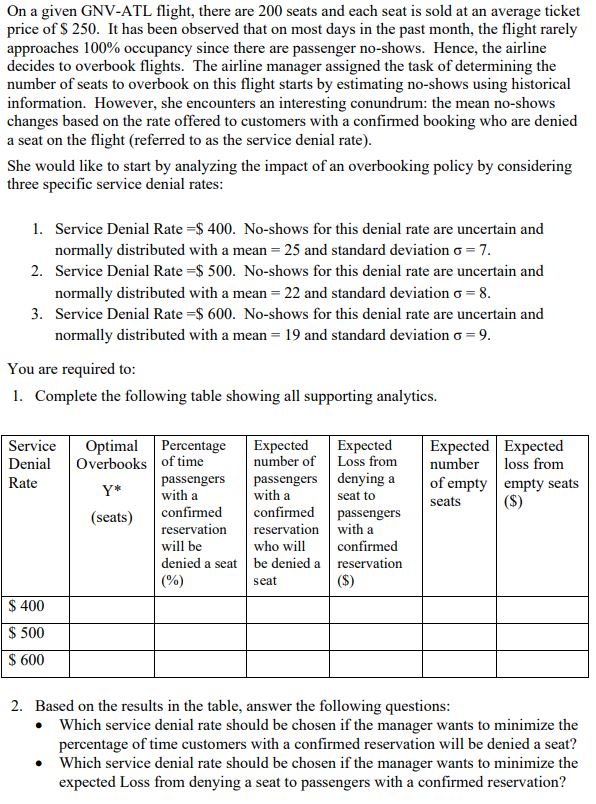
Question: On a given GNV - ATL flight, there are 2 0 0 seats and each seat is sold at an average ticket On a given
On a given GNVATL flight, there are seats and each seat is sold at an average ticket On a given GNVATL flight, there are seats and each seat is sold at an average ticket price of $ It has been observed that on most days in the past month, the flight rarely approaches occupancy since there are passenger noshows. Hence, the airline decides to overbook flights. The airline manager assigned the task of determining the number of seats to overbook on this flight starts by estimating noshows using historical information. However, she encounters an interesting conundrum: the mean noshows changes based on the rate offered to customers with a confirmed booking who are denied a seat on the flight referred to as the service denial rate
She would like to start by analyzing the impact of an overbooking policy by considering three specific service denial rates:
Service Denial Rate $ Noshows for this denial rate are uncertain and normally distributed with a mean and standard deviation
Service Denial Rate $ Noshows for this denial rate are uncertain and normally distributed with a mean and standard deviation
Service Denial Rate $ Noshows for this denial rate are uncertain and normally distributed with a mean and standard deviation
You are required to:
Complete the following table showing all supporting analytics.
tabletableServiceDenialRatetableOptimalOverbooksYseatstablePercentageof timepassengerswith aconfirmedreservationwill bedenied a seattableExpectednumber ofpassengerswith aconfirmedreservationwho willbe denied aseattableExpectedLoss fromdenying aseat topassengerswith aconfirmedreservation$tableExpectednumberof emptyseatstableExpectedloss fromempty seats$$$$
Based on the results in the table, answer the following questions:
Which service denial rate should be chosen if the manager wants to minimize the percentage of time customers with a confirmed reservation will be denied a seat?
Which service denial rate should be chosen if the manager wants to minimize the expected Loss from denying a seat to passengers with a confirmed reservation?
price of $ It has been observed that on most days in the past month, the flight rarely
approaches occupancy since there are passenger noshows. Hence, the airline
decides to overbook flights. The airline manager assigned the task of determining the
number of seats to overbook on this flight starts by estimating noshows using historical
information. However, she encounters an interesting conundrum: the mean noshows
changes based on the rate offered to customers with a confirmed booking who are denied
a seat on the flight referred to as the service denial rate
She would like to start by analyzing the impact of an overbooking policy by considering
three specific service denial rates:
Service Denial Rate $ Noshows for this denial rate are uncertain and
normally distributed with a mean and standard deviation sigma
Service Denial Rate $ Noshows for this denial rate are uncertain and
normally distributed with a mean and standard deviation sigma
Service Denial Rate $ Noshows for this denial rate are uncertain and
normally distributed with a mean and standard deviation sigma
You are required to:
Complete the following table showing all supporting analytics.
Based on the results in the table, answer the following questions:
Which service denial rate should be chosen if the manager wants to minimize the
percentage of time customers with a confirmed reservation will be denied a seat?
Which service denial rate should be chosen if the manager wants to minimize the
expected Loss from denying a seat to passengers with a confirmed reservation?
Step by Step Solution
There are 3 Steps involved in it
1 Expert Approved Answer
Step: 1 Unlock

Question Has Been Solved by an Expert!
Get step-by-step solutions from verified subject matter experts
Step: 2 Unlock
Step: 3 Unlock
 Study Help