







Question: On an excel spreadsheet. In our class example, I simplified the annuity prize option by assuming level, equal annual payments. Actually, this annuity prize option
On an excel spreadsheet.
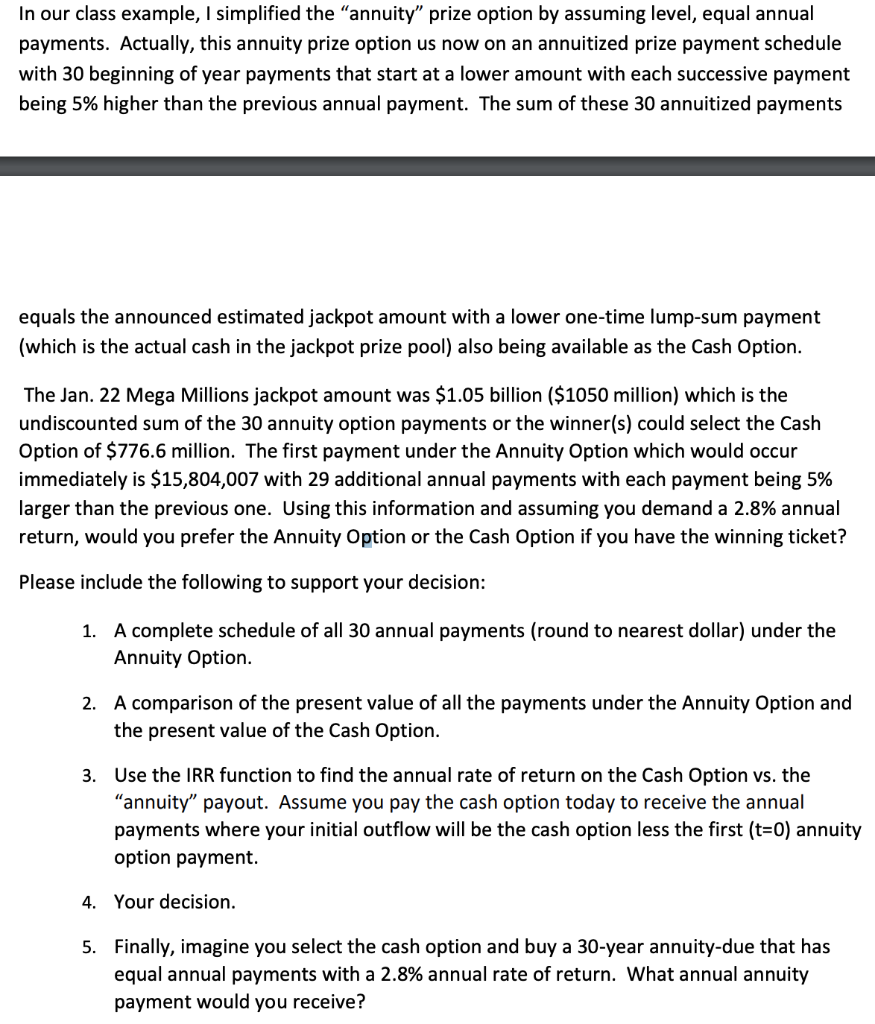
In our class example, I simplified the annuity" prize option by assuming level, equal annual payments. Actually, this annuity prize option us now on an annuitized prize payment schedule with 30 beginning of year payments that start at a lower amount with each successive payment being 5% higher than the previous annual payment. The sum of these 30 annuitized payments equals the announced estimated jackpot amount with a lower one-time lump-sum payment (which is the actual cash in the jackpot prize pool) also being available as the Cash Option. The Jan. 22 Mega Millions jackpot amount was $1.05 billion ($1050 million) which is the undiscounted sum of the 30 annuity option payments or the winner(s) could select the Cash Option of $776.6 million. The first payment under the Annuity Option which would occur immediately is $15,804,007 with 29 additional annual payments with each payment being 5% larger than the previous one. Using this information and assuming you demand a 2.8% annual return, would you prefer the Annuity Option or the Cash Option if you have the winning ticket? Please include the following to support your decision: 1. A complete schedule of all 30 annual payments (round to nearest dollar) under the Annuity Option. 2. A comparison of the present value of all the payments under the Annuity Option and the present value of the Cash Option. 3. Use the IRR function to find the annual rate of return on the Cash Option vs. the "annuity payout. Assume you pay the cash option today to receive the annual payments where your initial outflow will be the cash option less the first (t=0) annuity option payment. 4. Your decision. 5. Finally, imagine you select the cash option and buy a 30-year annuity-due that has equal annual payments with a 2.8% annual rate of return. What annual annuity payment would you receive? In our class example, I simplified the annuity" prize option by assuming level, equal annual payments. Actually, this annuity prize option us now on an annuitized prize payment schedule with 30 beginning of year payments that start at a lower amount with each successive payment being 5% higher than the previous annual payment. The sum of these 30 annuitized payments equals the announced estimated jackpot amount with a lower one-time lump-sum payment (which is the actual cash in the jackpot prize pool) also being available as the Cash Option. The Jan. 22 Mega Millions jackpot amount was $1.05 billion ($1050 million) which is the undiscounted sum of the 30 annuity option payments or the winner(s) could select the Cash Option of $776.6 million. The first payment under the Annuity Option which would occur immediately is $15,804,007 with 29 additional annual payments with each payment being 5% larger than the previous one. Using this information and assuming you demand a 2.8% annual return, would you prefer the Annuity Option or the Cash Option if you have the winning ticket? Please include the following to support your decision: 1. A complete schedule of all 30 annual payments (round to nearest dollar) under the Annuity Option. 2. A comparison of the present value of all the payments under the Annuity Option and the present value of the Cash Option. 3. Use the IRR function to find the annual rate of return on the Cash Option vs. the "annuity payout. Assume you pay the cash option today to receive the annual payments where your initial outflow will be the cash option less the first (t=0) annuity option payment. 4. Your decision. 5. Finally, imagine you select the cash option and buy a 30-year annuity-due that has equal annual payments with a 2.8% annual rate of return. What annual annuity payment would you receive
Step by Step Solution
There are 3 Steps involved in it

Get step-by-step solutions from verified subject matter experts
 Study Help