







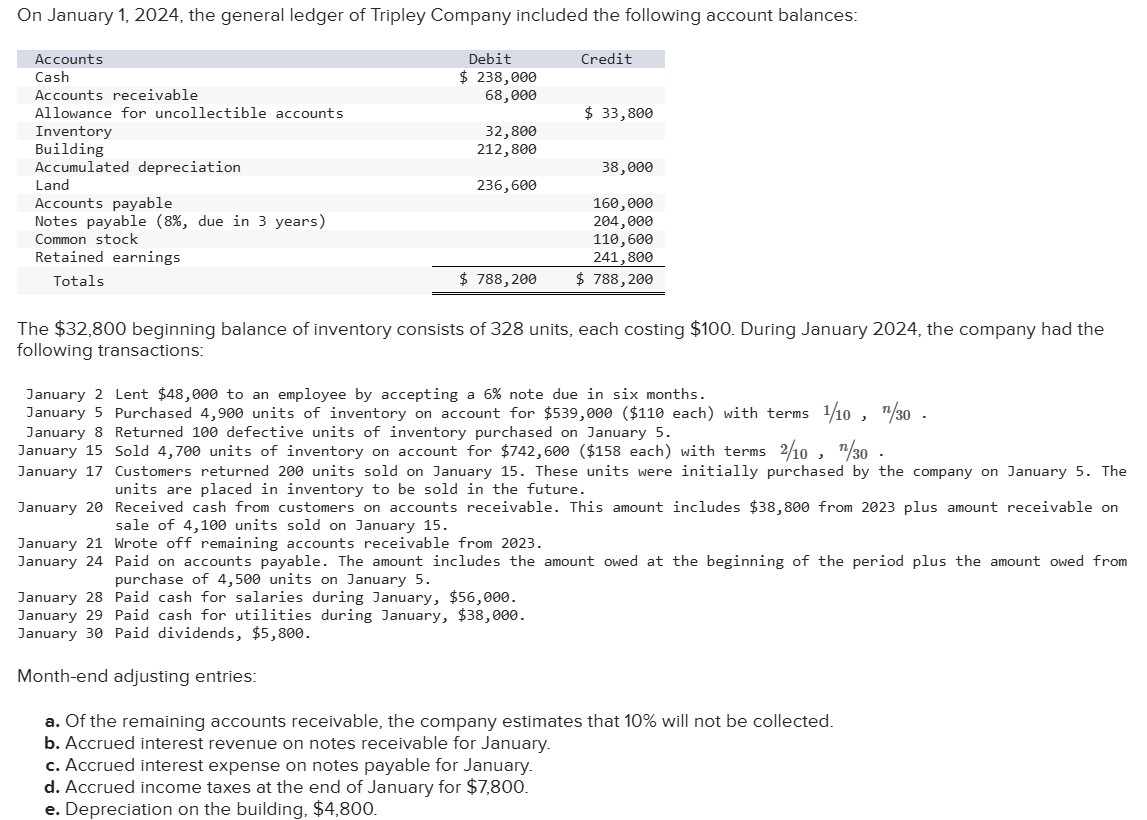
Question: On January 1 , 2 0 2 4 , the general ledger of Tripley Company included the following account balances: Record each of the transactions
On January the general ledger of Tripley Company included the following account balances: Record each of the transactions listed above in the "General Journal" tab these are shown as items assuming a
perpetual FIFO inventory system. Purchases and sales of inventory are recorded using the gross method for cash discounts.
Review the "General Ledger" and the "Trial Balance" tabs to see the effect of the transactions on the account balances.
Record adjusting entries on January in the "General Journal" tab these are shown as items
Review the adjusted "Trial Balance" as of January in the "Trial Balance" tab.
Prepare a multiplestep income statement for the period ended January in the "Income Statement" tab.
Prepare a classified balance sheet as of January in the "Balance Sheet" tab.
Record closing entries in the "General Journal" tab these are shown as items
Using the information from the requirements above, complete the "Analysi" tab. Analyze how well Tripley Company manages its inventory
a Calculate the inventory turnover ratio for the month of January. If the industry average of the inventory turnover ratio for the
month of January is times, is the company selling its inventory more or less quickly than other companies in the same
industry?
b Calculate the gross profit ratio for the month of January. If the industry average gross profit ratio is is the company
more or less profitable per dollar of sales than other companies in the same industry?
The gross profit ratio is:
The company is more profitable than other companies.
c Used together, what might the inventory turnover ratio and gross profit ratio suggest about the company's business
strategy? Is the company's strategy to sell a higher volume of less expensive items or does the company appear to be selling a
lower volume of more expensive items?tableTripley CompanyIncome StatementFor the Month Ended January Revenues:Sales revenue,Sales returns,theta Net sales revenues,,,,Cost of goods sold,VGross profit,,,,Operating expenses:Salaries expense,sigma Utilities expense,theta Bad debt expense,Depreciation expense,theta Total operating expe,,,,Operating income,,,,Other income expenses:Interest revenue,theta Interest expense,Income before taxes,VIncome tax expense,vartheta Net income,V$
The $ beginning balance of inventory consists of units, each costing $ During January the company had the
following transactions:
January Lent $ to an employee by accepting a note due in six months.
January Purchased units of inventory on account for $ $ each with terms
January Returned defective units of inventory purchased on January
January Sold units of inventory on account for $ $ each with terms
January Customers returned units sold on January These units were initially purchased by the company on January The
units are placed in inventory to be sold in the future.
January Received cash from customers on accounts receivable. This amount includes $ from plus amount receivable on
sale of units sold on January
January Wrote off remaining accounts receivable from
January Paid on accounts payable. The amount includes the amount owed at the beginning of the period plus the amount owed from
purchase of units on January
January Paid cash for salaries during January, $
January Paid cash for utilities during January, $
January Paid dividends, $
Monthend adjusting entries:
a Of the remaining accounts receivable, the company estimates that will not be collected.
b Accrued interest revenue on notes receivable for January.
c Accrued interest expense on notes payable for January.
d Accrued income taxes at the end of January for $
e Depreciation on the building, $
Step by Step Solution
There are 3 Steps involved in it
1 Expert Approved Answer
Step: 1 Unlock

Question Has Been Solved by an Expert!
Get step-by-step solutions from verified subject matter experts
Step: 2 Unlock
Step: 3 Unlock
 Study Help