







Question: On your spreadsheet remove any data points that were before the cart was released or after it had reached the end of the track. Highlight
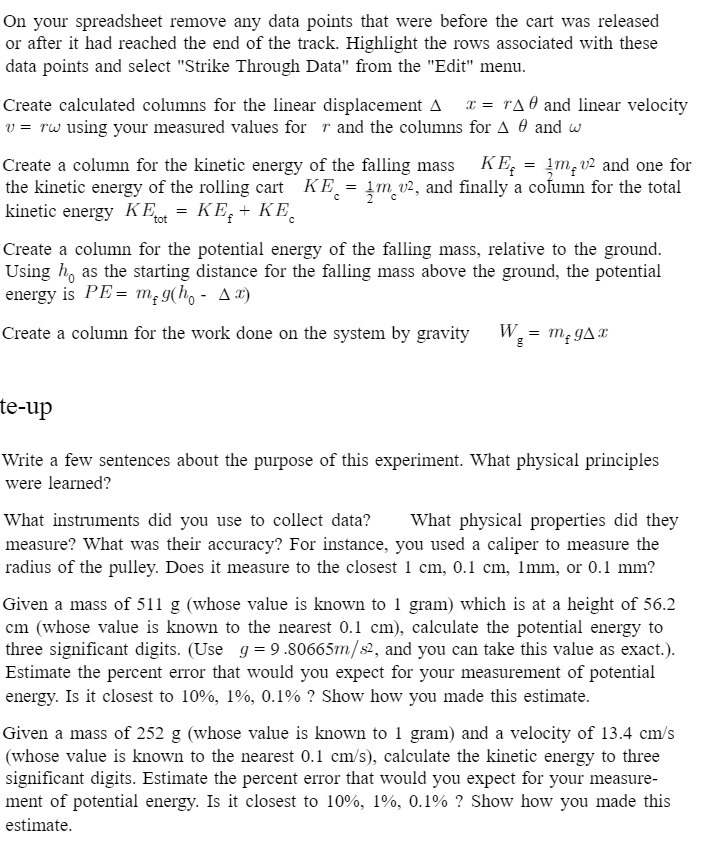
On your spreadsheet remove any data points that were before the cart was released or after it had reached the end of the track. Highlight the rows associated with these data points and select "Strike Through Data" from the "Edit" menu. Create calculated columns for the linear displacement A = "A and linear velocity v = rw using your measured values for r and the columns for A 0 and w Create a column for the kinetic energy of the falling mass KE, = 1m, v2 and one for the kinetic energy of the rolling cart KE - Im v2, and finally a column for the total kinetic energy KE of = KE, + KE. Create a column for the potential energy of the falling mass, relative to the ground. Using ho as the starting distance for the falling mass above the ground, the potential energy is PE = m,g(h, - A =) Create a column for the work done on the system by gravity W. = m, gAr te-up Write a few sentences about the purpose of this experiment. What physical principles were learned? What instruments did you use to collect data? What physical properties did they measure? What was their accuracy? For instance, you used a caliper to measure the radius of the pulley. Does it measure to the closest 1 cm, 0.1 cm, Imm, or 0.1 mm? Given a mass of 511 g (whose value is known to 1 gram) which is at a height of 56.2 cm (whose value is known to the nearest 0.1 cm), calculate the potential energy to three significant digits. (Use g = 9.80665m/s2, and you can take this value as exact.). Estimate the percent error that would you expect for your measurement of potential energy. Is it closest to 10%, 1%, 0.1% ? Show how you made this estimate. Given a mass of 252 g (whose value is known to 1 gram) and a velocity of 13.4 cm/s (whose value is known to the nearest 0.1 cm/s), calculate the kinetic energy to three significant digits. Estimate the percent error that would you expect for your measure- ment of potential energy. Is it closest to 10%, 1%, 0.1% ? Show how you made this estimate
Step by Step Solution
There are 3 Steps involved in it

Get step-by-step solutions from verified subject matter experts
 Study Help