







Question: On your textbook: Modern Operating Systems, Problem 1: Based on the discussion from page 379 to page 381 of the textbook, if the seek to
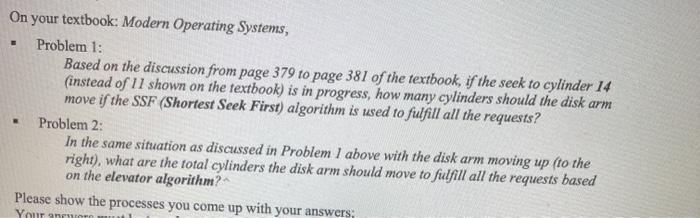
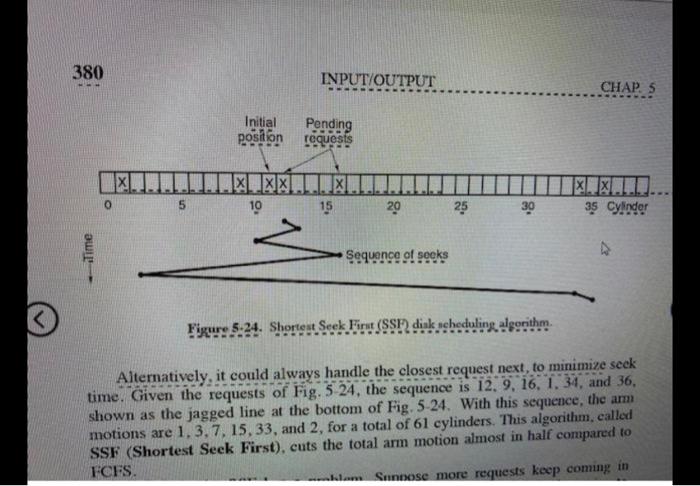
On your textbook: Modern Operating Systems, Problem 1: Based on the discussion from page 379 to page 381 of the textbook, if the seek to cylinder 14 (instead of 11 shown on the textbook) is in progress, how many cylinders should the disk arm move if the SSF (Shortest Seek First) algorithm is used to fulfill all the requests? Problem 2: In the same situation as discussed in Problem I above with the disk arm moving up to the right), what are the total cylinders the disk arm should move to fulfill all the requests based on the elevator algorithm? Please show the processes you come up with your answers V 380 INPUT/OUTPUT CHAP 5 Initial posion Pending requests LINUXXXII .X.XX. 10 15 XIX.L. 35 Cylinder 5 20 25 30 Time Sequence of seeks Figure 5:24. Shortest Seek Fiut (SSHdink scheduling algorithm Alternatively, it could always handle the closest request next, to minimize seek time. Given the requests of Fig. 5-24, the sequence is 12, 9, 16, 1. 34, and 36, shown as the jagged line at the bottom of Fig. 5-24. With this sequence, the amm motions are 1.3, 7, 15, 33, and 2, for a total of 61 cylinders. This algorithm, called SSF (Shortest Seck First), cuts the total arm motion almost in half compared to FCFS. klam Sunsese more requests keep coming in
Step by Step Solution
There are 3 Steps involved in it

Get step-by-step solutions from verified subject matter experts
 Study Help