



Question: Once youve familiarized yourself with the case background and documents, complete the assignment below. 1. Review Chapter 9 and study Dr. Junejas email. For each
Once youve familiarized yourself with the case background and documents, complete the assignment below.
1. Review Chapter 9 and study Dr. Junejas email. For each of the five points he makes, identify a passage or passages in the original draft that could be improved as he describes. Once you have done that, perform any necessary research to learn more about 3D printing, and then revise Document 9.1 to improve its coherence. Focus on the title, the headings, lists, and paragraphs (including topic sentences, adequate support, and transitional words and phrases). Note: You will address the "five points" as part of your overall revision; it does not have to be a separate part of this discussion forum.
2. Reflection: Return to one of the sources you consulted as you further researched 3D printing. Examine how effectively this source emphasizes important information. Explain the ways in which this source follows or strays from the principles of emphasis and coherence covered in the chapter. In presenting information about 3D printing, did any of your sources inspire ideas about how you might improve the organization and development of your own draft? How so?
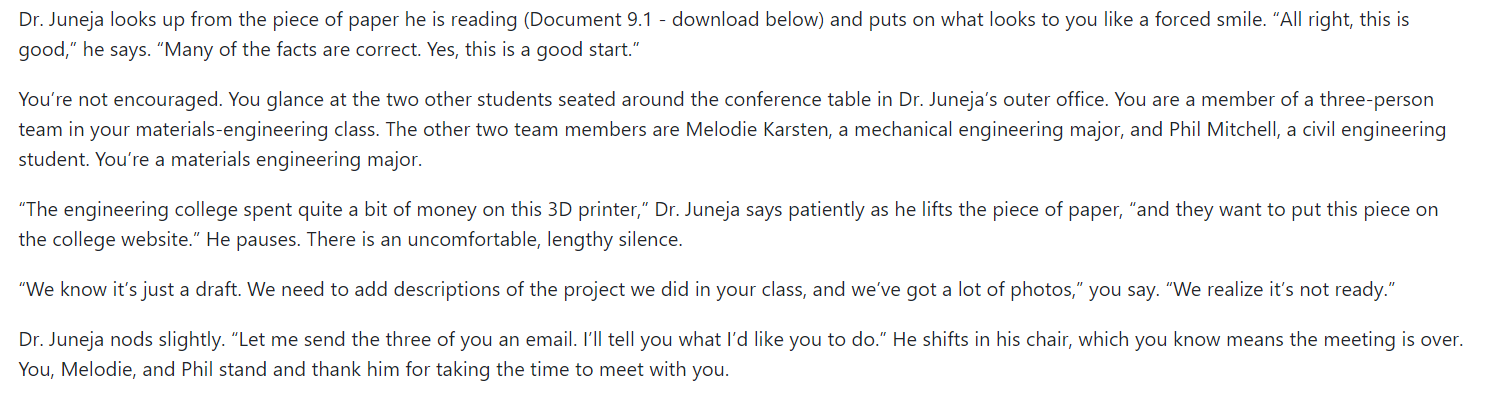
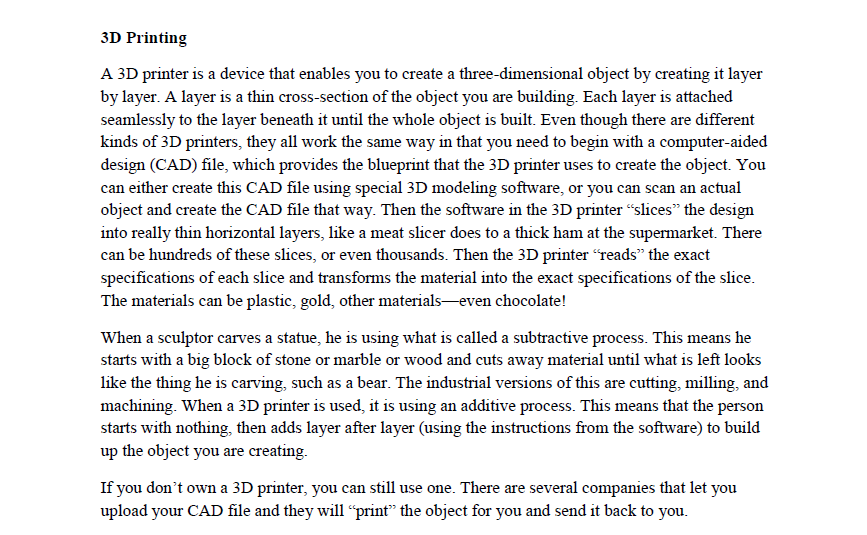
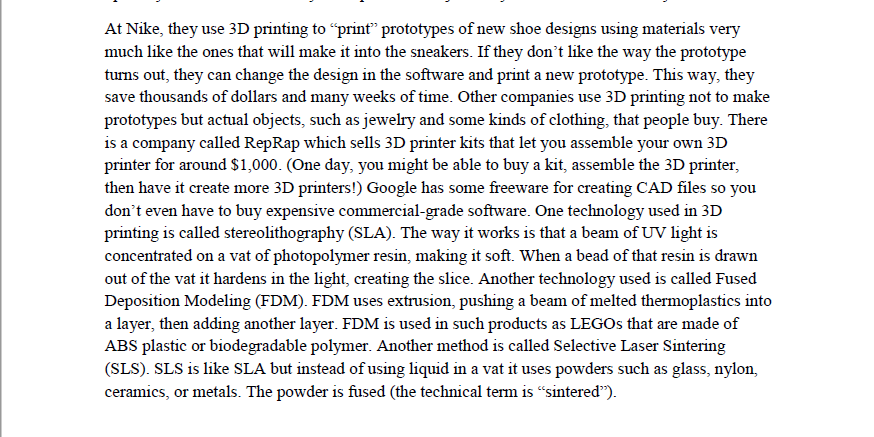
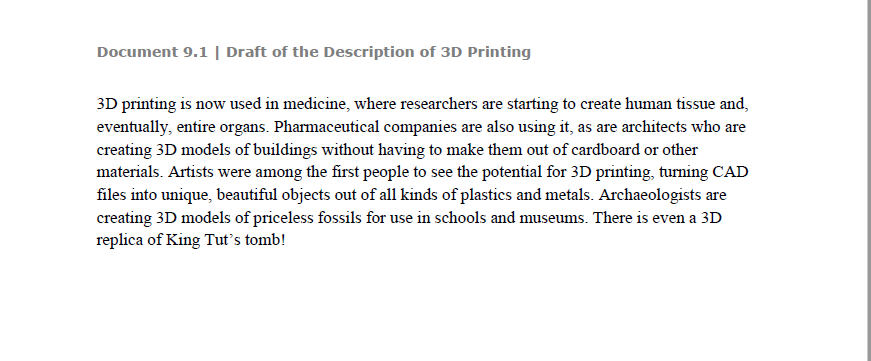
Dr. Juneja looks up from the piece of paper he is reading (Document 9.1 - download below) and puts on what looks to you like a forced smile. "All right, this is good," he says. "Many of the facts are correct. Yes, this is a good start." You're not encouraged. You glance at the two other students seated around the conference table in Dr. Juneja's outer office. You are a member of a three-person team in your materials-engineering class. The other two team members are Melodie Karsten, a mechanical engineering major, and Phil Mitchell, a civil engineering student. You're a materials engineering major. The engineering college spent quite a bit of money on this 3D printer," Dr. Juneja says patiently as he lifts the piece of paper, "and they want to put this piece on the college website." He pauses. There is an uncomfortable, lengthy silence. "We know it's just a draft. We need to add descriptions of the project we did in your class, and we've got a lot of photos," you say. "We realize it's not ready." Dr. Juneja nods slightly. Let me send the three of you an email. I'll tell you what I'd like you to do." He shifts in his chair, which you know means the meeting is over. You, Melodie, and Phil stand and thank him for taking the time to meet with you. 3D Printing A 3D printer is a device that enables you to create a three-dimensional object by creating it layer by layer. A layer is a thin cross-section of the object you are building. Each layer is attached seamlessly to the layer beneath it until the whole object is built. Even though there are different kinds of 3D printers, they all work the same way in that you need to begin with a computer-aided design (CAD) file, which provides the blueprint that the 3D printer uses to create the object. You can either create this CAD file using special 3D modeling software, or you can scan an actual object and create the CAD file that way. Then the software in the 3D printer "slices the design into really thin horizontal layers, like a meat slicer does to a thick ham at the supermarket. There can be hundreds of these slices, or even thousands. Then the 3D printer reads the exact specifications of each slice and transforms the material into the exact specifications of the slice. The materials can be plastic, gold, other materialseven chocolate! When a sculptor carves a statue, he is using what is called a subtractive process. This means he starts with a big block of stone or marble or wood and cuts away material until what is left looks like the thing he is carving, such as a bear. The industrial versions of this are cutting, milling, and machining. When a 3D printer is used, it is using an additive process. This means that the person starts with nothing, then adds layer after layer (using the instructions from the software) to build up the object you are creating. If you don't own a 3D printer, you can still use one. There are several companies that let you upload your CAD file and they will print" the object for you and send it back to you. At Nike, they use 3D printing to print prototypes of new shoe designs using materials very much like the ones that will make it into the sneakers. If they don't like the way the prototype turns out, they can change the design in the software and print a new prototype. This way, they save thousands of dollars and many weeks of time. Other companies use 3D printing not to make prototypes but actual objects, such as jewelry and some kinds of clothing, that people buy. There is a company called RepRap which sells 3D printer kits that let you assemble your own 3D printer for around $1,000. (One day, you might be able to buy a kit, assemble the 3D printer, then have it create more 3D printers!) Google has some freeware for creating CAD files so you don't even have to buy expensive commercial-grade software. One technology used in 3D printing is called stereolithography (SLA). The way it works is that a beam of UV light is concentrated on a vat of photopolymer resin, making it soft. When a bead of that resin is drawn out of the vat it hardens in the light, creating the slice. Another technology used is called Fused Deposition Modeling (FDM). FDM uses extrusion, pushing a beam of melted thermoplastics into a layer, then adding another layer. FDM is used in such products as LEGOs that are made of ABS plastic or biodegradable polymer. Another method is called Selective Laser Sintering (SLS). SLS is like SLA but instead of using liquid in a vat it uses powders such as glass, nylon, ceramics, or metals. The powder is fused (the technical term is sintered). Document 9.1 | Draft of the Description of 3D Printing 3D printing is now used in medicine, where researchers are starting to create human tissue and, eventually, entire organs. Pharmaceutical companies are also using it, as are architects who are creating 3D models of buildings without having to make them out of cardboard or other materials. Artists were among the first people to see the potential for 3D printing, turning CAD files into unique, beautiful objects out of all kinds of plastics and metals. Archaeologists are creating 3D models of priceless fossils for use in schools and museums. There is even a 3D replica of King Tut's tombStep by Step Solution
There are 3 Steps involved in it

Get step-by-step solutions from verified subject matter experts