



Question: One construction method employed in many public buildings is to have the exterior building walls composed of a large number of small tiles. These tiles
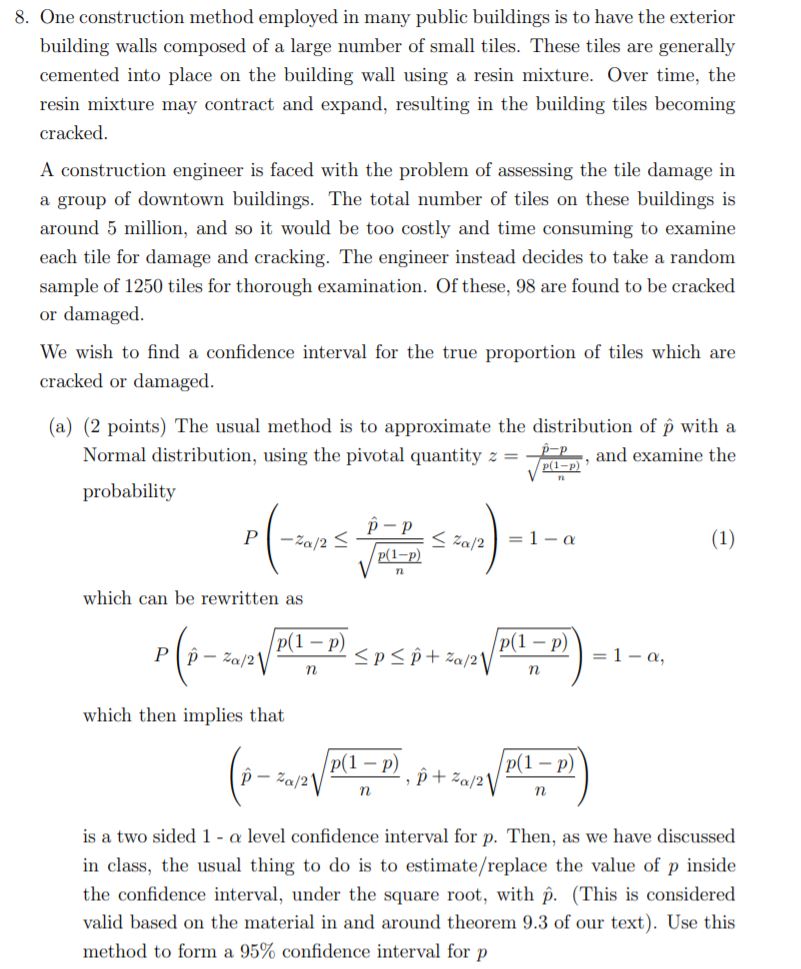
One construction method employed in many public buildings is to have the exterior building walls composed of a large number of small tiles. These tiles are generally cemented into place on the building wall using a resin mixture. Over time, the resin mixture may contract and expand, resulting in the building tiles becoming cracked. A construction engineer is faced with the problem of assessing the tile damage in a group of downtown buildings. The total number of tiles on these buildings is around 5 million, and so it would be too costly and time consuming to examine each tile for damage and cracking. The engineer instead decides to take a random sample of 1250 tiles for thorough examination. Of these, 98 are found to be cracked or damaged. We wish to find a confidence interval for the true proportion of tiles which are cracked or damaged.
(a) (2 points) The usual method is to approximate the distribution of ?p with a Normal distribution, using the pivotal quantity z = q p??p p(1?p) n , and examine the probability is a two sided 1 - ? level confidence interval for p. Then, as we have discussed in class, the usual thing to do is to estimate/replace the value of p inside the confidence interval, under the square root, with ?p. (This is considered valid based on the material in and around theorem 9.3 of our text). Use this method to form a 95% confidence interval for p
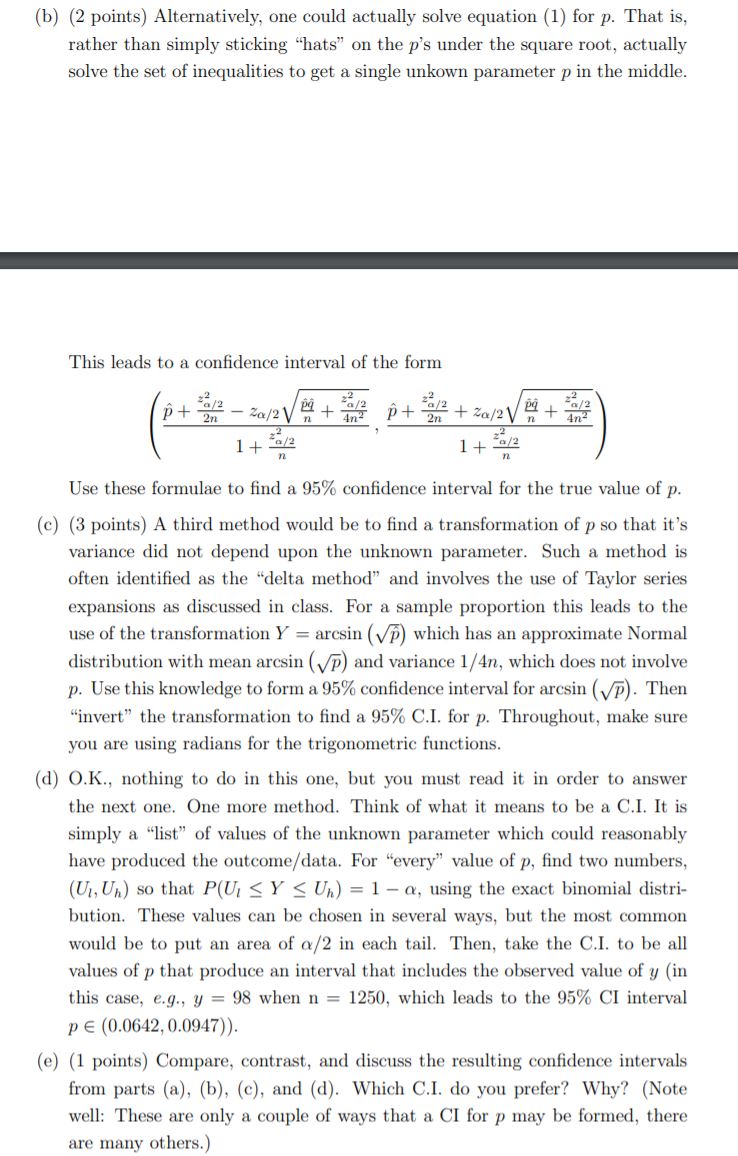
(b) (2 points) Alternatively, one could actually solve equation (1) for p. That is, rather than simply sticking "hats" on the p's under the square root, actually solve the set of inequalities to get a single unkown parameter p in the middle. This leads to a confidence interval of the form
Use these formulae to find a 95% confidence interval for the true value of p.
(c) (3 points) A third method would be to find a transformation of p so that it's variance did not depend upon the unknown parameter. Such a method is often identified as the "delta method" and involves the use of Taylor series expansions as discussed in class. For a sample proportion this leads to the use of the transformation Y = arcsin ? p? which has an approximate Normal distribution with mean arcsin ?p and variance 1/4n, which does not involve p. Use this knowledge to form a 95% confidence interval for arcsin ?p . Then "invert" the transformation to find a 95% C.I. for p. Throughout, make sure you are using radians for the trigonometric functions.
(d) O.K., nothing to do in this one, but you must read it in order to answer the next one. One more method. Think of what it means to be a C.I. It is simply a "list" of values of the unknown parameter which could reasonably have produced the outcome/data. For "every" value of p, find two numbers, (Ul , Uh) so that P(Ul ? Y ? Uh) = 1 ? ?, using the exact binomial distribution. These values can be chosen in several ways, but the most common would be to put an area of ?/2 in each tail. Then, take the C.I. to be all values of p that produce an interval that includes the observed value of y (in this case, e.g., y = 98 when n = 1250, which leads to the 95% CI interval p ? (0.0642, 0.0947)).
(e) (1 points) Compare, contrast, and discuss the resulting confidence intervals from parts (a), (b), (c), and (d). Which C.I. do you prefer? Why? (Note well: These are only a couple of ways that a CI for p may be formed, there are many other
\f\f
Step by Step Solution
There are 3 Steps involved in it

Get step-by-step solutions from verified subject matter experts