



Question: One die has two 6's and four 2's. Another has three 5's and three 1's. The third has four 4's and two blank faces.
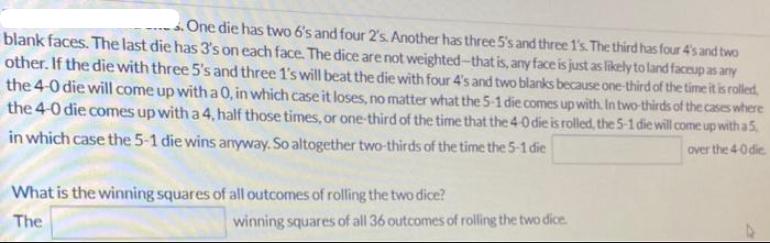
One die has two 6's and four 2's. Another has three 5's and three 1's. The third has four 4's and two blank faces. The last die has 3's on each face. The dice are not weighted-that is, any face is just as likely to land faceup as any other. If the die with three 5's and three 1's will beat the die with four 4's and two blanks because one-third of the time it is rolled the 4-0 die will come up with a 0, in which case it loses, no matter what the 5-1 die comes up with. In two-thirds of the cases where the 4-0 die comes up with a 4, half those times, or one-third of the time that the 4-0 die is rolled, the 5-1 die will come up with a 5, in which case the 5-1 die wins anyway. So altogether two-thirds of the time the 5-1 die What is the winning squares of all outcomes of rolling the two dice? over the 4-0 die The winning squares of all 36 outcomes of rolling the two dice
Step by Step Solution
There are 3 Steps involved in it
To determine the winning squares of all outcomes of rolling the two dice we need to consider the pos... View full answer

Get step-by-step solutions from verified subject matter experts