







Question: One - Dimensional Heat Equation Using MATLAB: Consider a slab with heat applied to the left and / or right side. As heat is applied,
OneDimensional Heat Equation
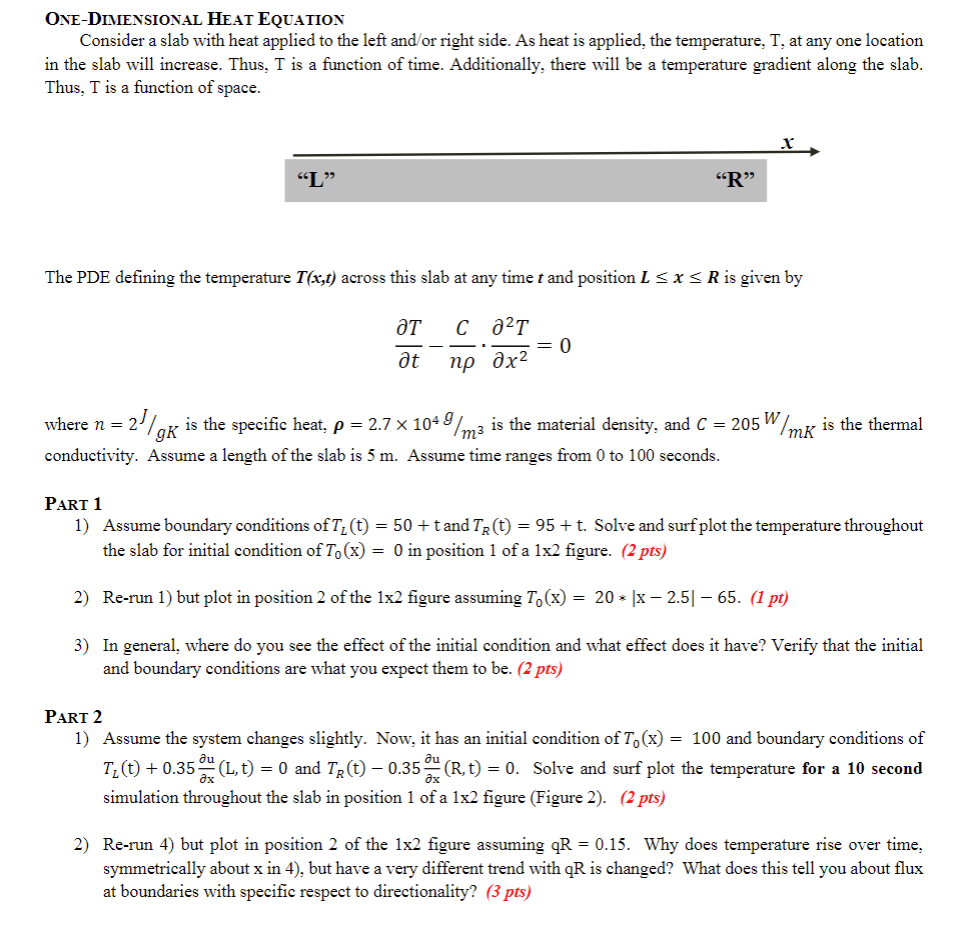
Using MATLAB: Consider a slab with heat applied to the left andor right side. As heat is applied, the temperature, at any one location
in the slab will increase. Thus, is a function of time. Additionally, there will be a temperature gradient along the slab.
Thus, is a function of space.
The PDE defining the temperature across this slab at any time and position is given by
where is the specific heat, is the material density, and is the thermal
conductivity. Assume a length of the slab is Assume time ranges from to seconds.
PART
Assume boundary conditions of and Solve and surf plot the temperature throughout
the slab for initial condition of in position of a figure. pts
Rerun but plot in position of the figure assuming pt
In general, where do you see the effect of the initial condition and what effect does it have? Verify that the initial
and boundary conditions are what you expect them to be pts
PART
Assume the system changes slightly. Now, it has an initial condition of and boundary conditions of
and Solve and surf plot the temperature for a second
simulation throughout the slab in position of a figure Figure pts
Rerun but plot in position of the figure assuming Why does temperature rise over time,
symmetrically about in but have a very different trend with is changed? What does this tell you about flux
at boundaries with specific respect to directionality? pts
Step by Step Solution
There are 3 Steps involved in it
1 Expert Approved Answer
Step: 1 Unlock

Question Has Been Solved by an Expert!
Get step-by-step solutions from verified subject matter experts
Step: 2 Unlock
Step: 3 Unlock
 Study Help