



Question: One method for straightening wire prior to coiling it to make a spring is called roller straightening. Suppose that a sample of 16 wires is
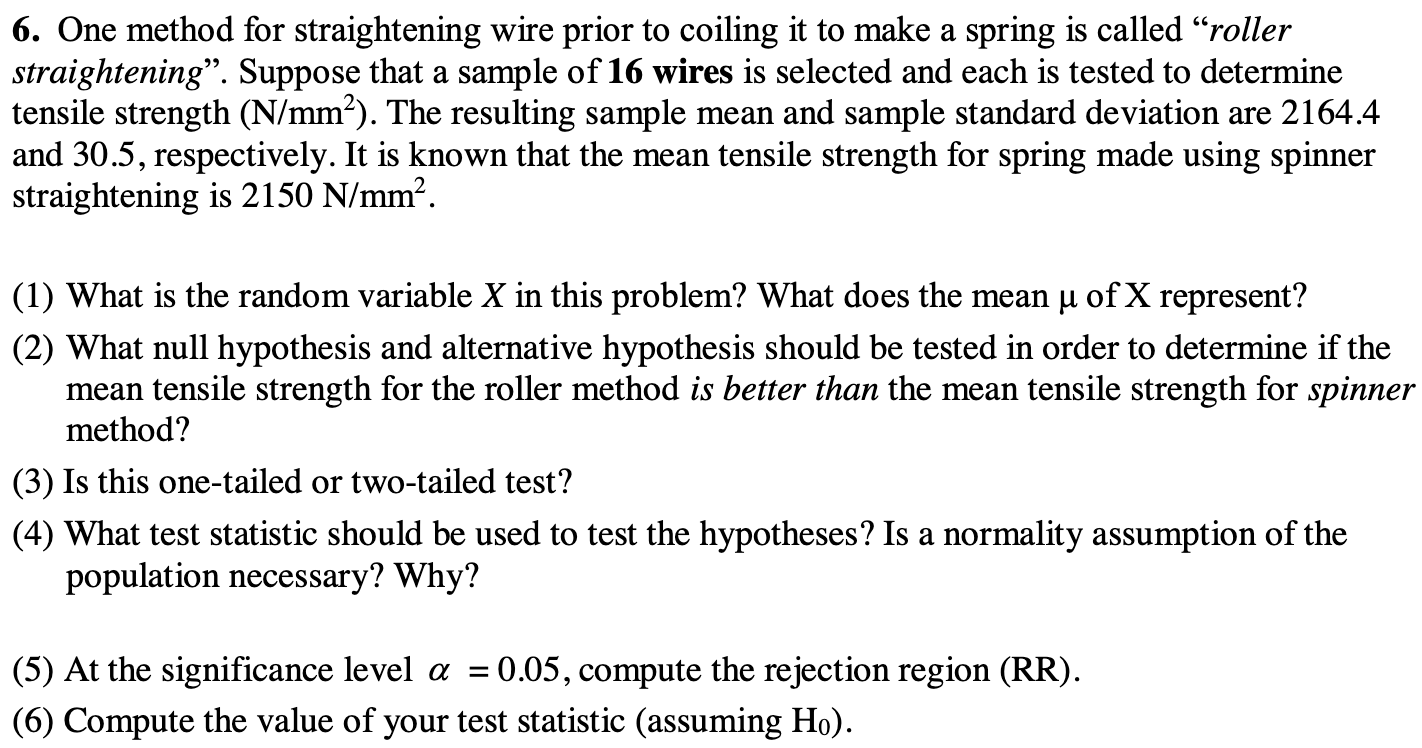
One method for straightening wire prior to coiling it to make a spring is called "roller straightening". Suppose that a sample of 16 wires is selected and each is tested to determine tensile strength (N/mm 2). The resulting sample mean and sample standard deviation are 2164.4 and 30.5, respectively. It is known that the mean tensile strength for spring made using spinner straightening is 2150 N/mm 2.
(1) What is the random variable X in this problem? What does the mean ? of X represent?
(2)What null hypothesis and alternative hypothesis should be tested in order to determine if the mean tensile strength for the roller method is better than the mean tensile strength for spinner method?
(3) Is this a one-tailed or two-tailed test?
(4) What test statistic should be used to test the hypotheses? Is a normality assumption of the population necessary? Why?
(5) At the significance level = 0.05, compute the rejection region (RR).
(6) Compute the value of your test statistic (assuming H0).
6. One method for straightening wire prior to coiling it to make a spring is called \"roller straightening\". Suppose that a sample of 16 Wires is selected and each is tested to determine tensile strength (N/mmz). The resulting sample mean and sample standard deviation are 2164.4 and 30.5, respectively. It is known that the mean tensile strength for spring made using spinner straightening is 2150 N/mmz. (1) What is the random variable X in this problem? What does the mean p. of X represent? (2) What null hypothesis and alternative hypothesis should be tested in order to determine if the mean tensile strength for the roller method is better than the mean tensile strength for spinner method? (3) Is this one-tailed or two-tailed test? (4) What test statistic should be used to test the hypotheses? Is a normality assumption of the population necessary? Why? (5) At the significance level a = 0.05, compute the rejection region (R). (6) Compute the value of your test statistic (assuming Ho)
Step by Step Solution
There are 3 Steps involved in it

Get step-by-step solutions from verified subject matter experts