







Question: one Question 1 (1 point each, 2 points total) For each write value of after code executes. x=4 before each line executes: Question 2 (1
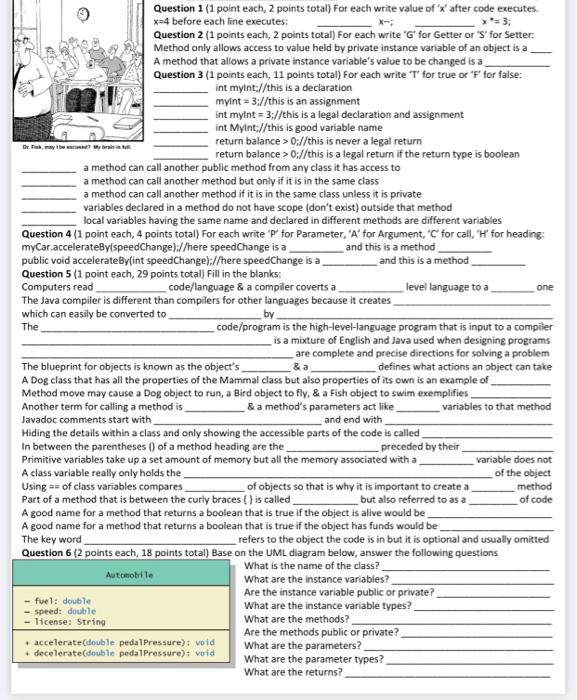
one Question 1 (1 point each, 2 points total) For each write value of after code executes. x=4 before each line executes: Question 2 (1 points each, 2 points total) For each write 'G' for Getter or 's for Setter: Method only allows access to value held by private instance variable of an object is a A method that allows a private instance variable's value to be changed is a Question 3 (1 points each, 11 points total) For each write T for true or "F" for false: int myint://this is a declaration myint=3://this is an assignment int myint = 3://this is a legal declaration and assignment int Myint://this is good variable name return balance > 0://this is never a legal return return balance > 0://this is a legal return if the return type is boolean a method can call another public method from any class it has access to a method can call another method but only if it is in the same class a method can call another method if it is in the same class unless it is private variables declared in a method do not have scope (don't exist) outside that method local variables having the same name and declared in different methods are different variables Question 4 (1 point each, 4 points total) For each wrte 'p' for Parameter,'A' for Argument, 'C' for call, 'H' for heading: myCar accelerateBy(speedChange)://here speedChange is a and this is a method public void accelerateBy(int speedChange)://here speedChange is a and this is a method Question 5 (1 point each, 29 points total) Fill in the blanks: Computers read code/language & a compiler coverts a level language to a The Java compiler is different than compilers for other languages because it creates which can easily be converted to by The code/program is the high-level-language program that is input to a compiler is a mixture of English and Java used when designing programs are complete and precise directions for solving a problem The blueprint for objects is known as the object's & a defines what actions an object can take A Dog class that has all the properties of the Mammal class but also properties of its own is an example of Method move may cause a Dog object to run, a Bird object to fly, & a Fish object to swim exemplifies Another term for calling a method is & a method's parameters act like variables to that method Javadoc comments start with and end with Hiding the details within a class and only showing the accessible parts of the code is called In between the parentheses () of a method heading are the preceded by their Primitive variables take up a set amount of memory but all the memory associated with a variable does not A class variable really only holds the of the object Using == of class variables compares of objects so that is why it is important to create a method Part of a method that is between the curly braces () is called but also referred to as a of code A good name for a method that returns a boolean that is true if the object is alive would be A good name for a method that returns a boolean that is true if the object has funds would be The key word refers to the object the code is in but it is optional and usually omitted Question 6 (2 points each, 18 points total) Base on the UML diagram below, answer the following questions What is the name of the class? Automobile What are the instance variables? Are the instance variable public or private? - fuel: double Speed: double What are the instance variable types? license: String What are the methods? Are the methods public or private? + accelerate double pedal Pressure): void What are the parameters? + decelerate(double pedal Pressure): void What are the parameter types? What are the returns
Step by Step Solution
There are 3 Steps involved in it

Get step-by-step solutions from verified subject matter experts
 Study Help