







Question: One sample mean test Plz answer question 1-3b Research Study #4 A rare congenital disease, Everley's syndrome, generally causes a reduction in concentration of blood
One sample mean test Plz answer question 1-3b
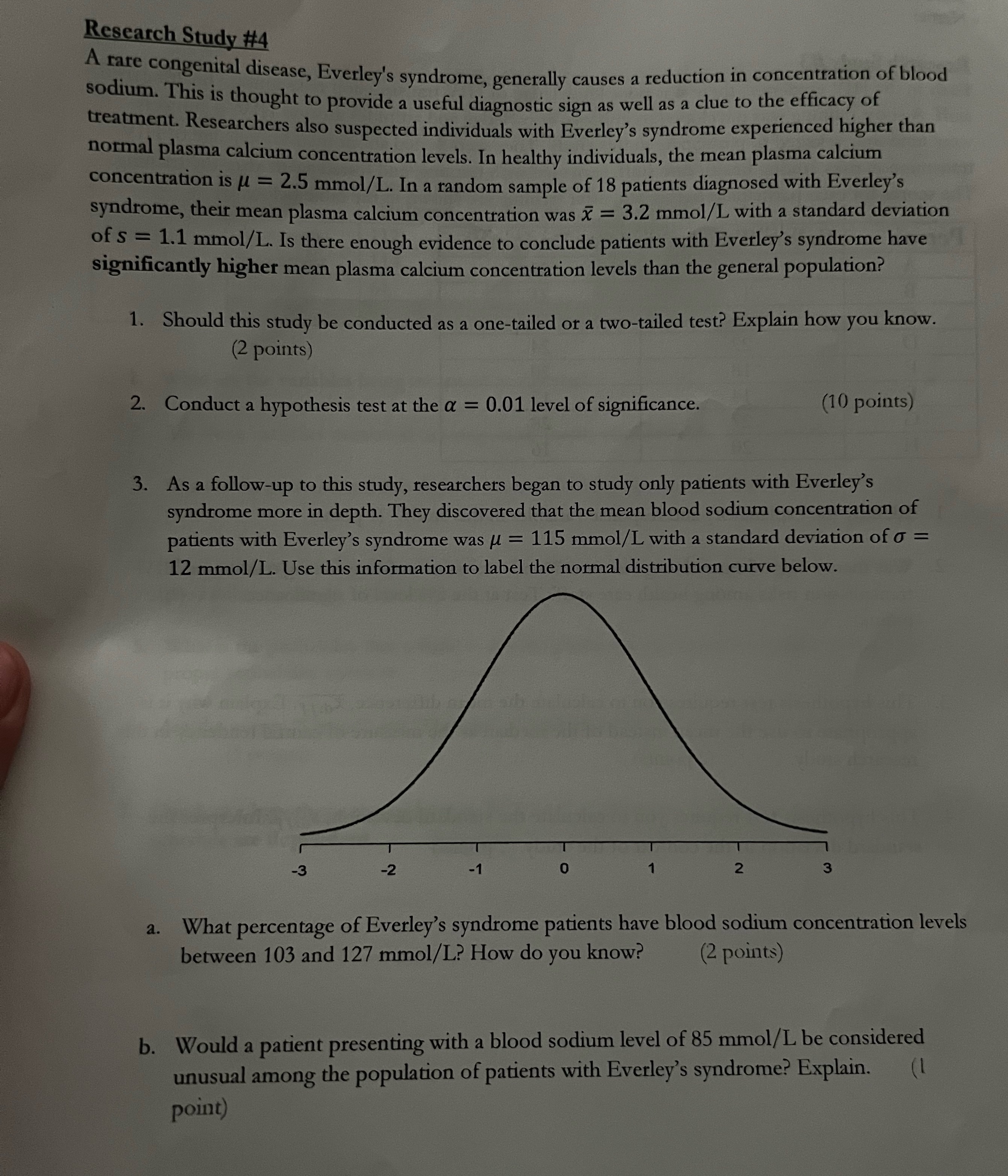
Research Study #4 A rare congenital disease, Everley's syndrome, generally causes a reduction in concentration of blood sodium. This is thought to provide a useful diagnostic sign as well as a clue to the efficacy of treatment. Researchers also suspected individuals with Everley's syndrome experienced higher than normal plasma calcium concentration levels. In healthy individuals, the mean plasma calcium concentration is M = 2.5 mmol/L. In a random sample of 18 patients diagnosed with Everley's syndrome, their mean plasma calcium concentration was x = 3.2 mmol/L with a standard deviation of s = 1.1 mmol/L. Is there enough evidence to conclude patients with Everley's syndrome have significantly higher mean plasma calcium concentration levels than the general population? 1. Should this study be conducted as a one-tailed or a two-tailed test? Explain how you know. (2 points) 2. Conduct a hypothesis test at the a = 0.01 level of significance. (10 points) 3. As a follow-up to this study, researchers began to study only patients with Everley's syndrome more in depth. They discovered that the mean blood sodium concentration of patients with Everley's syndrome was u = 115 mmol/L with a standard deviation of o = 12 mmol/L. Use this information to label the normal distribution curve below. 2 a. What percentage of Everley's syndrome patients have blood sodium concentration levels between 103 and 127 mmol/L? How do you know? (2 points) b. Would a patient presenting with a blood sodium level of 85 mmol/L be considered unusual among the population of patients with Everley's syndrome? Explain. (1 point)
Step by Step Solution
There are 3 Steps involved in it

Get step-by-step solutions from verified subject matter experts
 Study Help