



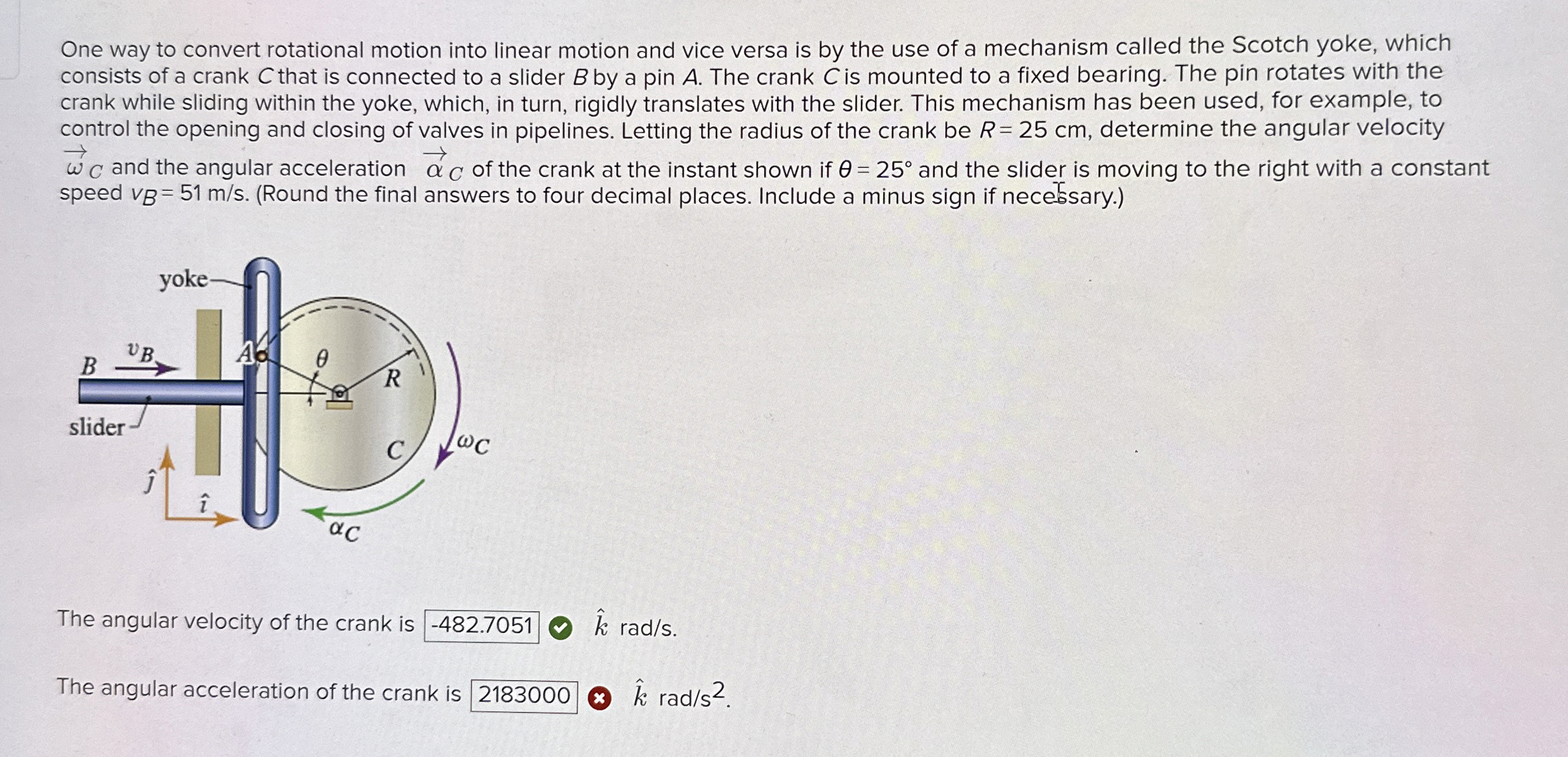
Question: One way to convert rotational motion into linear motion and vice versa is by the use of a mechanism called the Scotch yoke, which consists
One way to convert rotational motion into linear motion and vice versa is by the use of a mechanism called the Scotch yoke, which consists of a crank that is connected to a slider by a pin The crank is mounted to a fixed bearing. The pin rotates with the crank while sliding within the yoke, which, in turn, rigidly translates with the slider. This mechanism has been used, for example, to control the opening and closing of valves in pipelines. Letting the radius of the crank be determine the angular velocity vec and the angular acceleration vec of the crank at the instant shown if and the slider is moving to the right with a constant speed Round the final answers to four decimal places. Include a minus sign if nece sary.
The angular velocity of the crank is hat
The angular acceleration of the crank is hat
Step by Step Solution
There are 3 Steps involved in it
1 Expert Approved Answer
Step: 1 Unlock

Question Has Been Solved by an Expert!
Get step-by-step solutions from verified subject matter experts
Step: 2 Unlock
Step: 3 Unlock