







Question: One weekend you visit a local computer swap meet. While rummaging through a junk box at a vendor's stall, you find two very different looking
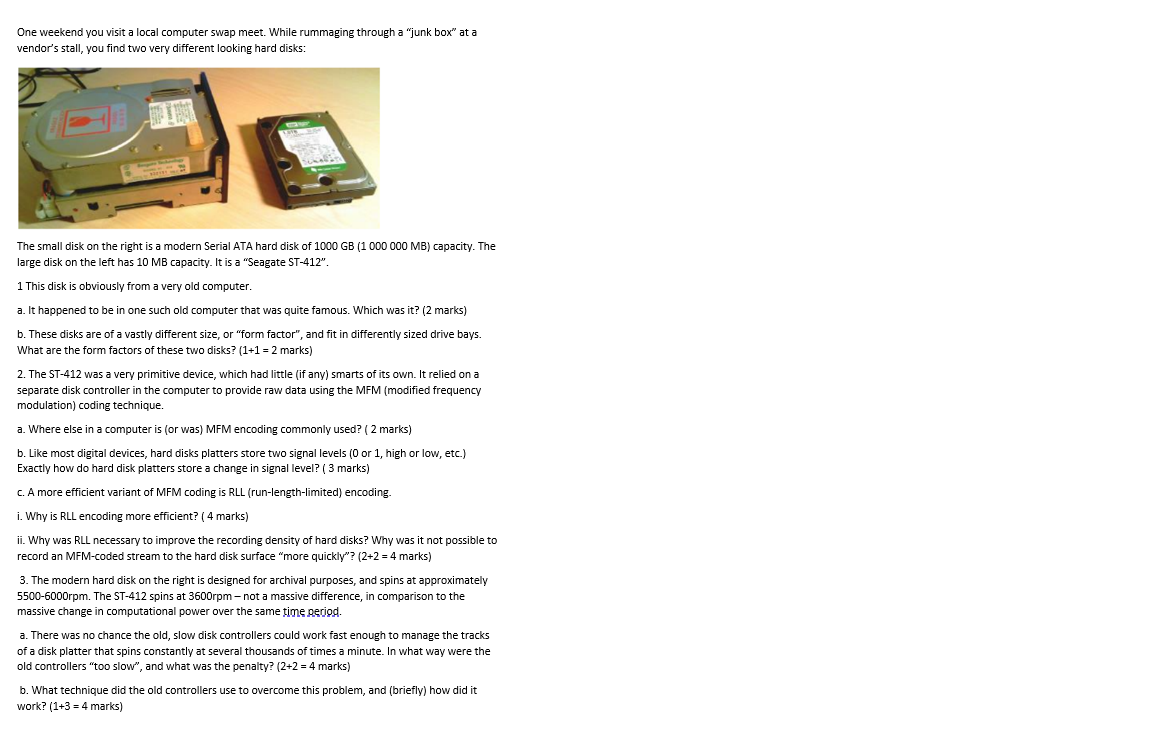
One weekend you visit a local computer swap meet. While rummaging through a "junk box" at a vendor's stall, you find two very different looking hard disks: The small disk on the right is a modern Serial ATA hard disk of 1000 GB (1 000 000 MB) capacity. The large disk on the left has 10 MB capacity. It is a "Seagate ST-412". 1 This disk is obviously from a very old computer. a. It happened to be in one such old computer that was quite famous. Which was it? (2 marks) b. These disks are of a vastly different size, or "form factor", and fit in differently sized drive bays. What are the form factors of these two disks? (1+1 = 2 marks) 2. The ST-412 was a very primitive device, which had little (if any) smarts of its own. It relied on a separate disk controller in the computer to provide raw data using the MFM (modified frequency modulation) coding technique. a. Where else in a computer is (or was) MFM encoding commonly used? (2 marks) b. Like most digital devices, hard disks platters store two signal levels (0 or 1, high or low, etc.) Exactly how do hard disk platters store a change in signal level? ( 3 marks) c. A more efficient variant of MFM coding is RLL (run-length-limited) encoding. i. Why is RLL encoding more efficient? ( 4 marks) ii. Why was RLL necessary to improve the recording density of hard disks? Why was it not possible to record an MFM-coded stream to the hard disk surface "more quickly"? (2+2 = 4 marks) 3. The modern hard disk on the right is designed for archival purposes, and spins at approximately 5500-6000rpm. The ST-412 spins at 3600rpm- not a massive difference, in comparison to the massive change in computational power over the same tine peciod. a. There was no chance the old, slow disk controllers could work fast enough to manage the tracks of a disk platter that spins constantly at several thousands of times a minute. In what way were the old controllers "too slow", and what was the penalty? (2+2 = 4 marks) b. What technique did the old controllers use to overcome this problem, and (briefly) how did it work? (1+3 = 4 marks)
Step by Step Solution
There are 3 Steps involved in it

Get step-by-step solutions from verified subject matter experts
 Study Help