







Question: Only 1-4 AP Physics 1 U5 WS2 - UCM page 1 Unit 5 11/9/2016 1. A block of ice with mass m is tied to
Only 1-4
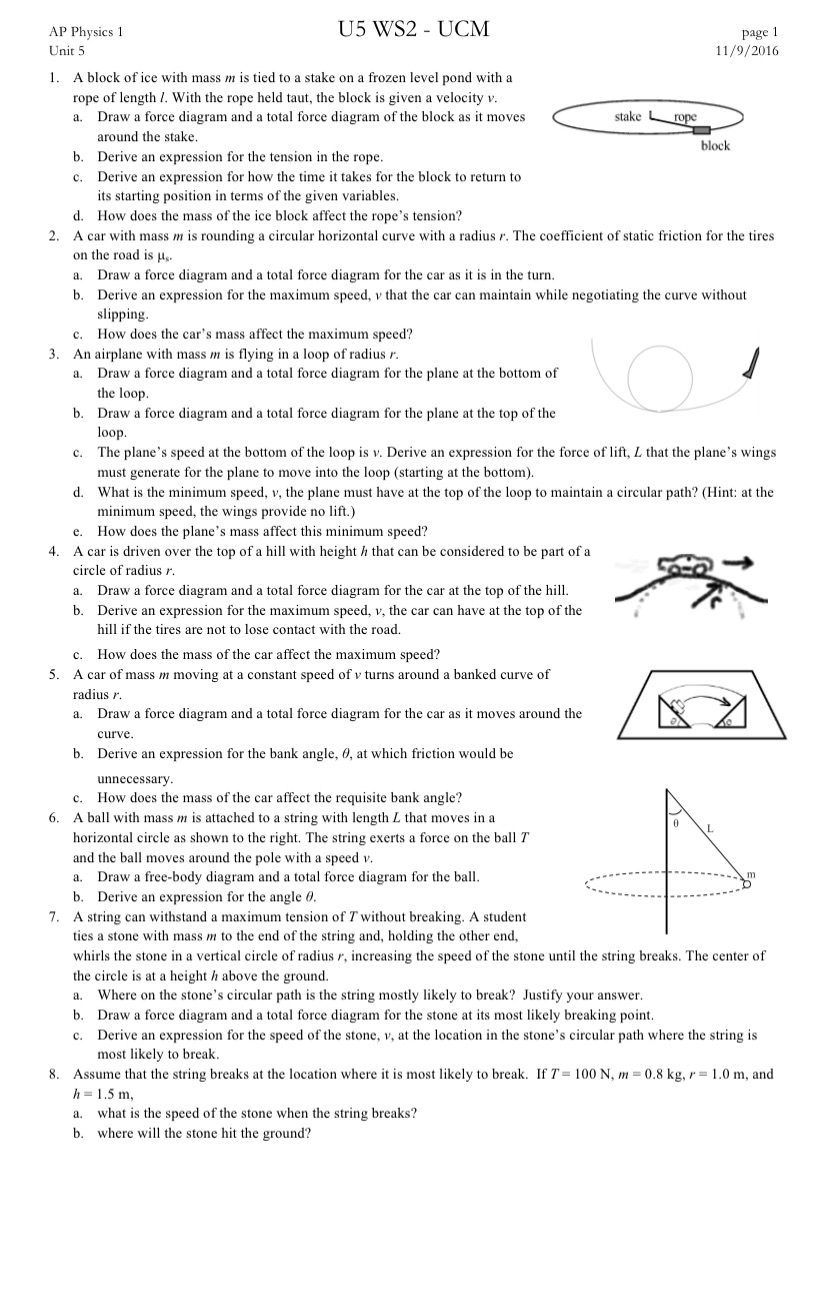
AP Physics 1 U5 WS2 - UCM page 1 Unit 5 11/9/2016 1. A block of ice with mass m is tied to a stake on a frozen level pond with a rope of length /. With the rope held taut, the block is given a velocity v. a. Draw a force diagram and a total force diagram of the block as it moves stake L rope around the stake. block b. Derive an expression for the tension in the rope. c. Derive an expression for how the time it takes for the block to return to its starting position in terms of the given variables. d. How does the mass of the ice block affect the rope's tension? 2. A car with mass m is rounding a circular horizontal curve with a radius r. The coefficient of static friction for the tires on the road is us. a. Draw a force diagram and a total force diagram for the car as it is in the turn. b. Derive an expression for the maximum speed, v that the car can maintain while negotiating the curve without slipping. c. How does the car's mass affect the maximum speed? 3. An airplane with mass m is flying in a loop of radius r. a. Draw a force diagram and a total force diagram for the plane at the bottom of the loop. b. Draw a force diagram and a total force diagram for the plane at the top of the loop. c. The plane's speed at the bottom of the loop is v. Derive an expression for the force of lift, L that the plane's wings must generate for the plane to move into the loop (starting at the bottom). d. What is the minimum speed, v, the plane must have at the top of the loop to maintain a circular path? (Hint: at the minimum speed, the wings provide no lift.) e. How does the plane's mass affect this minimum speed? 4. A car is driven over the top of a hill with height / that can be considered to be part of a circle of radius r. a. Draw a force diagram and a total force diagram for the car at the top of the hill. b. Derive an expression for the maximum speed, v, the car can have at the top of the hill if the tires are not to lose contact with the road. c. How does the mass of the car affect the maximum speed? 5. A car of mass m moving at a constant speed of v turns around a banked curve of radius r. a. Draw a force diagram and a total force diagram for the car as it moves around the curve. b. Derive an expression for the bank angle, 0, at which friction would be unnecessary. c. How does the mass of the car affect the requisite bank angle? 6. A ball with mass m is attached to a string with length L that moves in a horizontal circle as shown to the right. The string exerts a force on the ball and the ball moves around the pole with a speed v. a. Draw a free-body diagram and a total force diagram for the ball. b. Derive an expression for the angle 0. 7. A string can withstand a maximum tension of 7 without breaking. A student ties a stone with mass m to the end of the string and, holding the other end, whirls the stone in a vertical circle of radius , increasing the speed of the stone until the string breaks. The center of the circle is at a height h above the ground. a. Where on the stone's circular path is the string mostly likely to break? Justify your answer. b. Draw a force diagram and a total force diagram for the stone at its most likely breaking point. c. Derive an expression for the speed of the stone, v, at the location in the stone's circular path where the string is most likely to break. 8. Assume that the string breaks at the location where it is most likely to break. If 7= 100 N, m = 0.8 kg, / = 1.0 m, and h = 1.5 m, a. what is the speed of the stone when the string breaks? b. where will the stone hit the ground
Step by Step Solution
There are 3 Steps involved in it

Get step-by-step solutions from verified subject matter experts
 Study Help