







Question: ONLY ANSWER 3B a 3. Consider a small open economy with a single household who receives utility from consumption of a final good in two
ONLY ANSWER 3B
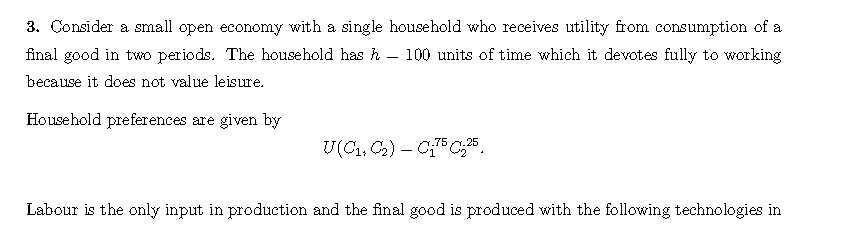
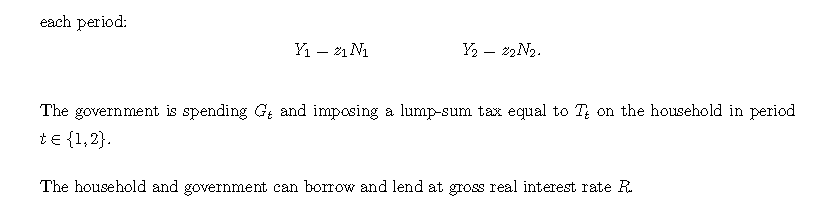
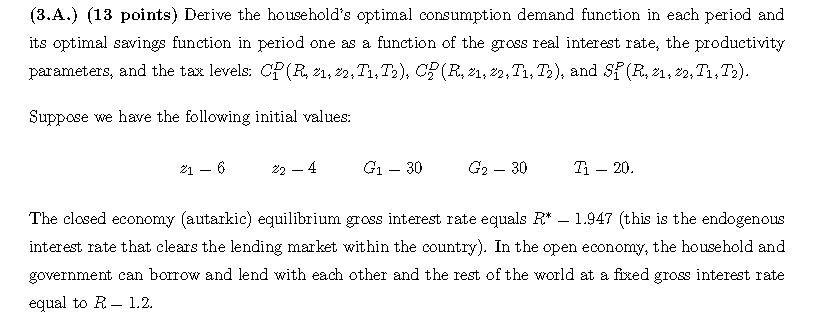
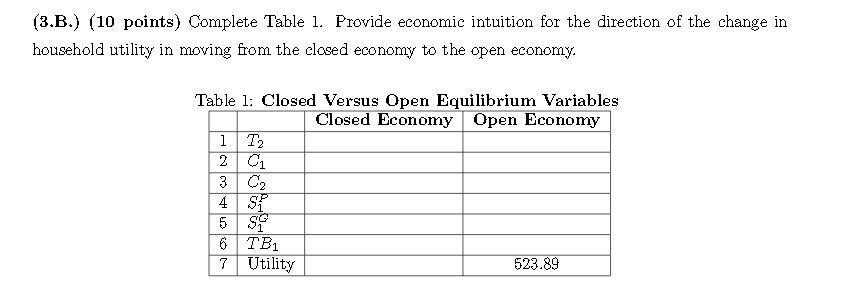
a 3. Consider a small open economy with a single household who receives utility from consumption of a final good in two periods. The household has h 100 units of time which it devotes fully to working because it does not value leisure. Household preferences are given by U(C1,C2) - C775 c25 Labour is the only input in production and the final good is produced with the following technologies in each period: Y1 21 Ni Y3 22N2. The government is spending Gt and imposing a lump-sum tax equal to Tt on the household in period te{1,2} The household and government can borrow and lend at gross real interest rate R. (3.A.) (13 points) Derive the household's optimal consumption demand function in each period and its optimal savings function in period one as a function of the gross real interest rate, the productivity parameters, and the tax levels: CP(R, 21, 22.71, 72), C? (R.21,22,71,72), and SP (R.21,22,71,72). Suppose we have the following initial values: 21 - 6 22 - 4 G1 30 G2 30 71 - 20. The closed economy (autarkic) equilibrium gross interest rate equals R* 1.947 (this is the endogenous interest rate that clears the lending market within the country). In the open economy, the household and government can borrow and lend with each other and the rest of the world at a fixed gross interest rate equal to R - 1.2. (3.B.) (10 points) Complete Table 1. Provide economic intuition for the direction of the change in household utility in moving from the closed economy to the open economy. Table 1: Closed Versus Open Equilibrium Variables Closed Economy Open Economy 1 12 2 C1 3 C2 4 SP 5 ST 6 TB1 7 Utility 523.89 a 3. Consider a small open economy with a single household who receives utility from consumption of a final good in two periods. The household has h 100 units of time which it devotes fully to working because it does not value leisure. Household preferences are given by U(C1,C2) - C775 c25 Labour is the only input in production and the final good is produced with the following technologies in each period: Y1 21 Ni Y3 22N2. The government is spending Gt and imposing a lump-sum tax equal to Tt on the household in period te{1,2} The household and government can borrow and lend at gross real interest rate R. (3.A.) (13 points) Derive the household's optimal consumption demand function in each period and its optimal savings function in period one as a function of the gross real interest rate, the productivity parameters, and the tax levels: CP(R, 21, 22.71, 72), C? (R.21,22,71,72), and SP (R.21,22,71,72). Suppose we have the following initial values: 21 - 6 22 - 4 G1 30 G2 30 71 - 20. The closed economy (autarkic) equilibrium gross interest rate equals R* 1.947 (this is the endogenous interest rate that clears the lending market within the country). In the open economy, the household and government can borrow and lend with each other and the rest of the world at a fixed gross interest rate equal to R - 1.2. (3.B.) (10 points) Complete Table 1. Provide economic intuition for the direction of the change in household utility in moving from the closed economy to the open economy. Table 1: Closed Versus Open Equilibrium Variables Closed Economy Open Economy 1 12 2 C1 3 C2 4 SP 5 ST 6 TB1 7 Utility 523.89
Step by Step Solution
There are 3 Steps involved in it

Get step-by-step solutions from verified subject matter experts
 Study Help