







Question: only answer the post-lab questions, last picture. Data Table BR counts (608) Run! Run 2 zo Run 3 12 Run 4 Run 5 5.0 cm
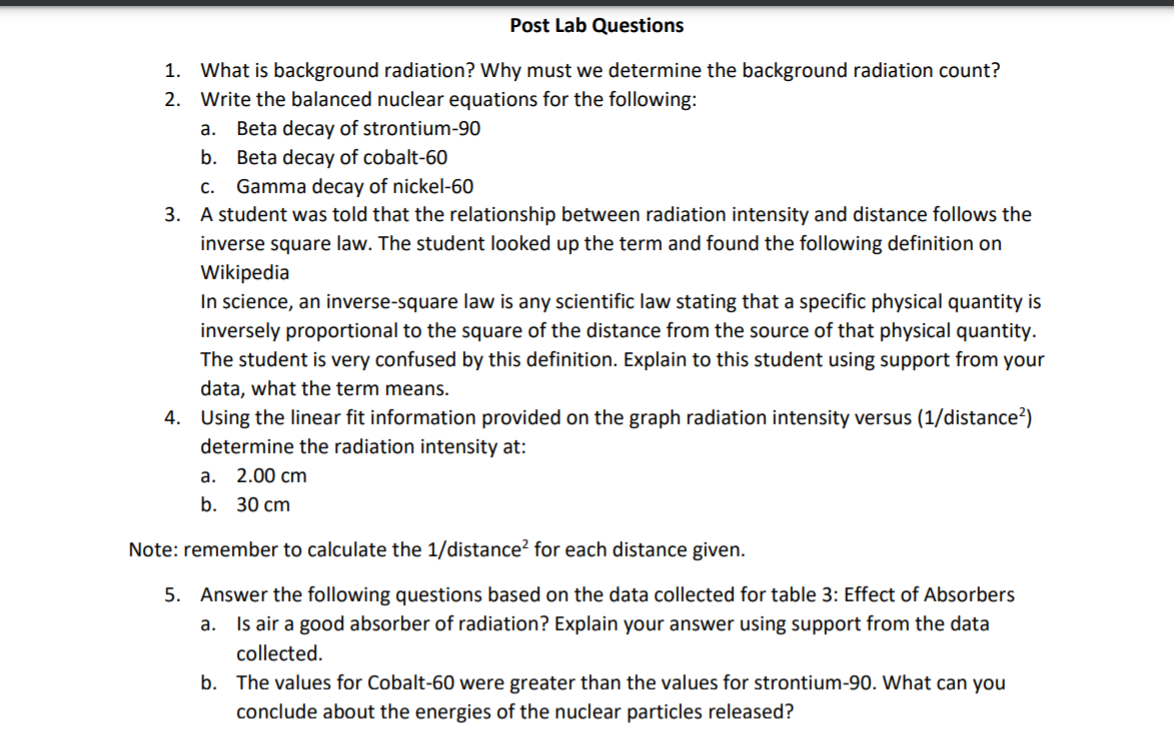 only answer the post-lab questions, last picture.
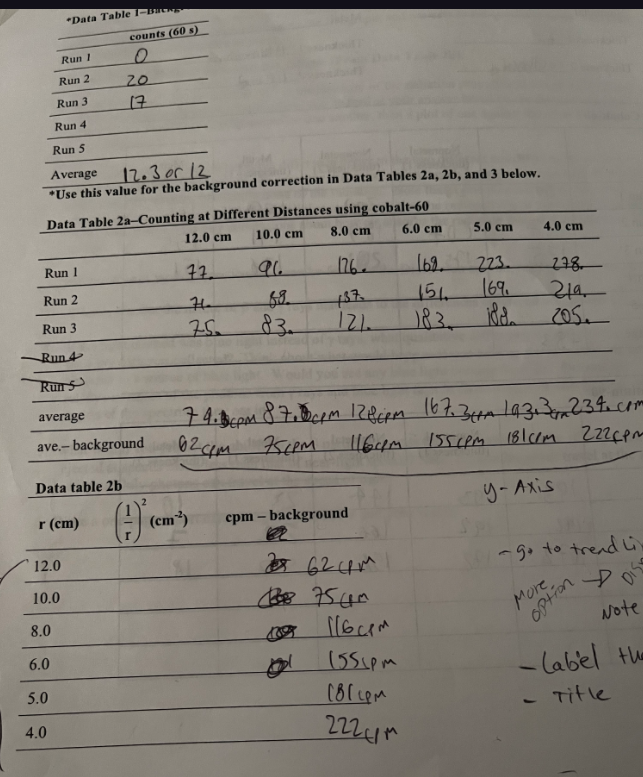
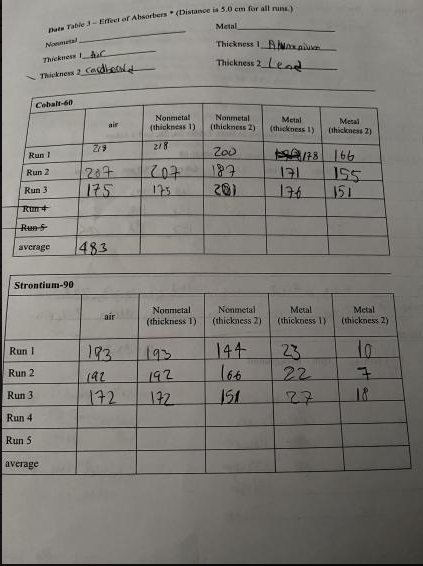
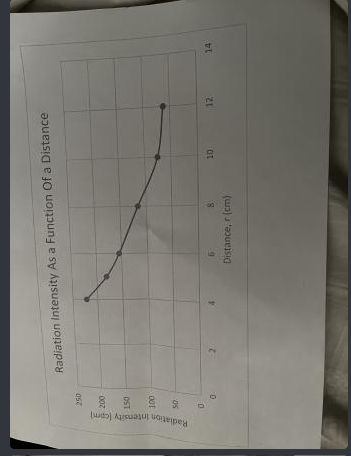
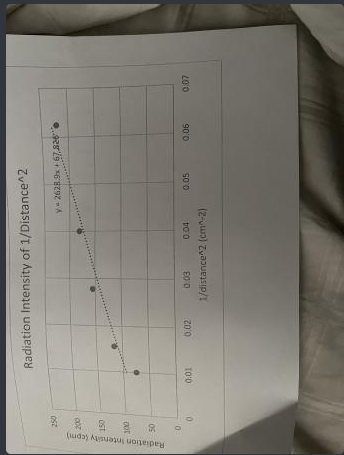
Data Table BR counts (608) Run! Run 2 zo Run 3 12 Run 4 Run 5 5.0 cm Average 12.3 or 12 *Use this value for the background correction in Data Tables 2a, 2b, and 3 below. Data Table 2a-Counting at Different Distances using cobalt-60 12.0 cm 10.0 cm 8.0 cm 6.0 cm 4.0 cm Run 1 72. 116. 162 223. 278 19. Run 2 169, 151 21a 75. Run 3 126 182 ide 205. Run 4 +37. 83. Runs average 74. BPM 87.6com 12&com 167.34 1933, 234.com 62com 75com 116com 1s5com 18lcom 2224pm ave.- background Data table 2b ya Axis r(cm) ec (cm) cpm - background ago to trendi 12.0 09 10.0 More option Note Jes 62.com BB 75cm 16com issuem Corcom 8.0 6.0 - label the - Title 5.0 4.0 2221m There are - Erler ar Absorbs (Distance 5.0 cm for all min) Man Metal Thickness 1 Thickness 2 Lead Thickness ac Thickness 2 Gardienne Cobalt-60 Nonmetal (thickness 2) Nonmetal (thickness 1) 2/8 Metal (thickness 1) Metal (thickness 2) Run! Run 2 1207 175 207 125 Zoo 182 2) S/78 166 121 155 176 151 Run 3 tor Run average 1483 Strontium-90 air Nonmetal (thickness 1) Nonmetal (thickness 2) Metal (thickness 1) Metal (thickness 2) Run! 193 Run 2 193 142 172 192 144 166 151 23 22 27 10 7 TA Run 3 122 Run 4 Run 5 average Radiation intensity As a Function of a Distance 200 150 Radiation intensity 100 SO 10 12 14 6 8 Distance, (cm) Radiation Intensity of 1/Distance2 - 26289 +67,826 230 150 Radiation Intensity 120 50 0.01 0.02 0.05 0.06 0.07 0.03 0.04 t/distance2 (cm-2) Post Lab Questions 1. What is background radiation? Why must we determine the background radiation count? 2. Write the balanced nuclear equations for the following: a. Beta decay of strontium-90 b. Beta decay of cobalt-60 C. Gamma decay of nickel-60 3. A student was told that the relationship between radiation intensity and distance follows the inverse square law. The student looked up the term and found the following definition on Wikipedia In science, an inverse-square law is any scientific law stating that a specific physical quantity is inversely proportional to the square of the distance from the source of that physical quantity. The student is very confused by this definition. Explain to this student using support from your data, what the term means. 4. Using the linear fit information provided on the graph radiation intensity versus (1/distance?) determine the radiation intensity at: a. 2.00 cm b. 30 cm Note: remember to calculate the 1/distance for each distance given. 5. Answer the following questions based on the data collected for table 3: Effect of Absorbers a. Is air a good absorber of radiation? Explain your answer using support from the data collected. b. The values for Cobalt-60 were greater than the values for strontium-90. What can you conclude about the energies of the nuclear particles released
Step by Step Solution
There are 3 Steps involved in it

Get step-by-step solutions from verified subject matter experts
 Study Help