







Question: ONLY answer this without defining new predicates OR new values. Thus, don't make up a new predicate or use new variables other than the variables
ONLY answer this without defining new predicates OR new values.
Thus, don't make up a new predicate or use new variables other than the variables EXPLICITLY mentioned in the table of symbols and definitions.
Many likes guaranteed if we think the answer is correct and viable.
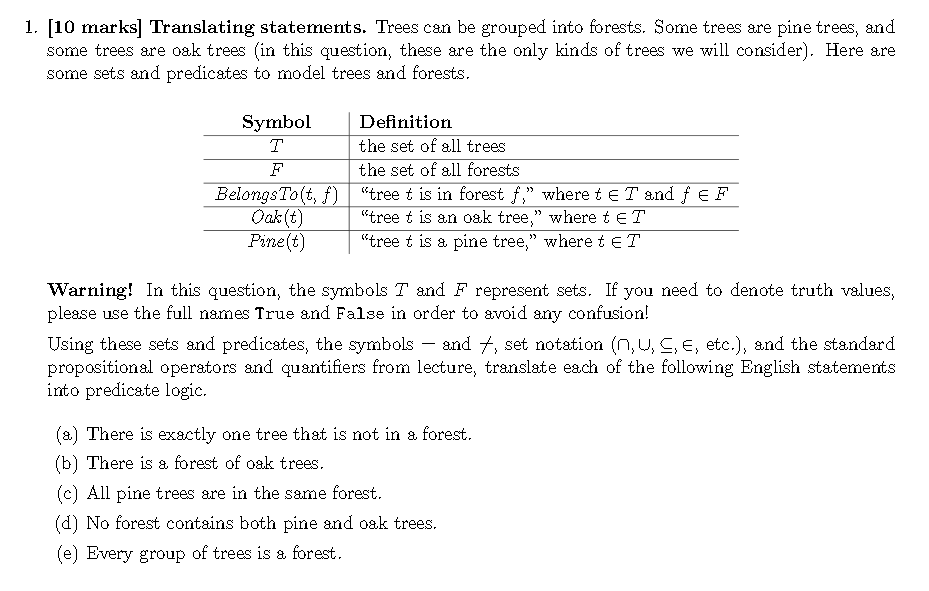
1. [10 marks] Translating statements. Trees can be grouped into forests. Some trees are pine trees, and some trees are oak trees (in this question, these are the only kinds of trees we will consider). Here are some sets and predicates to model trees and forests. Symbol Definition T the set of all trees F the set of all forests BelongsTo(t. f) "tree t is in forest f," where t e T and f EF Oak(t) "tree t is an oak tree," where t ET Pine(t) "tree t is a pine tree," where t ET Warning! In this question, the symbols T and F represent sets. If you need to denote truth values, please use the full names True and False in order to avoid any confusion! Using these sets and predicates, the symbols and 7, set notation (nu, S, E, etc.), and the standard propositional operators and quantifiers from lecture, translate each of the following English statements irto predicate logic. (a) There is exactly one tree that is not in a forest. (b) There is a forest of oak trees. (c) All pine trees are in the same forest. (d) No forest contains both pine and oak trees. (e) Every group of trees is a forest. 1. [10 marks] Translating statements. Trees can be grouped into forests. Some trees are pine trees, and some trees are oak trees (in this question, these are the only kinds of trees we will consider). Here are some sets and predicates to model trees and forests. Symbol Definition T the set of all trees F the set of all forests BelongsTo(t. f) "tree t is in forest f," where t e T and f EF Oak(t) "tree t is an oak tree," where t ET Pine(t) "tree t is a pine tree," where t ET Warning! In this question, the symbols T and F represent sets. If you need to denote truth values, please use the full names True and False in order to avoid any confusion! Using these sets and predicates, the symbols and 7, set notation (nu, S, E, etc.), and the standard propositional operators and quantifiers from lecture, translate each of the following English statements irto predicate logic. (a) There is exactly one tree that is not in a forest. (b) There is a forest of oak trees. (c) All pine trees are in the same forest. (d) No forest contains both pine and oak trees. (e) Every group of trees is a forest
Step by Step Solution
There are 3 Steps involved in it

Get step-by-step solutions from verified subject matter experts
 Study Help