







Question: Only answer to c) is needed. The rest is here for your reference. I will report plagiarism and spam, thank you. The optimal growth model
Only answer to c) is needed. The rest is here for your reference. I will report plagiarism and spam, thank you.
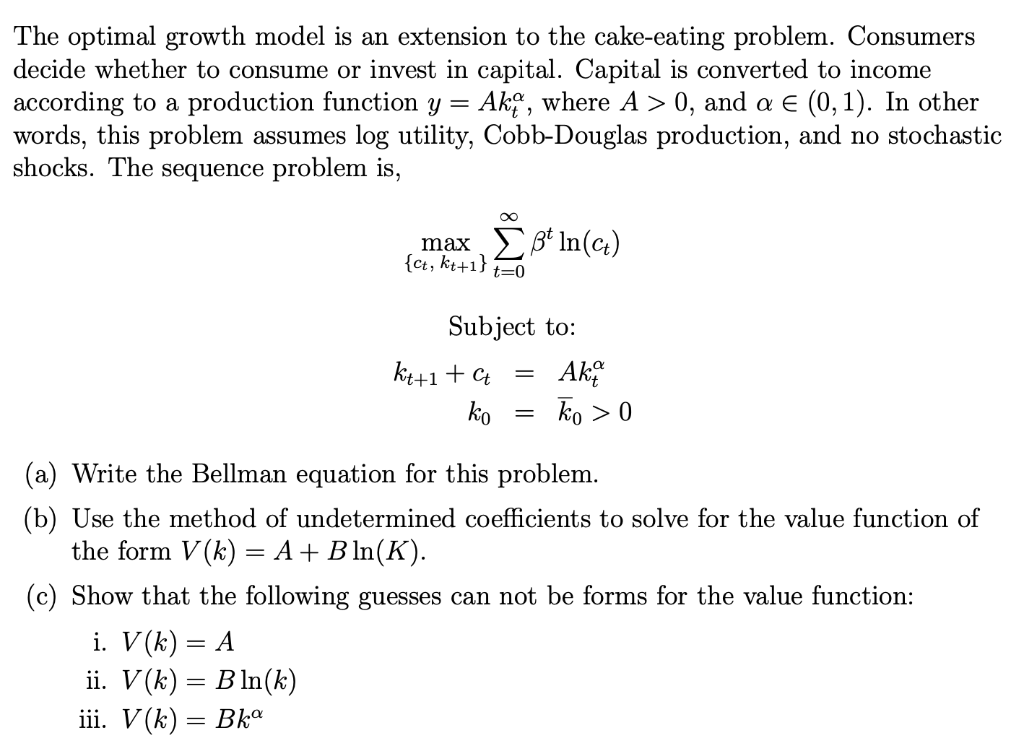
The optimal growth model is an extension to the cake-eating problem. Consumers decide whether to consume or invest in capital. Capital is converted to income according to a production function y= Ako, where A > 0, and a (0,1). In other words, this problem assumes log utility, Cobb-Douglas production, and no stochastic shocks. The sequence problem is, max Bf In(c) {Ct, kt+1} t=0 Subject to: kt+1 ta Akin ko ko > 0 = == = (a) Write the Bellman equation for this problem. (b) Use the method of undetermined coefficients to solve for the value function of the form V(k) = A + B ln(K). (c) Show that the following guesses can not be forms for the value function: i. V(k) = A ii. V(k) = B In(k) iii. V(k) = Bka The optimal growth model is an extension to the cake-eating problem. Consumers decide whether to consume or invest in capital. Capital is converted to income according to a production function y= Ako, where A > 0, and a (0,1). In other words, this problem assumes log utility, Cobb-Douglas production, and no stochastic shocks. The sequence problem is, max Bf In(c) {Ct, kt+1} t=0 Subject to: kt+1 ta Akin ko ko > 0 = == = (a) Write the Bellman equation for this problem. (b) Use the method of undetermined coefficients to solve for the value function of the form V(k) = A + B ln(K). (c) Show that the following guesses can not be forms for the value function: i. V(k) = A ii. V(k) = B In(k) iii. V(k) = Bka
Step by Step Solution
There are 3 Steps involved in it

Get step-by-step solutions from verified subject matter experts
 Study Help