







Question: Only (c) and (d) are needed, thanks! Problem 6 (3 points each) Now, we will focus on E' (20) = E(2) E(0) = 1 The
Only (c) and (d) are needed, thanks!
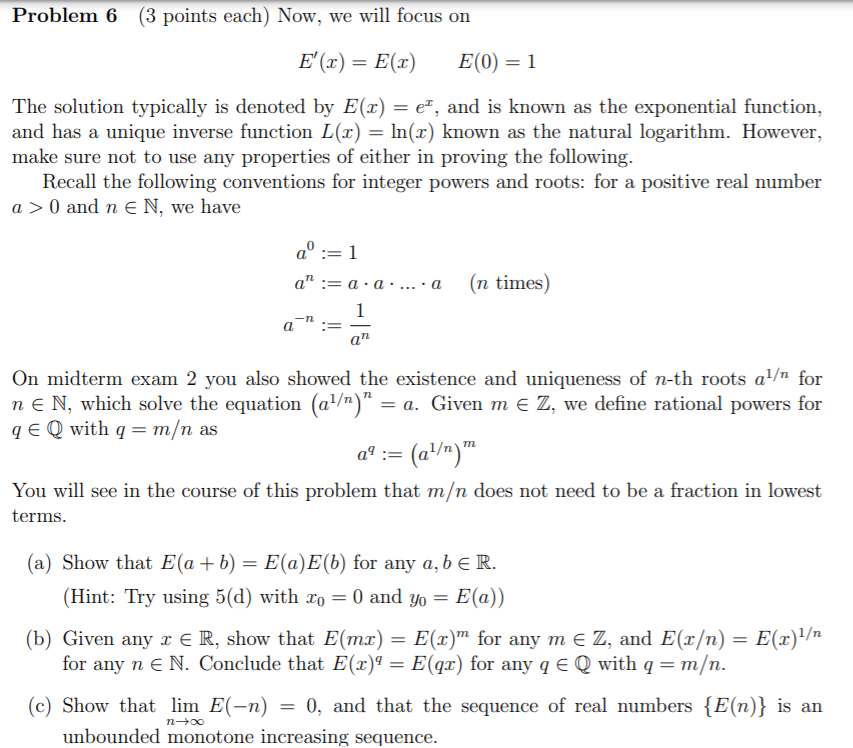
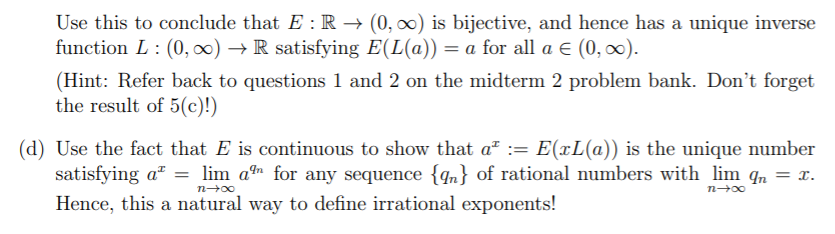
Problem 6 (3 points each) Now, we will focus on E' (20) = E(2) E(0) = 1 The solution typically is denoted by E(L) = ", and is known as the exponential function, and has a unique inverse function L(2) = ln(2) known as the natural logarithm. However, make sure not to use any properties of either in proving the following. Recall the following conventions for integer powers and roots: for a positive real number a> 0 and n N, we have a=1 a" := a.a.....a 1 a ":= (n times) an On midterm exam 2 you also showed the existence and uniqueness of n-th roots a for ne N, which solve the equation (a1)" = a. Given m Z, we define rational powers for qe Q with q=m as a!:= (ah)" You will see in the course of this problem that m does not need to be a fraction in lowest terms. (a) Show that E(a + b) = E(a)E(6) for any a, b E R. (Hint: Try using 5(d) with co = 0 and yo = E(a)) (b) Given any r ER, show that E(mx) = E()m for any m e Z, and E(r) = E(1)1 for any n E N. Conclude that E(2)9 = E(qr) for any q EQ with q=m. (c) Show that lim E(-n) = 0, and that the sequence of real numbers {E(n)} is an unbounded monotone increasing sequence. n-00 Use this to conclude that E:R + (0,00) is bijective, and hence has a unique inverse function L:(0,00) + R satisfying E(La)) = a for all a (0,0). (Hint: Refer back to questions 1 and 2 on the midterm 2 problem bank. Don't forget the result of 5(c)!) (d) Use the fact that E is continuous to show that a? := E(rL(a)) is the unique number satisfying a" = lim am for any sequence {en} of rational numbers with lim qn = I. Hence, this a natural way to define irrational exponents! 100 n-00 Problem 6 (3 points each) Now, we will focus on E' (20) = E(2) E(0) = 1 The solution typically is denoted by E(L) = ", and is known as the exponential function, and has a unique inverse function L(2) = ln(2) known as the natural logarithm. However, make sure not to use any properties of either in proving the following. Recall the following conventions for integer powers and roots: for a positive real number a> 0 and n N, we have a=1 a" := a.a.....a 1 a ":= (n times) an On midterm exam 2 you also showed the existence and uniqueness of n-th roots a for ne N, which solve the equation (a1)" = a. Given m Z, we define rational powers for qe Q with q=m as a!:= (ah)" You will see in the course of this problem that m does not need to be a fraction in lowest terms. (a) Show that E(a + b) = E(a)E(6) for any a, b E R. (Hint: Try using 5(d) with co = 0 and yo = E(a)) (b) Given any r ER, show that E(mx) = E()m for any m e Z, and E(r) = E(1)1 for any n E N. Conclude that E(2)9 = E(qr) for any q EQ with q=m. (c) Show that lim E(-n) = 0, and that the sequence of real numbers {E(n)} is an unbounded monotone increasing sequence. n-00 Use this to conclude that E:R + (0,00) is bijective, and hence has a unique inverse function L:(0,00) + R satisfying E(La)) = a for all a (0,0). (Hint: Refer back to questions 1 and 2 on the midterm 2 problem bank. Don't forget the result of 5(c)!) (d) Use the fact that E is continuous to show that a? := E(rL(a)) is the unique number satisfying a" = lim am for any sequence {en} of rational numbers with lim qn = I. Hence, this a natural way to define irrational exponents! 100 n-00
Step by Step Solution
There are 3 Steps involved in it

Get step-by-step solutions from verified subject matter experts
 Study Help