







Question: ONLY HAND SOLUTION ONLY HAND SOLUTION ONLY HAND SOLUTION ONLY HAND SOLUTION ONLY HAND SOLUTION ONLY HAND SOLUTION ONLY HAND SOLUTION ONLY HAND SOLUTION ONLY
ONLY HAND SOLUTION
ONLY HAND SOLUTION
ONLY HAND SOLUTION
ONLY HAND SOLUTION
ONLY HAND SOLUTION
ONLY HAND SOLUTION
ONLY HAND SOLUTION
ONLY HAND SOLUTION
ONLY HAND SOLUTION
ONLY HAND SOLUTION
HEURISTIC MINIMIZATION, GENETIC ALGORITHM DESIGN:
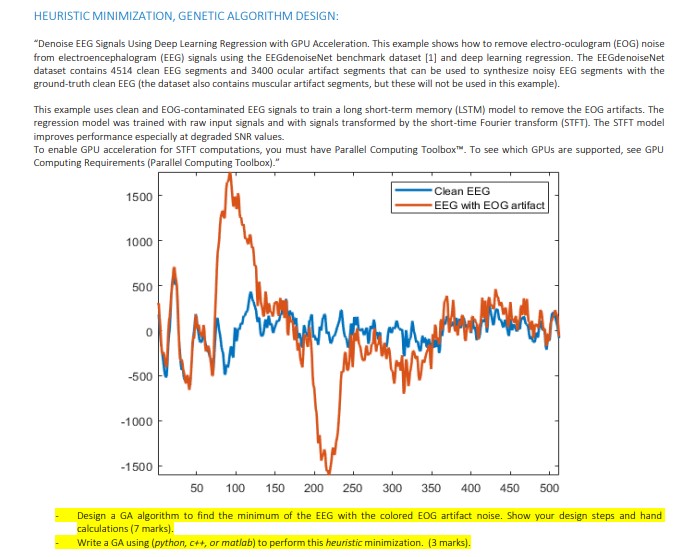
Denoise EEG Signals Using Deep Learning Regression with GPU Acceleration. This example shows how to remove electrooculogram EOG noise from electroencephalogram EEG signals using the EEGdenoiseNet benchmark dataset and deep learning regression. The EEGdenoiseNet dataset contains clean EEG segments and ocular artifact segments that can be used to synthesize noisy EEG segments with the groundtruth clean EEG the dataset also contains muscular artifact segments, but these will not be used in this example
This example uses clean and EOGcontaminated EEG signals to train a long shortterm memory LSTM model to remove the EOG artifacts. The regression model was trained with raw input signals and with signals transformed by the shorttime Fourier transform STFT The STFT model improves performance especially at degraded SNR values.
To enable GPU acceleration for STFT computations, you must have Parallel Computing Toolbox To see which GPUs are supported, see GPU Computing Requirements Parallel Comoutine Toolbox
Design a GA algorithm to find the minimum of the EEG with the colored EOG artifact noise. Show your design steps and hand calculations marks
Write a GA using python ct or matab to perform this heuristic minimization. marks
Step by Step Solution
There are 3 Steps involved in it
1 Expert Approved Answer
Step: 1 Unlock

Question Has Been Solved by an Expert!
Get step-by-step solutions from verified subject matter experts
Step: 2 Unlock
Step: 3 Unlock
 Study Help