







Question: *****Only need 3 through 6, please. NAT Operations First let us define a flow : two packets belong to the same TCP (or UDP) flow
*****Only need 3 through 6, please.
NAT Operations
First let us define a flow: two packets belong to the same TCP (or UDP) flow if both packets carry a TCP segment (or a UDP datagram) that have the same source IP address, destination IP address, source port number, and destination port number.
For all the following questions, we assume that the NAT box has the following available ports for translation for TCP and UDP. When the NAT box needs to translate a packet for a new flow, it will pick the next available port number from the table below. We assume that the next available port number for TCP (resp., UDP) is at Index 1. If the port number at Index 1 is already used, the next available will be the one at Index 2 and so on. We assume that the NAT was just turned on. Therefore, the next available port # for translation of a TCP (resp. UDP) flow is 4060 (resp. 5070).
| Index | TCP | UDP |
| 1 | 4060 | 5070 |
| 2 | 6982 | 1082 |
| 3 | 1463 | 1070 |
| 4 | 1078 | 2553 |
As seen on Figure 5-55, a customer sets up a network with multiple machines. However, the Internet provider assigned only one IP address to the customer: this IP address is 128.194.56.20.
Consider a machine M on the customer's network "behind" a NAT box, i.e. on the premises of the customer (see Figure 5-55 above). The IP address of Machine M is 192.168.67.2. A TCP client socket is established at Port # 10100 to send an http query Q to the server at IP address 64.233.101.177.
- (10 points) Consider Packet P1 carrying the http request Q. P1leaves Machine M and reaches Point A (see Figure 5-55). Fill in the array below with the source IP address, destination IP address, source port number, destination port number of Packet P1 when it is at Point A. Tell whether this packet P1 carries a TCP segment or a UDP datagram.
| TCP or UDP? | IP Source | IP Destination | Source Port # | Dest. Port # |
| TCP | 192.168.67.2 | 64.233.101.177 | 10100 | 80 |
2) (10 points) When the NAT box receives Packet P1, it translates it and outputs on Point B (see Figure 5-55) a translated packet. Fill in the array below with the source IP address, destination IP address, source port number, destination port number of the translated Packet P1. Highlight the information that will change (by the translation) and explain why.
| TCP or UDP? | IP Source | IP Destination | Source Port # | Dest. Port # |
| TCP | 128.194.56.20 | 64.233.101.177 | 4060 | 80 |
3) (10 points) When Packet P1 reaches the server, the server will respond with a packet P2. Fill in the array below with the source IP address, destination IP address, source port number, destination port number of the Packet P2.
| TCP or UDP? | IP Source | IP Destination | Source Port # | Dest. Port # |
4) (10 points) When the inbound packet P2 reaches the NAT box, it will be translated. Fill in the array below with the source IP address, destination IP address, source port number, destination port number of the translated Packet P2 (Point A).
| TCP or UDP? | IP Source | IP Destination | Source Port # | Dest. Port # |
5) (10 points) Suppose now that the same machine M (IP address :192.168.67.2) makes a DNS request to the server at IP address 128.194.54.253. The DNS client is bound to Port # 10020. The DNS request will be carried by Packet P3. Fill in the array below with the source IP address, destination IP address, source port number, destination port number of Packet P3 (Point A).
| TCP or UDP? | IP Source | IP Destination | Source Port # | Dest. Port # |
6) (10 points) When the NAT box receives Packet P3, it translates it and outputs on Point B (see Figure 5-55) a translated packet. Fill in the array below with the source IP address, destination IP address, source port number, destination port number of the translated Packet P3. Highlight the information that will change (by the translation) and explain why.
| TCP or UDP? | IP Source | IP Destination | Source Port # | Dest. Port # |
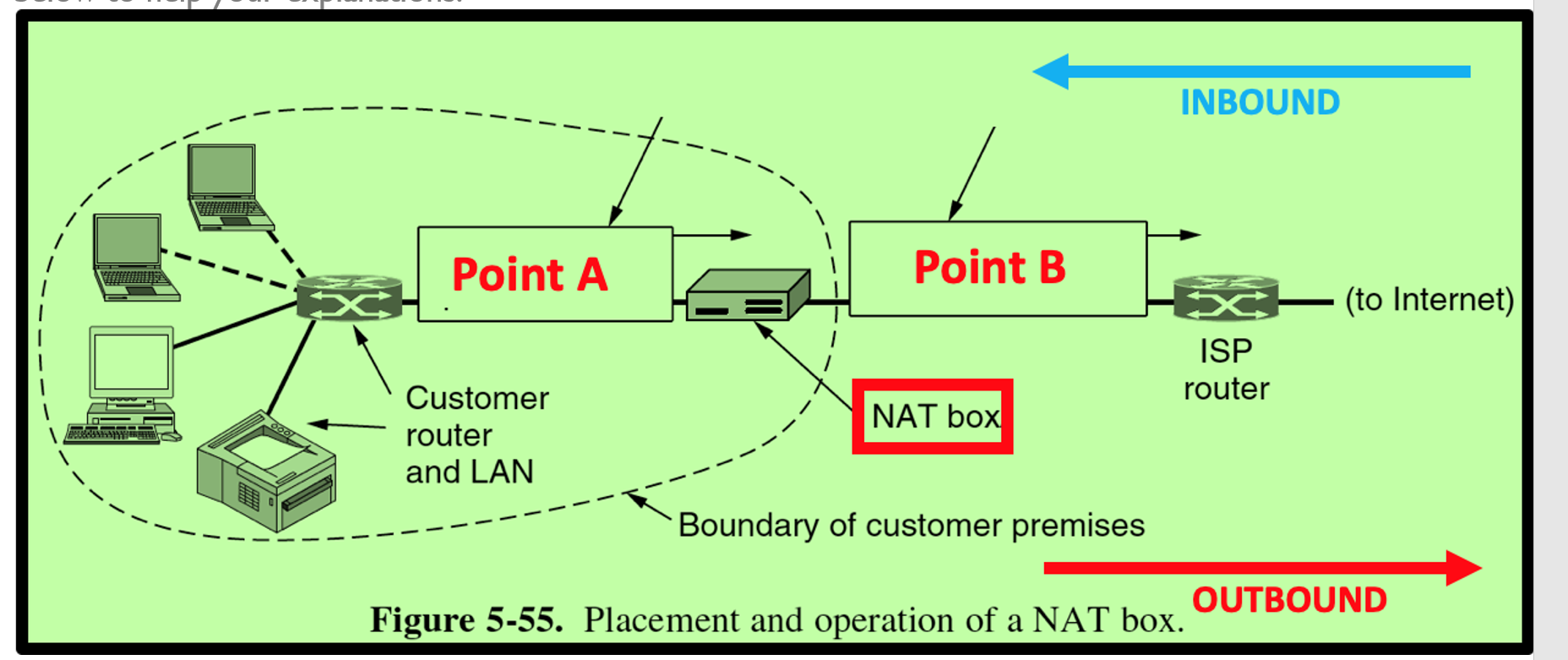
- INBOUND - --- Point A Point B X (to Internet) ------ ISP router NAT box es Customer router and LAN -- - -- -- Boundary of customer premises Figure 5-55. Placement and operation of a NAT box. by OUTBOUND
Step by Step Solution
There are 3 Steps involved in it

Get step-by-step solutions from verified subject matter experts
 Study Help