







Question: Only need d-g Consider the figure below. Suppose host A has a packet of size S = 1500B to send to host B at time
Only need d-g
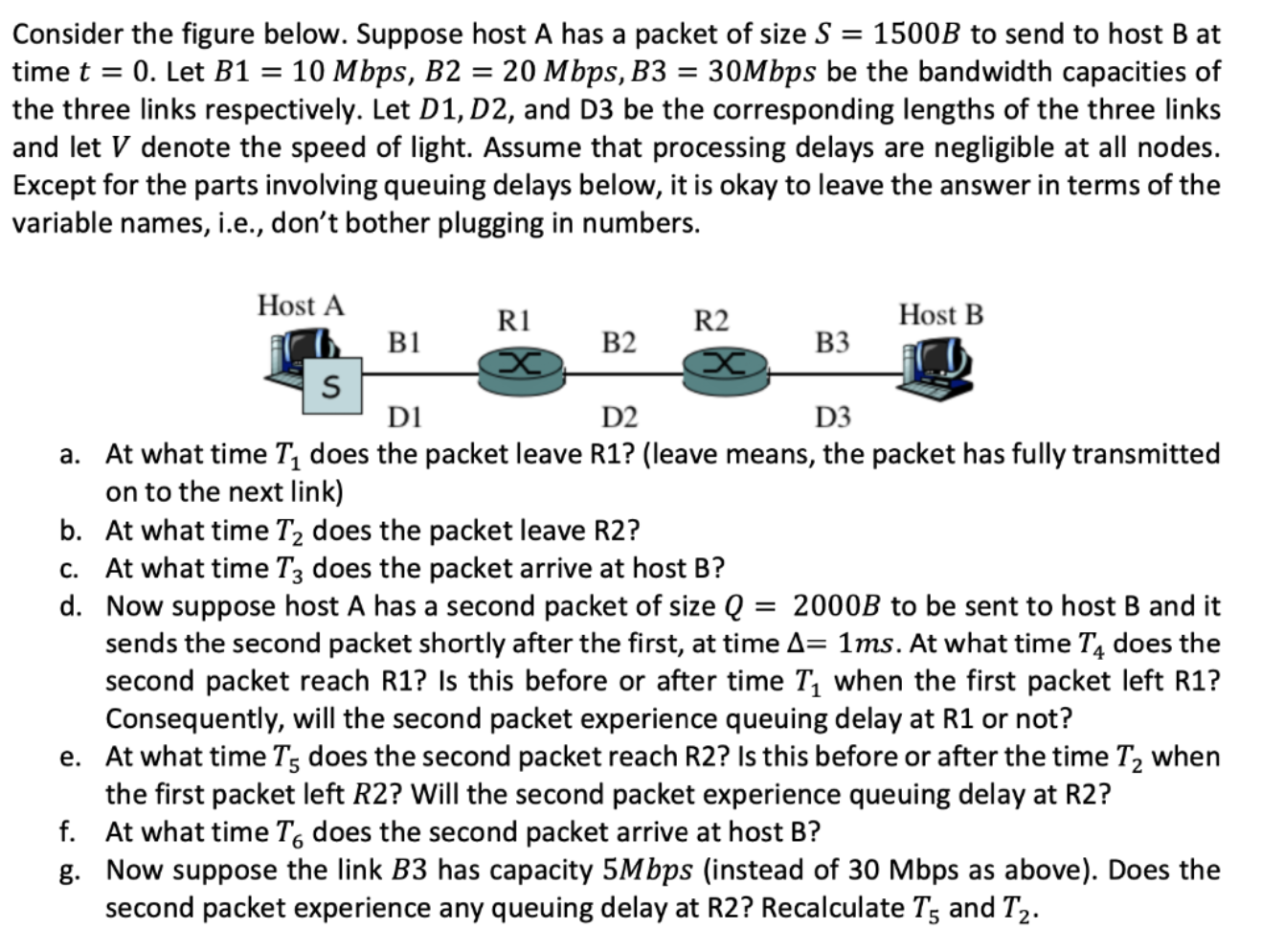
Consider the figure below. Suppose host A has a packet of size S = 1500B to send to host B at time t = 0. Let B1 = 10 Mbps, B2 = 20 Mbps, B3 = 30Mbps be the bandwidth capacities of the three links respectively. Let D1, D2, and D3 be the corresponding lengths of the three links and let V denote the speed of light. Assume that processing delays are negligible at all nodes. Except for the parts involving queuing delays below, it is okay to leave the answer in terms of the variable names, i.e., don't bother plugging in numbers. Host A Host B B2 R2 TO BIRI B3 D1 s D2 D3 a. At what time T, does the packet leave R1? (leave means, the packet has fully transmitted on to the next link) b. At what time T2 does the packet leave R2? C. At what time T3 does the packet arrive at host B? d. Now suppose host A has a second packet of size Q = 2000B to be sent to host B and it sends the second packet shortly after the first, at time A= 1ms. At what time T4 does the second packet reach R1? Is this before or after time T1 when the first packet left R1? Consequently, will the second packet experience queuing delay at R1 or not? e. At what time T, does the second packet reach R2? Is this before or after the time t, when the first packet left R2? Will the second packet experience queuing delay at R2? f. At what time to does the second packet arrive at host B? g. Now suppose the link B3 has capacity 5Mbps (instead of 30 Mbps as above). Does the second packet experience any queuing delay at R2? Recalculate Ts and Tz
Step by Step Solution
There are 3 Steps involved in it

Get step-by-step solutions from verified subject matter experts
 Study Help