







Question: Only need help with C) and D). i have provided the answers for A) and B) to reference in order to complete C) and D).
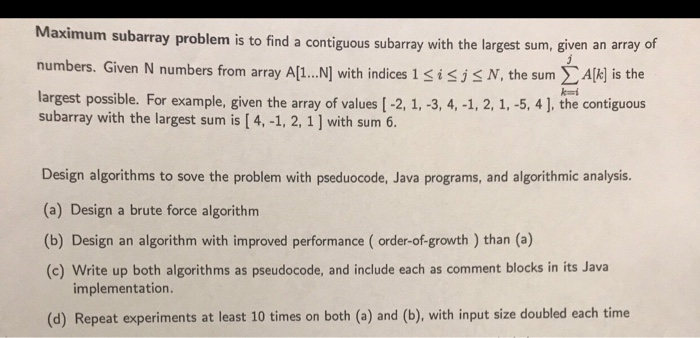
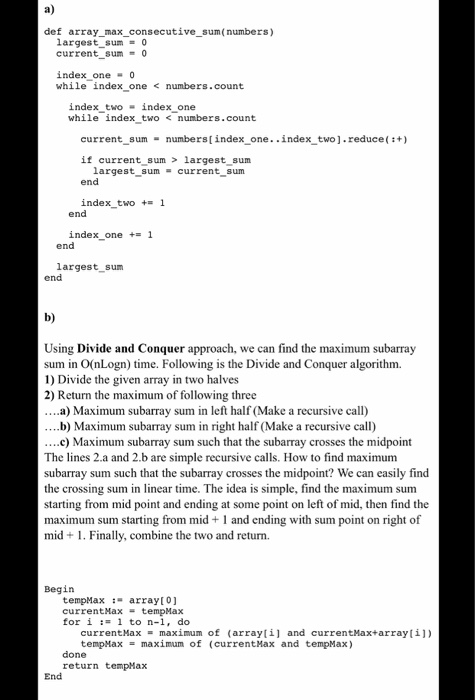
Maximum subarray problem is to find a contiguous subarray with the largest sum, given an array of mbers. Given N numbers from array A[1..N] with indices 1 s isjs N, the sum Alk] is the largest possible. For example, given the array of values [-2, 1, -3, 4, -1, 2, 1, -5, 4 ], the contiguous subarray with the largest sum is [ 4,-1, 2, 1 ] with sum 6. Design algorithms to sove the problem with pseduocode, Java programs, and algorithmic analysis (a) Design a brute force algorithm (b) Design an algorithm with improved performance ( order-of-growth ) than (a) (c) Write up both algorithms as pseudocode, and include each as comment blocks in its Java implementation. (d) Repeat experiments at least 10 times on both (a) and (b), with input size doubled each time a) def array max_consecutive sum(numbers) largest sum current sum = 0 index one0 while index_onenumbers.count index twoindex one while index two
Step by Step Solution
There are 3 Steps involved in it

Get step-by-step solutions from verified subject matter experts
 Study Help