







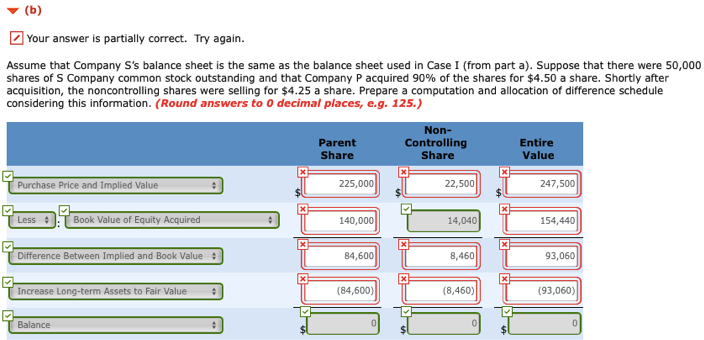
Question: **ONLY NEED HELP WITH PART B** Problem 3-1 The two following separate cases show the financial position of a parent company and its subsidiary company
**ONLY NEED HELP WITH PART B**
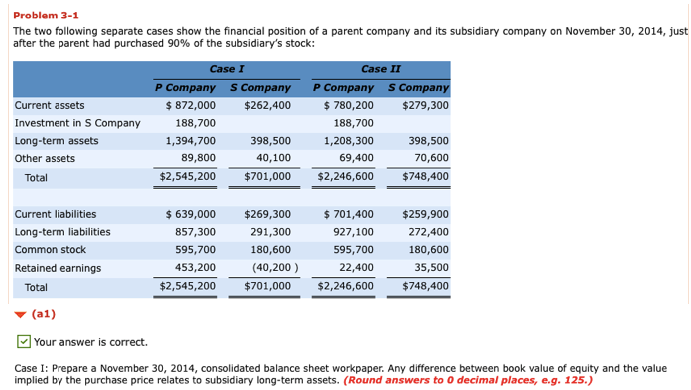
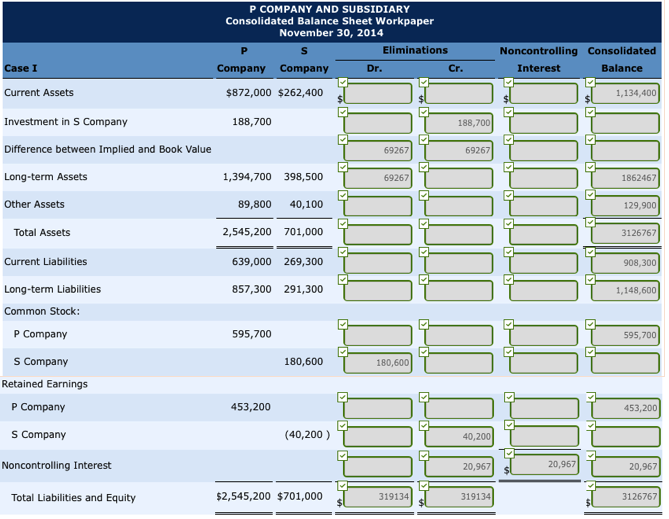
Problem 3-1 The two following separate cases show the financial position of a parent company and its subsidiary company on November 30, 2014, just after the parent had purchased 90% of the subsidiary's stock; se P Company $872,000 188,700 1,394,700 89,800 S CompanyP Company $780,200 188,700 1,208,300 69,400 S Company $279,300 Current assets Investment in S Company Long-term assets Other assets $262,400 398,500 70,600 $2,545,200 $701,000 $2,246,600 $748,400 398,500 40,100 Total Current liabilities Long-term liabilities Common stock Retained earnings $639,000 857,300 595,700 453,200 $2,545,200 701,400 $259,900 272,400 180,600 35,500 $748,400 $269,300 927,100 595,700 22,400 $701,000 $2,246,600 291,300 180,600 (40,200) Total (a1) Your answer is correct. Case I: Prepare a November 30, 2014, consolidated balance sheet workpaper. Any difference between book value of equity and the value implied by the purchase price relates to subsidiary long-term assets. (Round answers to 0 decimal places, e.g. 125.)
Step by Step Solution
There are 3 Steps involved in it

Get step-by-step solutions from verified subject matter experts
 Study Help