Question: ONLY NEED PART E PLEASE PART E ONLY PLEASE Problem (2600, aces of the way drink mi 10 legal - There were there without parte
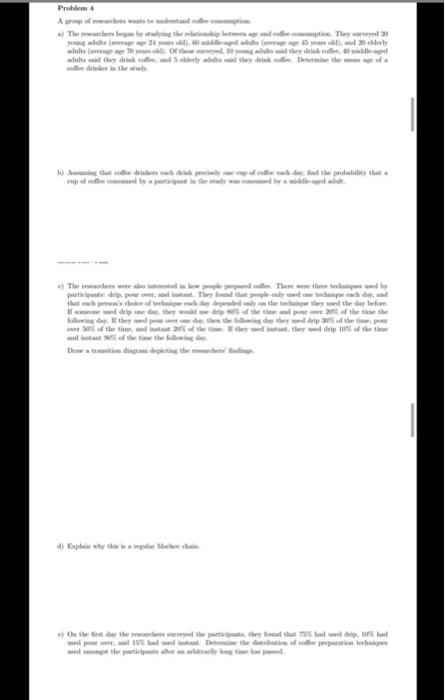
ONLY NEED PART E PLEASE
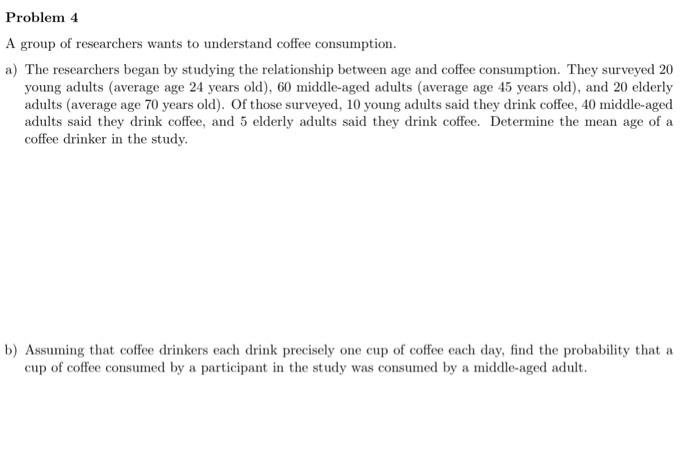
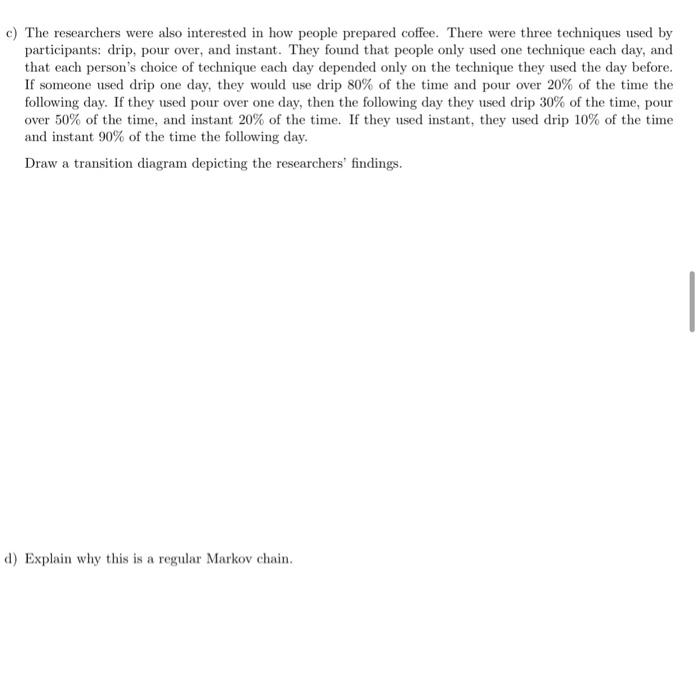
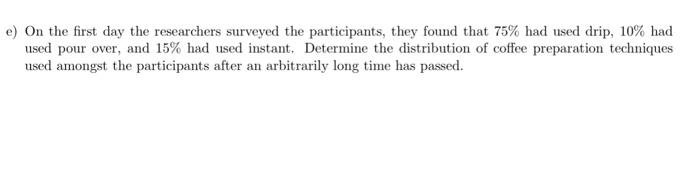
Problem (2600, aces of the way drink mi 10 legal - There were there without parte del per Thesaprope my een techniques, that meet the they were dependent of the find the death the part of the www.trip of the Dewan dating the Othey were that we drill Problem 4 A group of researchers wants to understand coffee consumption. a) The researchers began by studying the relationship between age and coffee consumption. They surveyed 20 young adults (average age 24 years old), 60 middle-aged adults (average age 45 years old), and 20 elderly adults (average age 70 years old). Of those surveyed, 10 young adults said they drink coffee, 40 middle-aged adults said they drink coffee, and 5 elderly adults said they drink coffee. Determine the mean age of a coffee drinker in the study. b) Assuming that coffee drinkers each drink precisely one cup of coffee each day, find the probability that a cup of coffee consumed by a participant in the study was consumed by a middle-aged adult. c) The researchers were also interested in how people prepared coffee. There were three techniques used by participants: drip, pour over, and instant. They found that people only used one technique each day, and that each person's choice of technique each day depended only on the technique they used the day before. If someone used drip one day, they would use drip 80% of the time and pour over 20% of the time the following day. If they used pour over one day, then the following day they used drip 30% of the time, pour over 50% of the time, and instant 20% of the time. If they used instant, they used drip 10% of the time and instant 90% of the time the following day. Draw a transition diagram depicting the researchers' findings. d) Explain why this is a regular Markov chain. e) On the first day the researchers surveyed the participants, they found that 75% had used drip, 10% had used pour over, and 15% had used instant. Determine the distribution of coffee preparation techniques used amongst the participants after an arbitrarily long time has passed. Problem (2600, aces of the way drink mi 10 legal - There were there without parte del per Thesaprope my een techniques, that meet the they were dependent of the find the death the part of the www.trip of the Dewan dating the Othey were that we drill Problem 4 A group of researchers wants to understand coffee consumption. a) The researchers began by studying the relationship between age and coffee consumption. They surveyed 20 young adults (average age 24 years old), 60 middle-aged adults (average age 45 years old), and 20 elderly adults (average age 70 years old). Of those surveyed, 10 young adults said they drink coffee, 40 middle-aged adults said they drink coffee, and 5 elderly adults said they drink coffee. Determine the mean age of a coffee drinker in the study. b) Assuming that coffee drinkers each drink precisely one cup of coffee each day, find the probability that a cup of coffee consumed by a participant in the study was consumed by a middle-aged adult. c) The researchers were also interested in how people prepared coffee. There were three techniques used by participants: drip, pour over, and instant. They found that people only used one technique each day, and that each person's choice of technique each day depended only on the technique they used the day before. If someone used drip one day, they would use drip 80% of the time and pour over 20% of the time the following day. If they used pour over one day, then the following day they used drip 30% of the time, pour over 50% of the time, and instant 20% of the time. If they used instant, they used drip 10% of the time and instant 90% of the time the following day. Draw a transition diagram depicting the researchers' findings. d) Explain why this is a regular Markov chain. e) On the first day the researchers surveyed the participants, they found that 75% had used drip, 10% had used pour over, and 15% had used instant. Determine the distribution of coffee preparation techniques used amongst the participants after an arbitrarily long time has passed









 Study Help