







Question: Only need to solve part(b) for this question. The answer for part(a) is 12.25 and 79.97, can be used directly. Problem 3 (a). (This is
Only need to solve part(b) for this question. The answer for part(a) is 12.25 and 79.97, can be used directly.
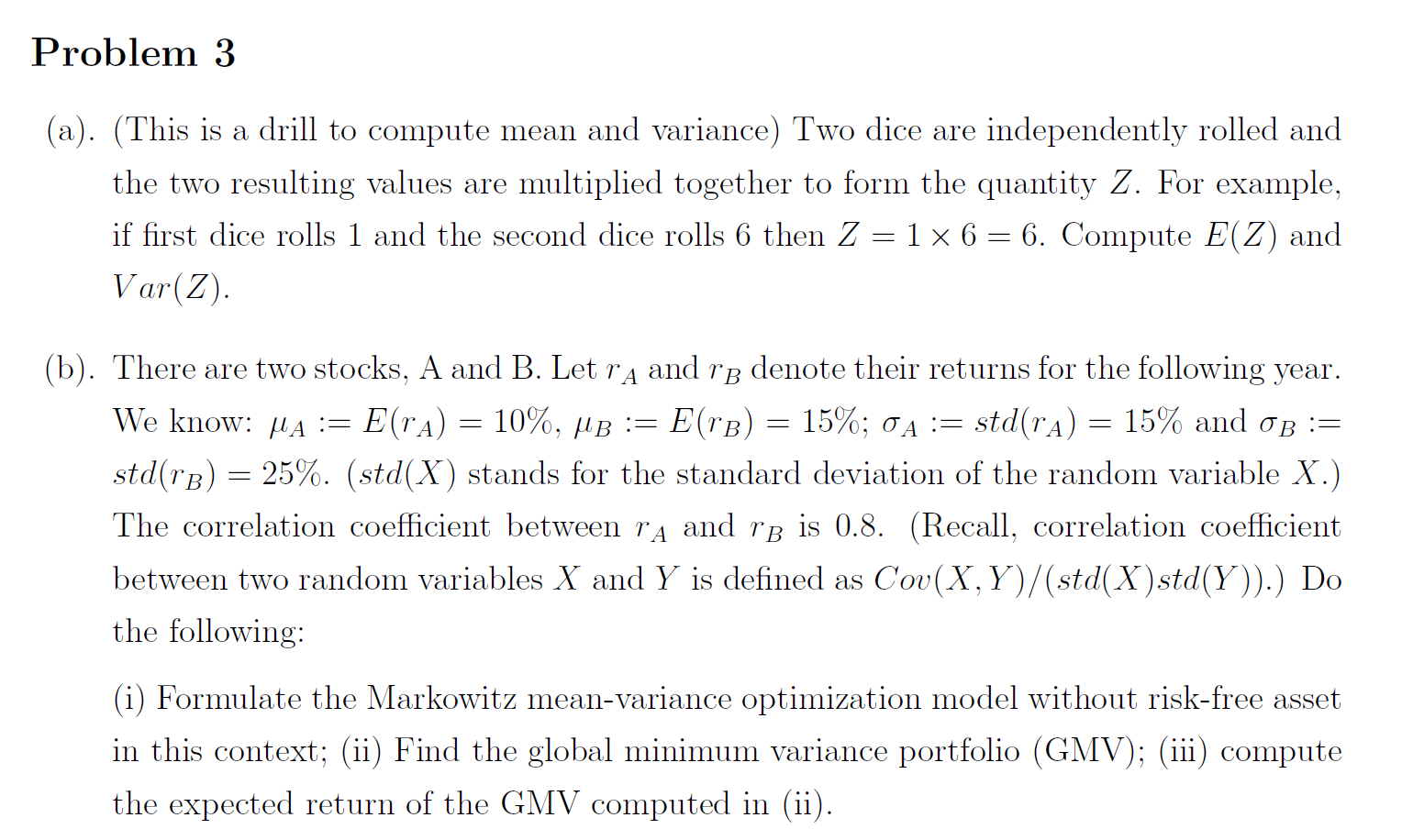
Problem 3 (a). (This is a drill to compute mean and variance) Two dice are independently rolled and the two resulting values are multiplied together to form the quantity Z. For example, if first dice rolls 1 and the second dice rolls 6 then Z = 1 x 6 = 6. Compute E(Z) and Var(Z). (b). There are two stocks, A and B. Let r A and ro denote their returns for the following year. We know: MA := E(ra) = 10%, MB := E(TB) = 15%; 0 A := std(rA) = 15% and ob := std(rb) = 25%. (std(X) stands for the standard deviation of the random variable X.) The correlation coefficient between ra and rb is 0.8. (Recall, correlation coefficient between two random variables X and Y is defined as Cov(X,Y)/(std(X)std(Y)).) Do the following: (i) Formulate the Markowitz mean-variance optimization model without risk-free asset in this context; (ii) Find the global minimum variance portfolio (GMV); (iii) compute the expected return of the GMV computed in (ii). Problem 3 (a). (This is a drill to compute mean and variance) Two dice are independently rolled and the two resulting values are multiplied together to form the quantity Z. For example, if first dice rolls 1 and the second dice rolls 6 then Z = 1 x 6 = 6. Compute E(Z) and Var(Z). (b). There are two stocks, A and B. Let r A and ro denote their returns for the following year. We know: MA := E(ra) = 10%, MB := E(TB) = 15%; 0 A := std(rA) = 15% and ob := std(rb) = 25%. (std(X) stands for the standard deviation of the random variable X.) The correlation coefficient between ra and rb is 0.8. (Recall, correlation coefficient between two random variables X and Y is defined as Cov(X,Y)/(std(X)std(Y)).) Do the following: (i) Formulate the Markowitz mean-variance optimization model without risk-free asset in this context; (ii) Find the global minimum variance portfolio (GMV); (iii) compute the expected return of the GMV computed in (ii)
Step by Step Solution
There are 3 Steps involved in it

Get step-by-step solutions from verified subject matter experts
 Study Help