







Question: Only need to solve question (c) In this exercise we consider the properties of the OLS estimator in the AR(1) model yt=yti+t in some more
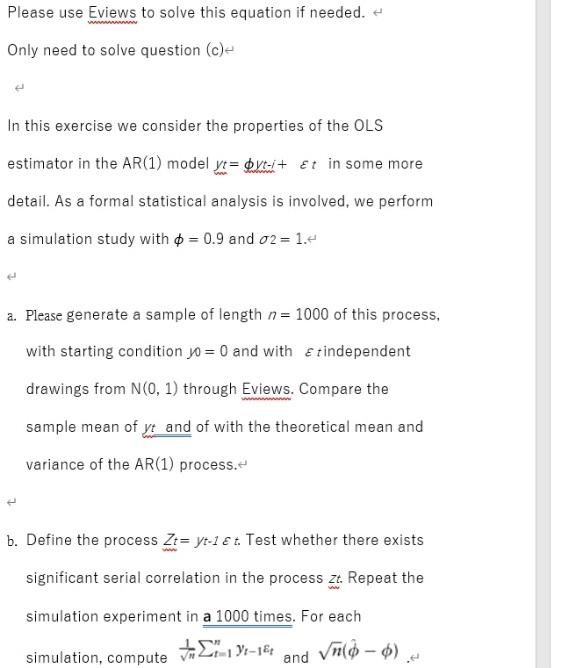
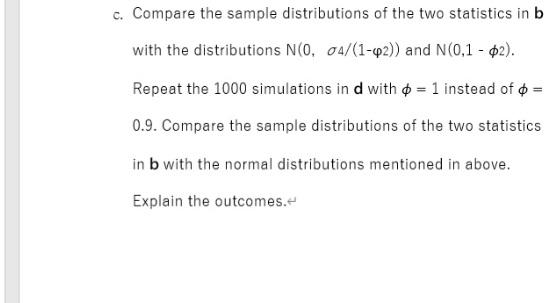
Only need to solve question (c) In this exercise we consider the properties of the OLS estimator in the AR(1) model yt=yti+t in some more detail. As a formal statistical analysis is involved, we perform a simulation study with =0.9 and 2=1. a. Please generate a sample of length n=1000 of this process, with starting condition y0=0 and with tindependent drawings from N(0,1) through Eviews. Compare the sample mean of yt and of with the theoretical mean and variance of the AR(1) process. b. Define the process Zt=yt1t. Test whether there exists significant serial correlation in the process z t. Repeat the simulation experiment in a 1000 times. For each simulation, compute n1t=1nyt1t and n(~) c. Compare the sample distributions of the two statistics in b with the distributions N(0,4/(12)) and N(0,12). Repeat the 1000 simulations in d with =1 instead of = 0.9. Compare the sample distributions of the two statistics in b with the normal distributions mentioned in above. Explain the outcomes. Only need to solve question (c) In this exercise we consider the properties of the OLS estimator in the AR(1) model yt=yti+t in some more detail. As a formal statistical analysis is involved, we perform a simulation study with =0.9 and 2=1. a. Please generate a sample of length n=1000 of this process, with starting condition y0=0 and with tindependent drawings from N(0,1) through Eviews. Compare the sample mean of yt and of with the theoretical mean and variance of the AR(1) process. b. Define the process Zt=yt1t. Test whether there exists significant serial correlation in the process z t. Repeat the simulation experiment in a 1000 times. For each simulation, compute n1t=1nyt1t and n(~) c. Compare the sample distributions of the two statistics in b with the distributions N(0,4/(12)) and N(0,12). Repeat the 1000 simulations in d with =1 instead of = 0.9. Compare the sample distributions of the two statistics in b with the normal distributions mentioned in above. Explain the outcomes
Step by Step Solution
There are 3 Steps involved in it

Get step-by-step solutions from verified subject matter experts
 Study Help