







Question: ONLY PARTS D,E,F,G 1. (100 points) Consider a utility function given by u(ct)=ln(ct)+ln(ct+1) where =1+1 and the constraints are given by yt=ct+st yt+1+(1+r)st=ct+1 (a) (10
ONLY PARTS D,E,F,G
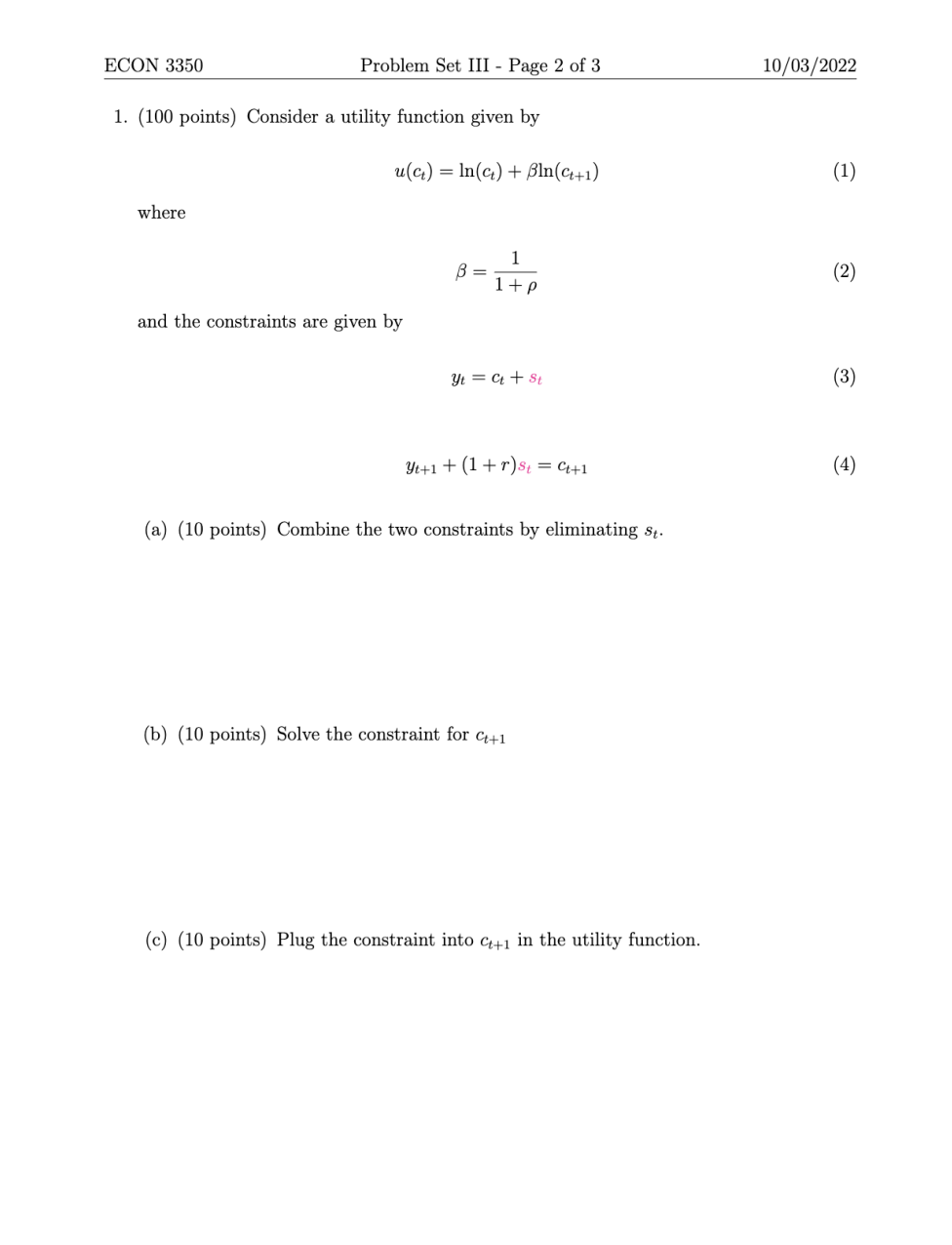
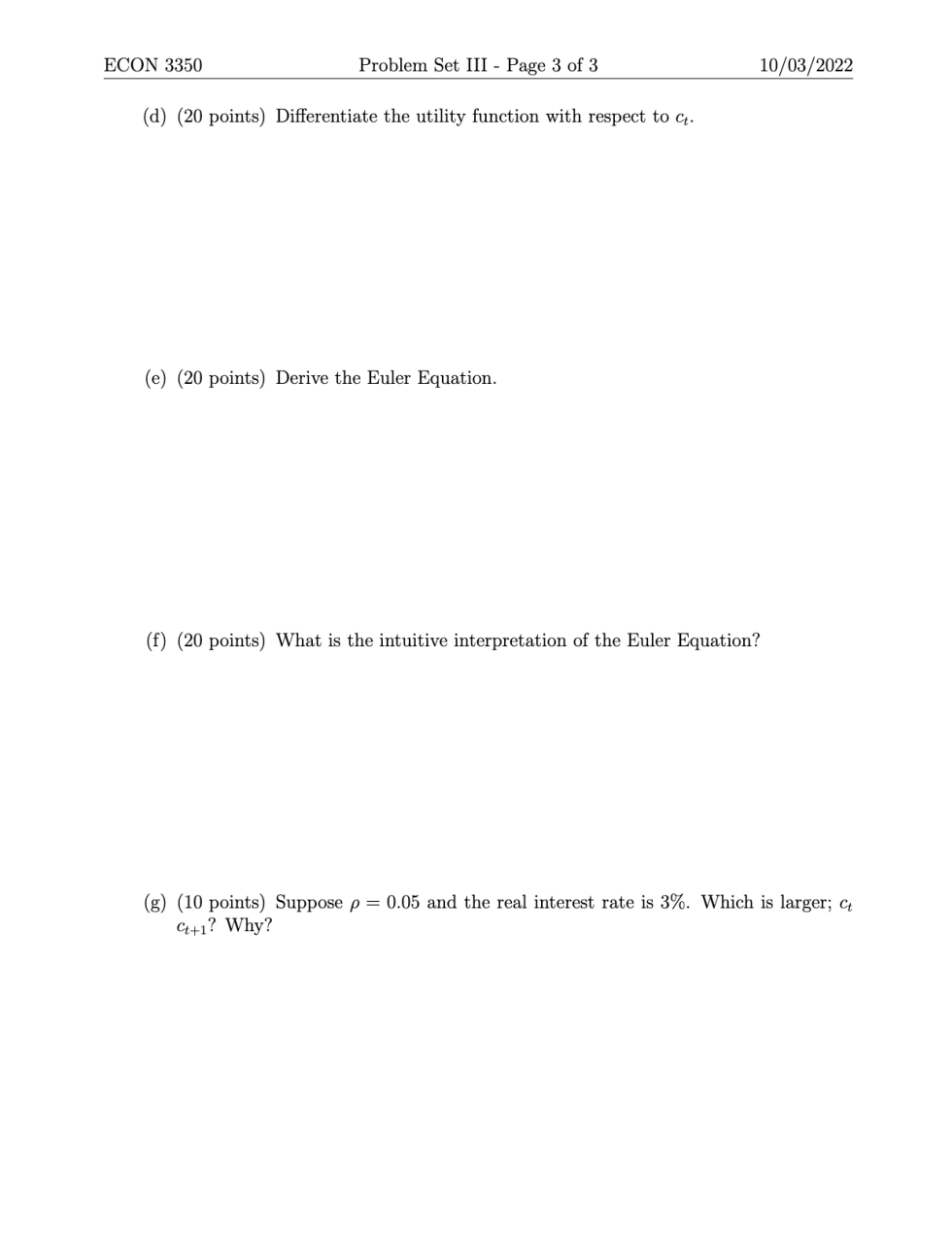
1. (100 points) Consider a utility function given by u(ct)=ln(ct)+ln(ct+1) where =1+1 and the constraints are given by yt=ct+st yt+1+(1+r)st=ct+1 (a) (10 points) Combine the two constraints by eliminating st. (b) (10 points) Solve the constraint for ct+1 (c) (10 points) Plug the constraint into ct+1 in the utility function. (d) (20 points) Differentiate the utility function with respect to ct. (e) (20 points) Derive the Euler Equation. (f) (20 points) What is the intuitive interpretation of the Euler Equation? (g) (10 points) Suppose =0.05 and the real interest rate is 3%. Which is larger; ct ct+1 ? Why? 1. (100 points) Consider a utility function given by u(ct)=ln(ct)+ln(ct+1) where =1+1 and the constraints are given by yt=ct+st yt+1+(1+r)st=ct+1 (a) (10 points) Combine the two constraints by eliminating st. (b) (10 points) Solve the constraint for ct+1 (c) (10 points) Plug the constraint into ct+1 in the utility function. (d) (20 points) Differentiate the utility function with respect to ct. (e) (20 points) Derive the Euler Equation. (f) (20 points) What is the intuitive interpretation of the Euler Equation? (g) (10 points) Suppose =0.05 and the real interest rate is 3%. Which is larger; ct ct+1 ? Why
Step by Step Solution
There are 3 Steps involved in it

Get step-by-step solutions from verified subject matter experts
 Study Help