Question: only, Q b and C Question 6: (20 marks) A renovation company plans to expand its operations in the Great Bay Area. Demand for home
 only, Q b and C
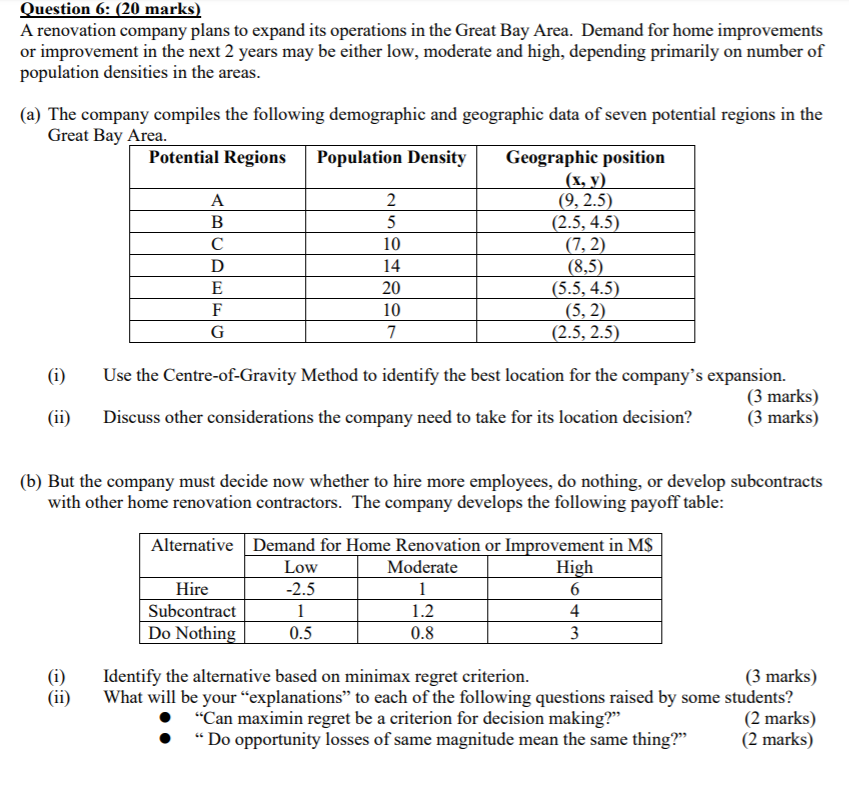
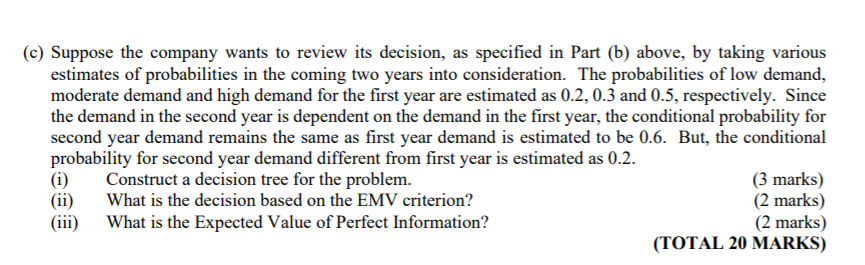
Question 6: (20 marks) A renovation company plans to expand its operations in the Great Bay Area. Demand for home improvements or improvement in the next 2 years may be either low, moderate and high, depending primarily on number of population densities in the areas. (a) The company compiles the following demographic and geographic data of seven potential regions in the Great Bay Area. Potential Regions Population Density Geographic position (x, y) A 2 (9, 2.5) B 5 (2.5, 4.5) 10 (1,2) D 14 (8,5) E 20 (5.5, 4.5) F 10 (5,2) G 7 (2.5, 2.5) (i) Use the Centre-of-Gravity Method to identify the best location for the company's expansion. (3 marks) Discuss other considerations the company need to take for its location decision? (3 marks) (ii) (b) But the company must decide now whether to hire more employees, do nothing, or develop subcontracts with other home renovation contractors. The company develops the following payoff table: Alternative Demand for Home Renovation or Improvement in M$ Low Moderate High Hire -2.5 1 6 Subcontract 1 1.2 4 Do Nothing 0.5 0.8 3 (i) (ii) Identify the alternative based on minimax regret criterion. (3 marks) What will be your "explanations to each of the following questions raised by some students? Can maximin regret be a criterion for decision making? (2 marks) Do opportunity losses of same magnitude mean the same thing?" (2 marks) (C) Suppose the company wants to review its decision, as specified in Part (6) above, by taking various estimates of probabilities in the coming two years into consideration. The probabilities of low demand, moderate demand and high demand for the first year are estimated as 0.2, 0.3 and 0.5, respectively. Since the demand in the second year is dependent on the demand in the first year, the conditional probability for second year demand remains the same as first year demand is estimated to be 0.6. But, the conditional probability for second year demand different from first year is estimated as 0.2. (i) Construct a decision tree for the problem. (3 marks) What is the decision based on the EMV criterion? (2 marks) (iii) What is the Expected Value of Perfect Information? (2 marks) (TOTAL 20 MARKS)









 Study Help