







Question: ONLY QUESTION 2 only do question 2 if you want to do everything that will be appreciated Au Naturel Incorporated is feeling growing pains. After
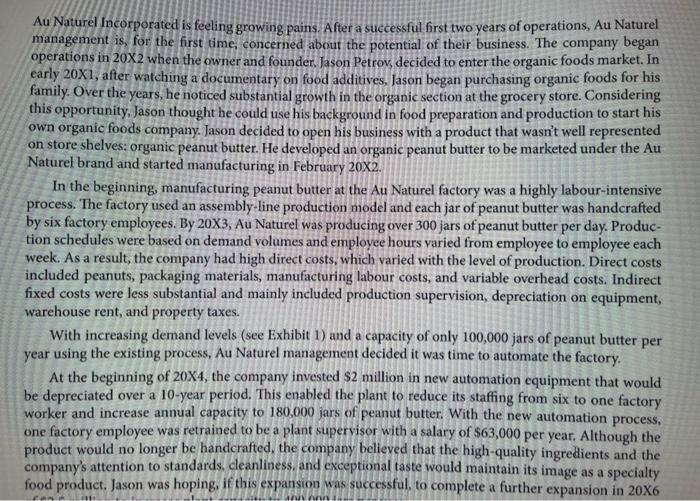
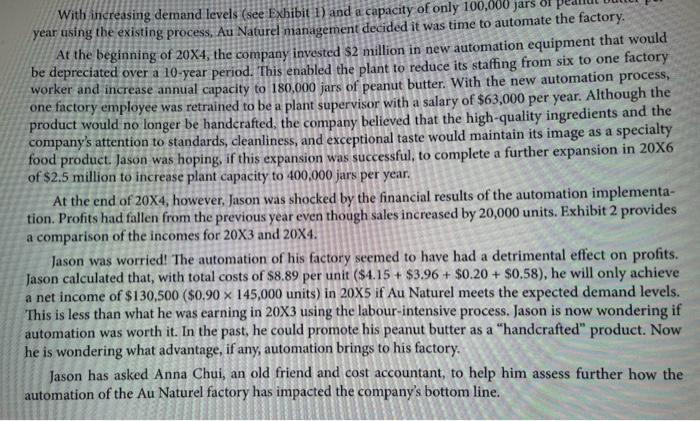

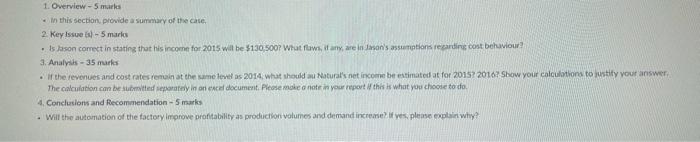
Au Naturel Incorporated is feeling growing pains. After a successful first two years of operations, Au Naturel management is, for the first time, concerned about the potential of their business. The company began operations in 20X2 when the owner and founder. Jason Petrov, decided to enter the organic foods market. In early 20X1, after watching a documentary on food additives, Jason began purchasing organic foods for his family. Over the years, he noticed substantial growth in the organic section at the grocery store. Considering this opportunity, Jason thought he could use his background in food preparation and production to start his own organic foods company. Jason decided to open his business with a product that wasn't well represented on store shelves: organic peanut butter. He developed an organic peanut butter to be marketed under the Au Naturel brand and started manufacturing in February 20X2. In the beginning, manufacturing peanut butter at the Au Naturel factory was a highly labour-intensive process. The factory used an assembly-line production model and each jar of peanut butter was handcrafted by six factory employees. By 20X3, Au Naturel was producing over 300 jars of peanut butter per day. Production schedules were based on demand volumes and employee hours varied from employee to employee each week. As a result, the company had high direct costs, which varied with the level of production. Direct costs included peanuts, packaging materials, manufacturing labour costs, and variable overhead costs. Indirect fixed costs were less substantial and mainly included production supervision, depreciation on equipment, warehouse rent, and property taxes. With increasing demand levels (see Exhibit 1) and a capacity of only 100,000 jars of peanut butter per year using the existing process, Au Naturel management decided it was time to automate the factory. At the beginning of 20X4, the company invested \$2 million in new automation equipment that would be depreciated over a 10-year period. This enabled the plant to reduce its staffing from six to one factory worker and increase annual capacity to 180,000 jars of peanut butter. With the new automation process, one factory employee was retrained to be a plant supervisor with a salary of $63,000 per year. Although the product would no longer be handcrafted, the company believed that the high-quality ingredients and the company's attention to standards, cleanliness, and exceptional taste would maintain its image as a specialty food product. Jason was hoping, if this expansion was successful, to complete a further expansion in 20X6 With increasing demand levels (see Exhibit 1) and a capacity ol ony roo,ovo factory. year using the existing process, Au Naturel management decided it was time to automate the factory. At the beginning of 20X4, the company invested $2 million in new automation equipment that would be depreciated over a 10-year period. This enabled the plant to reduce its staffing from six to one factory worker and increase annual capacity to 180,000 jars of peanut butter. With the new automation process, one factory employee was retrained to be a plant supervisor with a salary of $63,000 per year. Although the company's attention to standards, cleanliness, and exceptional taste would maintain its image as a specialty food product. Jason was hoping, if this expansion was successful, to complete a further expansion in 206 of $2.5 million to increase plant capacity to 400,000 jars per year. At the end of 20X4, however, Jason was shocked by the financial results of the automation implementation. Profits had fallen from the previous year even though sales increased by 20,000 units. Exhibit 2 provides a comparison of the incomes for 20X3 and 20X4. Jason was worried! The automation of his factory seemed to have had a detrimental effect on profits. Jason calculated that, with total costs of $8.89 per unit ($4.15+$3.96+$0.20+$0.58), he will only achieve a net income of $130,500($0.90145,000 units) in 20X5 if Au Naturel meets the expected demand levels. This is less than what he was earning in 20X3 using the labour-intensive process. Jason is now wondering if automation was worth it. In the past, he could promote his peanut butter as a "handcrafted" product. Now he is wondering what advantage, if any, automation brings to his factory. Jason has asked Anna Chui, an old friend and cost accountant, to help him assess further how the automation of the Au Naturel factory has impacted the company's bottom line. 2. Key issue (s) - 5 marks 3. Analysis - 35 marks 1. Overview 5 maeks - In this section, provide a summary of the case. 2. Ker fsuve (i) 5 marlos 3. Analrits =35 maeks 4. Conclurions and foecommendation 5 marks - Wil the audomation of the factory improve profifabilfy as poodictoon volurnes ard demand increase? if ves, please emplairt why
Step by Step Solution
There are 3 Steps involved in it

Get step-by-step solutions from verified subject matter experts
 Study Help