







Question: only using matlab solve questions 5,6 and 7 92 1 9|xi 3-6 13 2 11 2 3 35 1 0 2 8 4 9 2
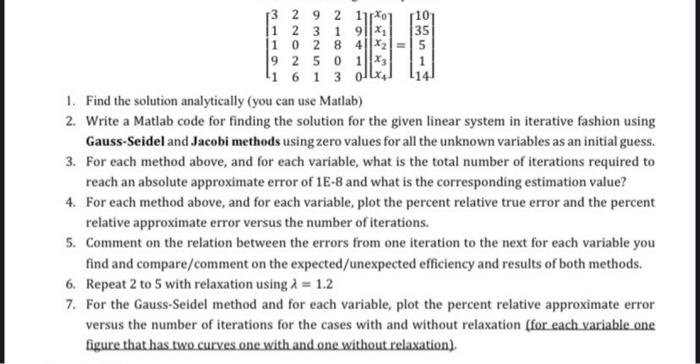
92 1 9|xi 3-6 13 2 11 2 3 35 1 0 2 8 4 9 2 5 0 1||*3 li 6 1 3 01 1. Find the solution analytically (you can use Matlab) 2. Write a Matlab code for finding the solution for the given linear system in iterative fashion using Gauss-Seidel and Jacobi methods using zero values for all the unknown variables as an initial guess. 3. For each method above, and for each variable, what is the total number of iterations required to reach an absolute approximate error of 1E-8 and what is the corresponding estimation value? 4. For each method above, and for each variable, plot the percent relative true error and the percent relative approximate error versus the number of iterations. 5. Comment on the relation between the errors from one iteration to the next for each variable you find and compare/comment on the expected/unexpected efficiency and results of both methods. 6. Repeat 2 to 5 with relaxation using 2 = 1.2 7. For the Gauss-Seidel method and for each variable, plot the percent relative approximate error versus the number of iterations for the cases with and without relaxation (for each variable one figure that has two curves one with and one without relaxation). 92 1 9|xi 3-6 13 2 11 2 3 35 1 0 2 8 4 9 2 5 0 1||*3 li 6 1 3 01 1. Find the solution analytically (you can use Matlab) 2. Write a Matlab code for finding the solution for the given linear system in iterative fashion using Gauss-Seidel and Jacobi methods using zero values for all the unknown variables as an initial guess. 3. For each method above, and for each variable, what is the total number of iterations required to reach an absolute approximate error of 1E-8 and what is the corresponding estimation value? 4. For each method above, and for each variable, plot the percent relative true error and the percent relative approximate error versus the number of iterations. 5. Comment on the relation between the errors from one iteration to the next for each variable you find and compare/comment on the expected/unexpected efficiency and results of both methods. 6. Repeat 2 to 5 with relaxation using 2 = 1.2 7. For the Gauss-Seidel method and for each variable, plot the percent relative approximate error versus the number of iterations for the cases with and without relaxation (for each variable one figure that has two curves one with and one without relaxation)
Step by Step Solution
There are 3 Steps involved in it

Get step-by-step solutions from verified subject matter experts
 Study Help