







Question: ***ONLY WPE in ONE JOURNAL ENTRY FORMAT *** No need for consolidated worksheet*** excel 32. Father, Inc., buys 80 percent of the outstanding common stock
***ONLY WPE in ONE JOURNAL ENTRY FORMAT *** No need for consolidated worksheet***
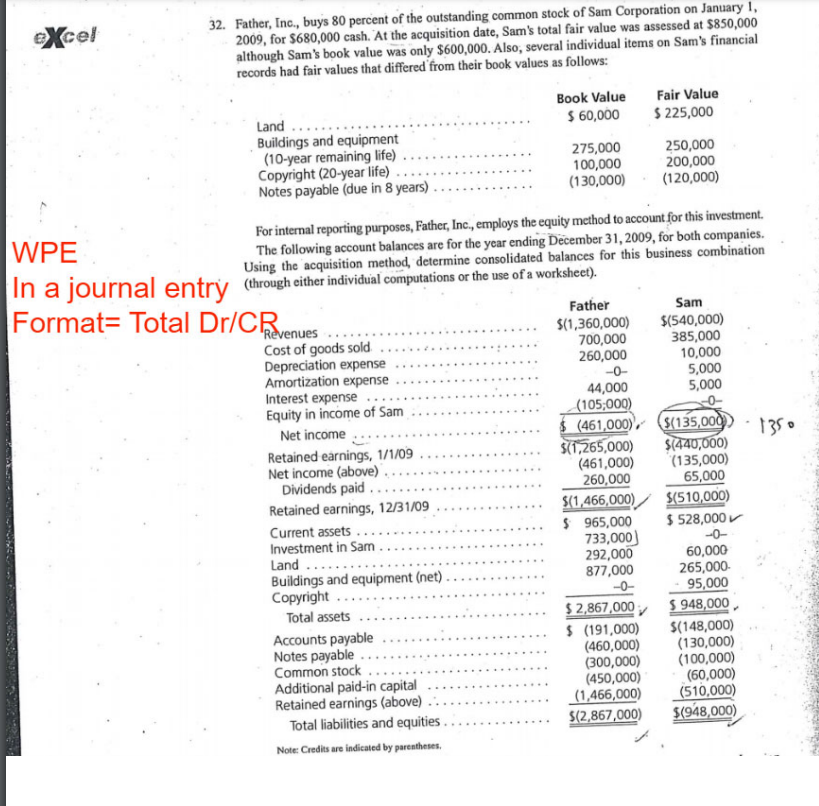
excel 32. Father, Inc., buys 80 percent of the outstanding common stock of Sam Corporation on January 1, 2009, for $680,000 cash. At the acquisition date, Sam's total fair value was assessed at $850,000 although Sam's book value was only $600,000. Also, several individual items on Sam's financial records had fair values that differed from their book values as follows: Book Value $ 60,000 Fair Value $ 225,000 Land Buildings and equipment (10-year remaining life) Copyright (20-year life) Notes payable (due in 8 years) 275,000 100,000 (130,000) 250,000 200,000 (120,000) WPE In a journal entry (through either individual computations or the use of a worksheet)." For internal reporting purposes, Father, Inc., employs the equity method to account for this investment. The following account balances are for the year ending December 31, 2009, for both companies. Using the acquisition method, determine consolidated balances for this business combination Format= Total Dr/C Revenues.... Sam $(540,000) 385,000 10,000 5,000 5,000 1350 Father $(1,360,000) 700,000 260,000 -0- 44,000 (105,000) $ (461,000) $(1,265,000) (461,000) 260,000 $(1,466,000) $ 965,000 733,000) 292,000 877,000 -0- $ 2,867,000 $(191,000) (460,000) (300,000) (450,000) (1,466,000) $(2,867,000) " Cost of goods sold Depreciation expense Amortization expense Interest expense Equity in income of Sam Net income Retained earnings, 1/1/09 Net income (above) Dividends paid Retained earnings, 12/31/09 Current assets ... Investment in Sam.. Land .... Buildings and equipment (net) Copyright Total assets Accounts payable Notes payable Common stock Additional paid-in capital Retained earnings (above) Total liabilities and equities. Note: Credits are indicated by parentheses, ($(135,000 $(440,000) (135,000) 65,000 $(510,000) $ 528,000 60,000 265,000 95,000 $948,000 $(148,000) (130,000) (100,000) (60,000) (510,000) $(948,000) excel 32. Father, Inc., buys 80 percent of the outstanding common stock of Sam Corporation on January 1, 2009, for $680,000 cash. At the acquisition date, Sam's total fair value was assessed at $850,000 although Sam's book value was only $600,000. Also, several individual items on Sam's financial records had fair values that differed from their book values as follows: Book Value $ 60,000 Fair Value $ 225,000 Land Buildings and equipment (10-year remaining life) Copyright (20-year life) Notes payable (due in 8 years) 275,000 100,000 (130,000) 250,000 200,000 (120,000) WPE In a journal entry (through either individual computations or the use of a worksheet)." For internal reporting purposes, Father, Inc., employs the equity method to account for this investment. The following account balances are for the year ending December 31, 2009, for both companies. Using the acquisition method, determine consolidated balances for this business combination Format= Total Dr/C Revenues.... Sam $(540,000) 385,000 10,000 5,000 5,000 1350 Father $(1,360,000) 700,000 260,000 -0- 44,000 (105,000) $ (461,000) $(1,265,000) (461,000) 260,000 $(1,466,000) $ 965,000 733,000) 292,000 877,000 -0- $ 2,867,000 $(191,000) (460,000) (300,000) (450,000) (1,466,000) $(2,867,000) " Cost of goods sold Depreciation expense Amortization expense Interest expense Equity in income of Sam Net income Retained earnings, 1/1/09 Net income (above) Dividends paid Retained earnings, 12/31/09 Current assets ... Investment in Sam.. Land .... Buildings and equipment (net) Copyright Total assets Accounts payable Notes payable Common stock Additional paid-in capital Retained earnings (above) Total liabilities and equities. Note: Credits are indicated by parentheses, ($(135,000 $(440,000) (135,000) 65,000 $(510,000) $ 528,000 60,000 265,000 95,000 $948,000 $(148,000) (130,000) (100,000) (60,000) (510,000) $(948,000)
Step by Step Solution
There are 3 Steps involved in it

Get step-by-step solutions from verified subject matter experts
 Study Help