







Question: Onlyneed 2-G on the second page TOPICS 1 UNIT 2a Thermite Reaction 1. The reaction looks like: Al(s) +Fe2O3(s) _Al2O3(s) + Fe(s) A. Balance the
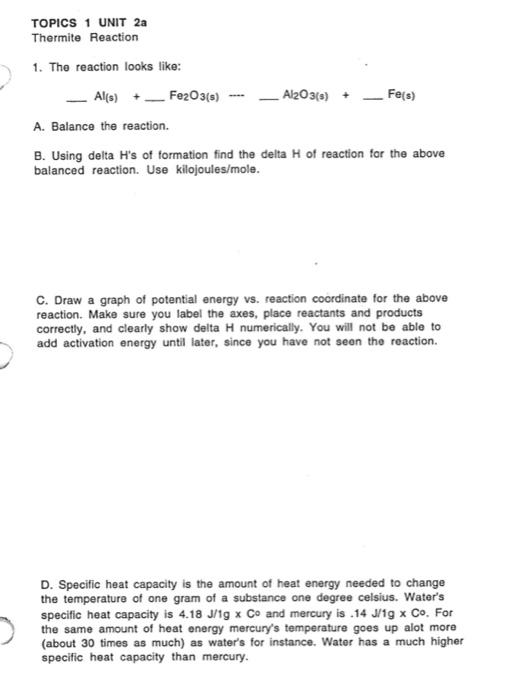
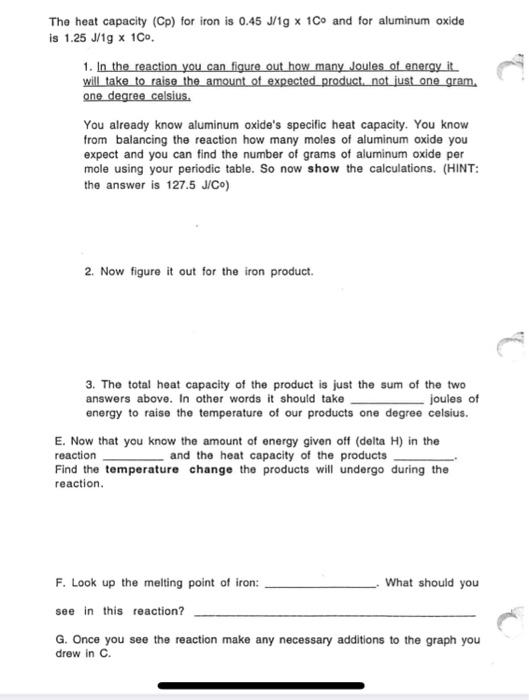
TOPICS 1 UNIT 2a Thermite Reaction 1. The reaction looks like: Al(s) +Fe2O3(s) _Al2O3(s) + Fe(s) A. Balance the reaction. B. Using delta H's of formation find the delta H of reaction for the above balanced reaction. Use kilojoules/mole. C. Draw a graph of potential energy vs. reaction coordinate for the above reaction. Make sure you label the axes, place reactants and products correctly, and clearly show delta H numerically. You will not be able to add activation energy until later, since you have not seen the reaction. D. Specific heat capacity is the amount of heat energy needed to change the temperature of one gram of a substance one degree celsius. Water's specific heat capacity is 4.18 J/g * Co and mercury is .14 J/19 x Co. For the same amount of heat energy mercury's temperature goes up alot more (about 30 times as much) as water's for instance. Water has a much higher specific heat capacity than mercury. The heat capacity (Cp) for iron is 0.45 J/1g 1Co and for aluminum oxide is 1.25 J/19 x 100. 1. In the reaction you can figure out how many Joules of energy it will take to raise the amount of expected product not just one gram. one degree celsius. You already know aluminum oxide's specific heat capacity. You know from balancing the reaction how many moles of aluminum oxide you expect and you can find the number of grams of aluminum oxide per mole using your periodic table. So now show the calculations. (HINT: the answer is 127.5 J/C) 2. Now figure it out for the iron product. 3. The total heat capacity of the product is just the sum of the two answers above. In other words it should take joules of energy to raise the temperature of our products one degree celsius. E. Now that you know the amount of energy given oft (delta H) in the reaction and the heat capacity of the products Find the temperature change the products will undergo during the reaction F. Look up the melting point of iron: What should you see in this reaction? G. Once you see the reaction make any necessary additions to the graph you drew in C. TOPICS 1 UNIT 2a Thermite Reaction 1. The reaction looks like: Al(s) +Fe2O3(s) _Al2O3(s) + Fe(s) A. Balance the reaction. B. Using delta H's of formation find the delta H of reaction for the above balanced reaction. Use kilojoules/mole. C. Draw a graph of potential energy vs. reaction coordinate for the above reaction. Make sure you label the axes, place reactants and products correctly, and clearly show delta H numerically. You will not be able to add activation energy until later, since you have not seen the reaction. D. Specific heat capacity is the amount of heat energy needed to change the temperature of one gram of a substance one degree celsius. Water's specific heat capacity is 4.18 J/g * Co and mercury is .14 J/19 x Co. For the same amount of heat energy mercury's temperature goes up alot more (about 30 times as much) as water's for instance. Water has a much higher specific heat capacity than mercury. The heat capacity (Cp) for iron is 0.45 J/1g 1Co and for aluminum oxide is 1.25 J/19 x 100. 1. In the reaction you can figure out how many Joules of energy it will take to raise the amount of expected product not just one gram. one degree celsius. You already know aluminum oxide's specific heat capacity. You know from balancing the reaction how many moles of aluminum oxide you expect and you can find the number of grams of aluminum oxide per mole using your periodic table. So now show the calculations. (HINT: the answer is 127.5 J/C) 2. Now figure it out for the iron product. 3. The total heat capacity of the product is just the sum of the two answers above. In other words it should take joules of energy to raise the temperature of our products one degree celsius. E. Now that you know the amount of energy given oft (delta H) in the reaction and the heat capacity of the products Find the temperature change the products will undergo during the reaction F. Look up the melting point of iron: What should you see in this reaction? G. Once you see the reaction make any necessary additions to the graph you drew in C
Step by Step Solution
There are 3 Steps involved in it

Get step-by-step solutions from verified subject matter experts
 Study Help