







Question: onsider the following JFlex specification: c { System.out.printf(1) ac +b * System.out.printf(2) cc System.out.printf(3); } ab System.out.printf(4) a { System.out.printf(5); } acb+{ System.out.printf(6) Which rules
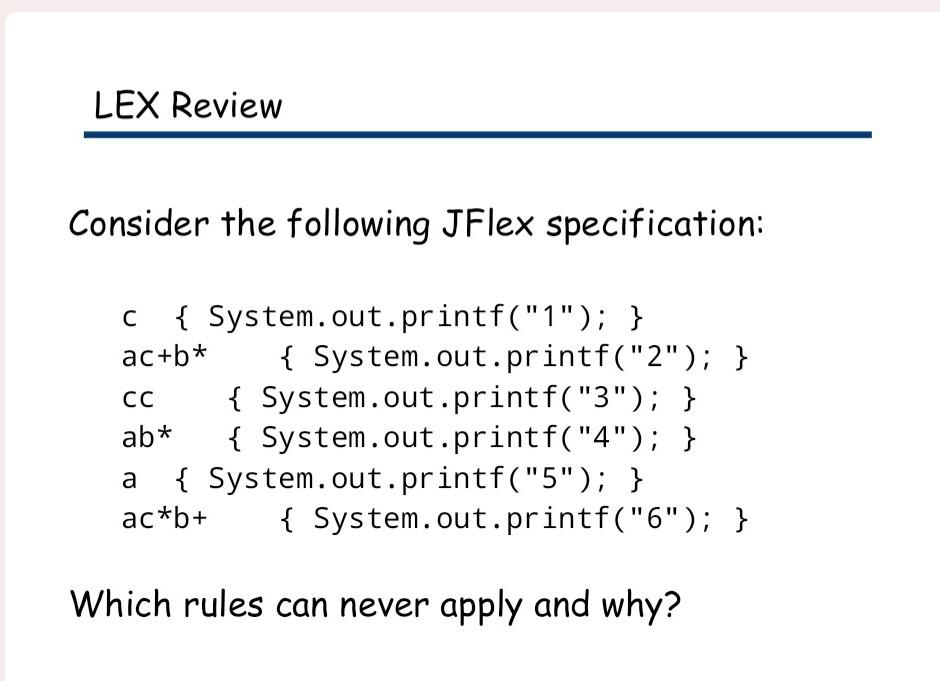
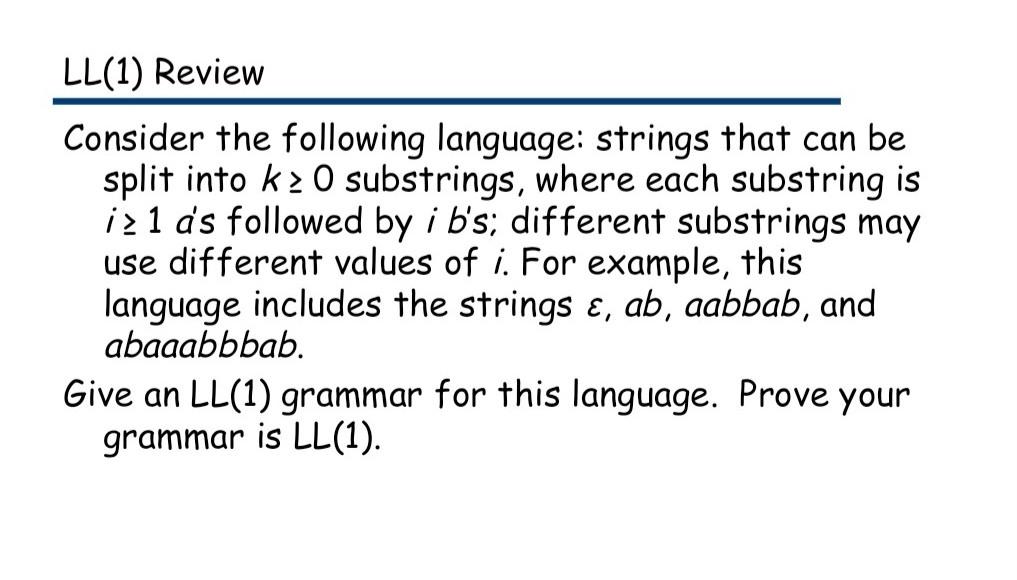
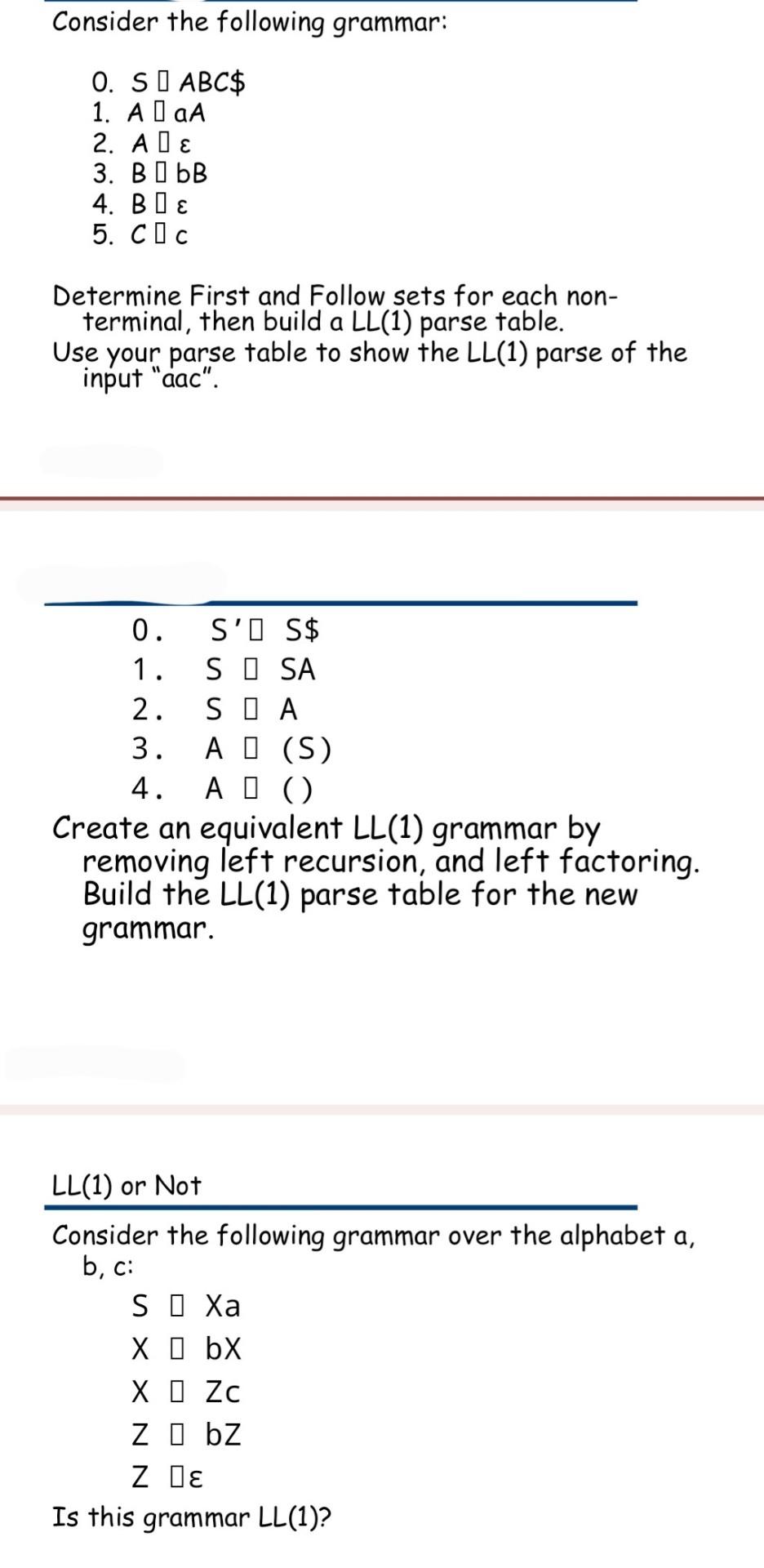
onsider the following JFlex specification: c \{ System.out.printf("1") ac +b * System.out.printf("2") cc System.out.printf("3"); \} ab System.out.printf("4") a { System.out.printf("5"); } acb+{ System.out.printf("6") Which rules can never apply and why? Consider the following language: strings that can be split into k0 substrings, where each substring is i1 a's followed by i b's; different substrings may use different values of i. For example, this language includes the strings ,ab, aabbab, and abaaabbbab. Give an LL(1) grammar for this language. Prove your grammar is LL(1). Consider the following grammar: 0. SABC$ 1. AaA 2. A 3. BbB 4. B 5. C Determine First and Follow sets for each nonterminal, then build a LL(1) parse table. Use your parse table to show the LL(1) parse of the input "aac". Create an equivalent LL(1) grammar by removing left recursion, and left factoring. Build the LL(1) parse table for the new grammar. LL(1) or Not Consider the following grammar over the alphabet a, b,c: SXaXbXXZcZbZZ Is this grammar LL(1)
Step by Step Solution
There are 3 Steps involved in it

Get step-by-step solutions from verified subject matter experts
 Study Help