







Question: Open in... Python 3 (ipykern Create a Python function ( simSatelliteOrbit ) which takes 3 arguments: . alt : The altitude of the satellite above
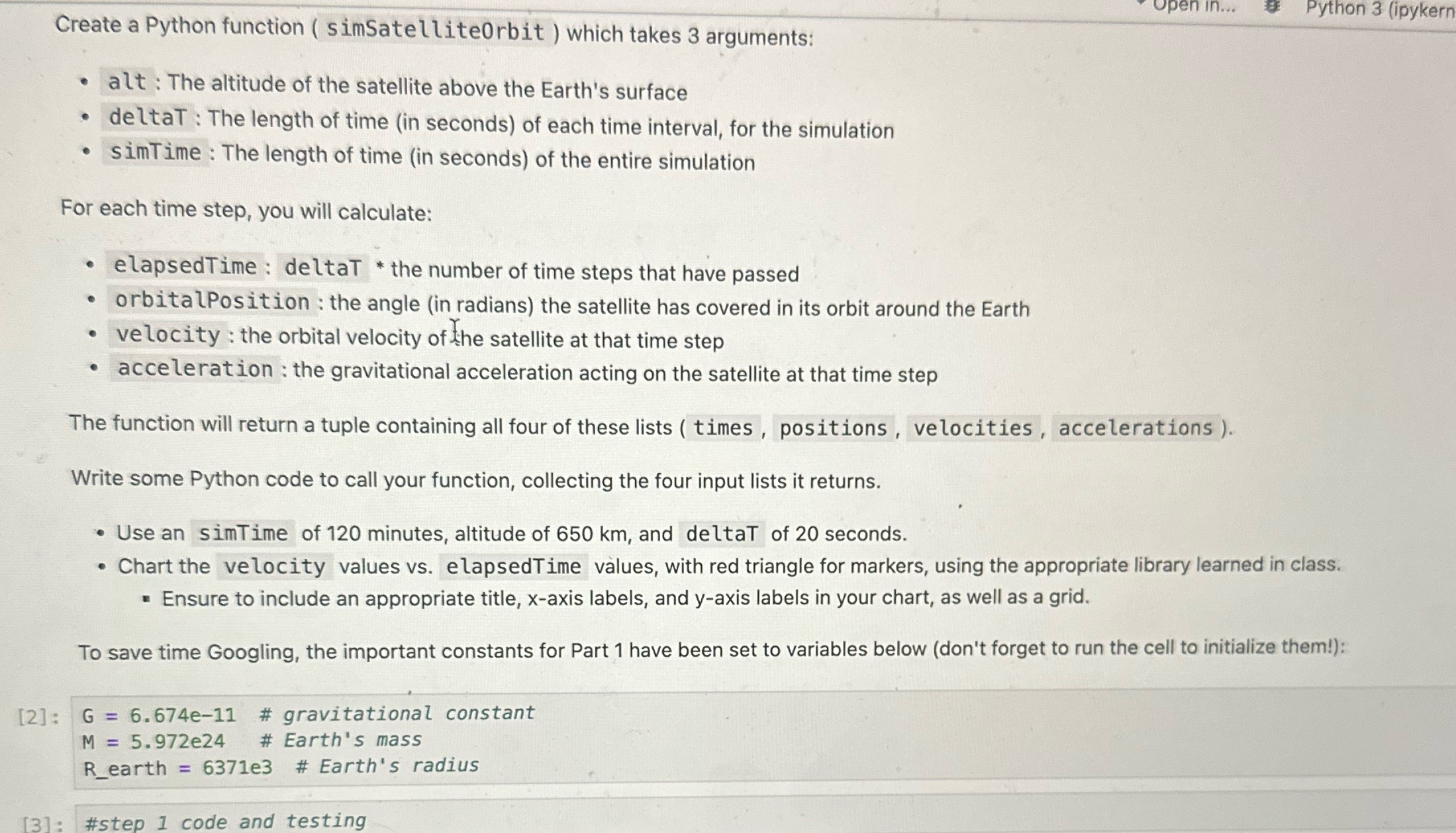
Open in... Python 3 (ipykern Create a Python function ( simSatelliteOrbit ) which takes 3 arguments: . alt : The altitude of the satellite above the Earth's surface . deltaT : The length of time (in seconds) of each time interval, for the simulation . simTime : The length of time (in seconds) of the entire simulation For each time step, you will calculate: . elapsedTime : deltaT * the number of time steps that have passed . orbitalPosition : the angle (in radians) the satellite has covered in its orbit around the Earth . velocity : the orbital velocity of the satellite at that time step . acceleration : the gravitational acceleration acting on the satellite at that time step The function will return a tuple containing all four of these lists ( times , positions , velocities , accelerations ). Write some Python code to call your function, collecting the four input lists it returns. . Use an simTime of 120 minutes, altitude of 650 km, and deltaT of 20 seconds. . Chart the velocity values vs. elapsedTime values, with red triangle for markers, using the appropriate library learned in class. . Ensure to include an appropriate title, x-axis labels, and y-axis labels in your chart, as well as a grid. To save time Googling, the important constants for Part 1 have been set to variables below (don't forget to run the cell to initialize them!): [2]: G = 6. 674e-11 # gravitational constant M = 5.972e24 # Earth's mass R_earth = 6371e3 # Earth's radius 13]: #step 1 code and testing
Step by Step Solution
There are 3 Steps involved in it

Get step-by-step solutions from verified subject matter experts
 Study Help