







Question: operating systems theory 1. If a short-term scheduling algorithm favors those processes that have used the least processor time in the recent past, why will
 operating systems theory
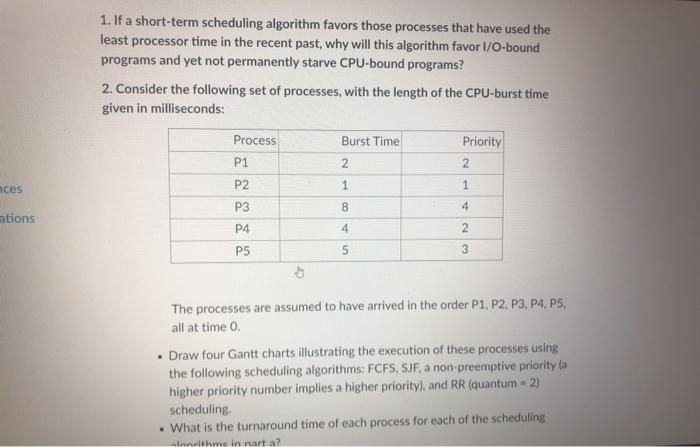
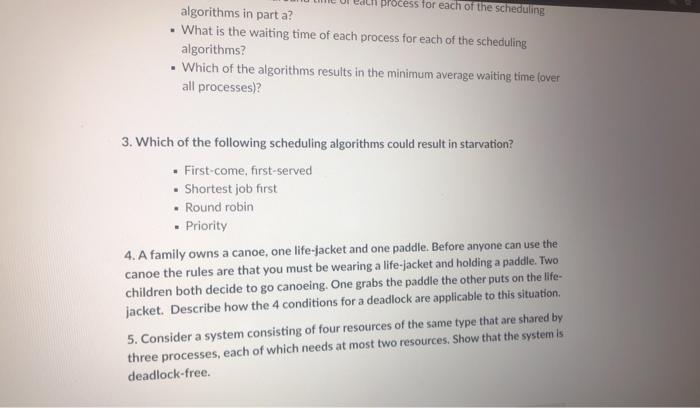
1. If a short-term scheduling algorithm favors those processes that have used the least processor time in the recent past, why will this algorithm favor 1/O-bound programs and yet not permanently starve CPU-bound programs? 2. Consider the following set of processes, with the length of the CPU-burst time given in milliseconds: Process Burst Time Priority P1 2 2 nces P2 1 1 P3 8 4 ations P4 4 2 P5 5 3 The processes are assumed to have arrived in the order P1, P2, P3, P4, P5, all at time 0. Draw four Gantt charts illustrating the execution of these processes using the following scheduling algorithms: FCFS, SJF, a non-preemptive priority la higher priority number implies a higher priority), and RR (quantum - 2) scheduling What is the turnaround time of each process for each of the scheduling innrihme in narta? process for each of the scheduling algorithms in part a . What is the waiting time of each process for each of the scheduling algorithms? . Which of the algorithms results in the minimum average waiting time lover all processes)? 3. Which of the following scheduling algorithms could result in starvation? . First-come, first-served . Shortest job first . Round robin . Priority 4. A family owns a canoe, one life-jacket and one paddle. Before anyone can use the canoe the rules are that you must be wearing a life-jacket and holding a paddle. Two children both decide to go canoeing. One grabs the paddle the other puts on the life- jacket. Describe how the 4 conditions for a deadlock are applicable to this situation 5. Consider a system consisting of four resources of the same type that are shared by three processes, each of which needs at most two resources. Show that the system is deadlock-free
Step by Step Solution
There are 3 Steps involved in it

Get step-by-step solutions from verified subject matter experts
 Study Help