







Question: Operation Propositional Logic Set Theory Disjunction Or Union And Intersection Conjunction Negation Implication Not Complement If, Then Subset Exclusive or Symmetric difference 1. A very
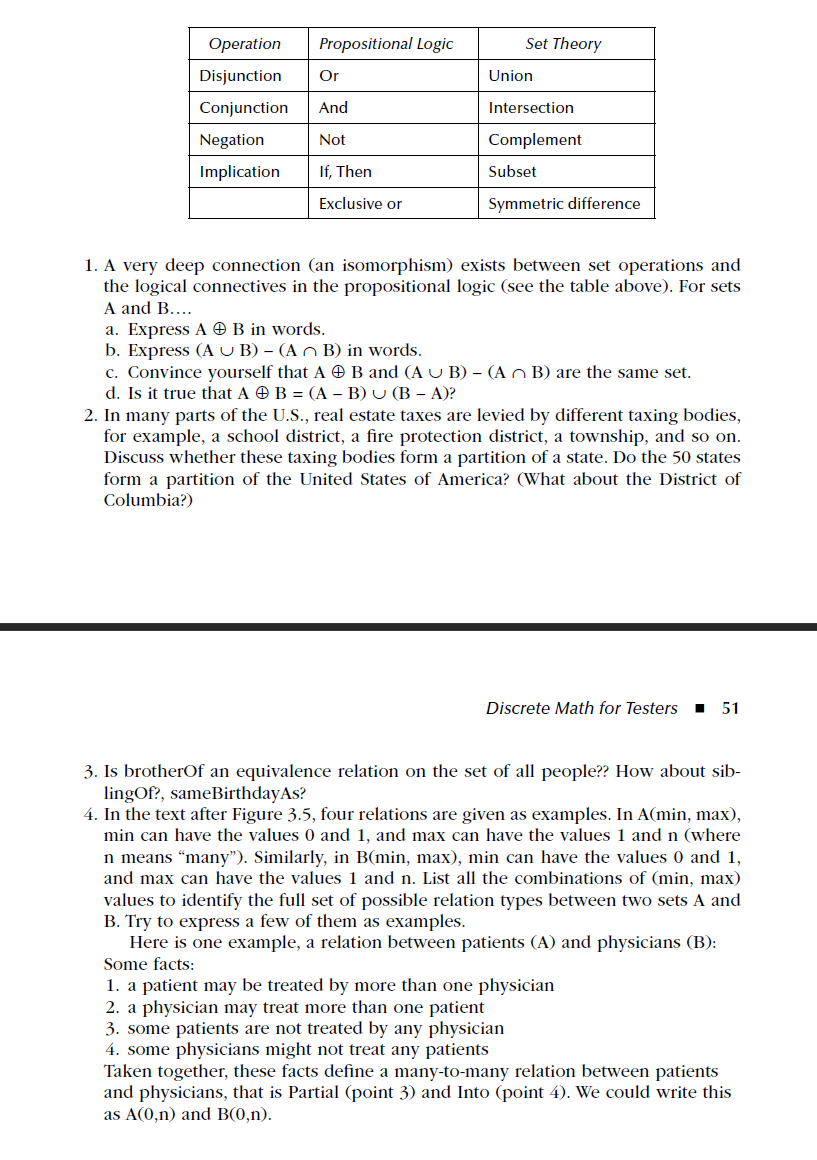
Operation Propositional Logic Set Theory Disjunction Or Union And Intersection Conjunction Negation Implication Not Complement If, Then Subset Exclusive or Symmetric difference 1. A very deep connection (an isomorphism) exists between set operations and the logical connectives in the propositional logic (see the table above). For sets A and B.... a. Express A B in words. b. Express (A UB) - (An B) in words. c. Convince yourself that A B and (AUB) - ( AB) are the same set. d. Is it true that A B = (A - B) U (B - A)? 2. In many parts of the U.S., real estate taxes are levied by different taxing bodies, for example, a school district, a fire protection district, a township, and so on. Discuss whether these taxing bodies form a partition of a state. Do the 50 states form a partition of the United States of America? (What about the District of Columbia?) Discrete Math for Testers 151 3. Is brotherOf an equivalence relation on the set of all people?? How about sib- lingOf?, sameBirthdayAs? 4. In the text after Figure 3.5, four relations are given as examples. In A(min, max), min can have the values 0 and 1, and max can have the values 1 and n (where n means "many"). Similarly, in B(min, max), min can have the values 0 and 1, and max can have the values 1 and n. List all the combinations of (min, max) values to identify the full set of possible relation types between two sets A and B. Try to express a few of them as examples. Here is one example, a relation between patients (A) and physicians (B): Some facts: 1. a patient may be treated by more than one physician 2. a physician may treat more than one patient 3. some patients are not treated by any physician 4. some physicians might not treat any patients Taken together, these facts define a many-to-many relation between patients and physicians, that is Partial (point 3) and Into (point 4). We could write this as A(0,n) and B(0,n)
Step by Step Solution
There are 3 Steps involved in it

Get step-by-step solutions from verified subject matter experts
 Study Help