







Question: operation research solve it by hand please solve part a,b,c,d and e as shown in the photo 3-66. In the Reddy Mikks model of Example
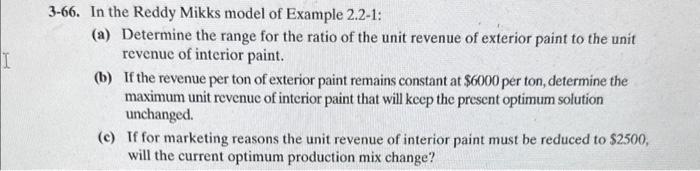
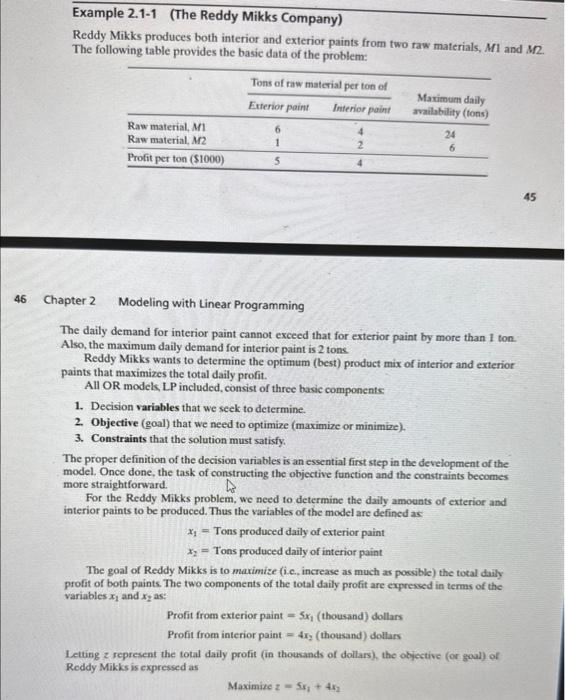

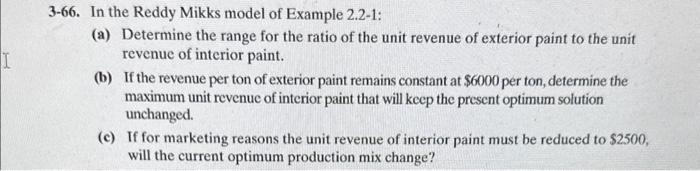
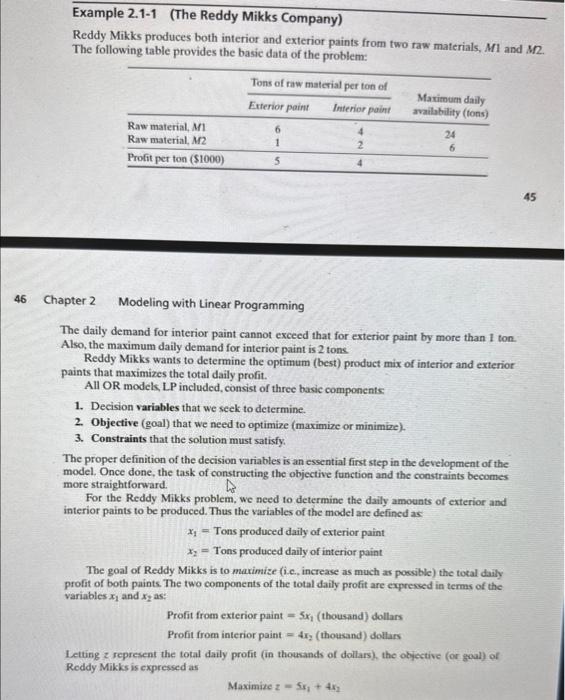

3-66. In the Reddy Mikks model of Example 2.2-1: (a) Determine the range for the ratio of the unit revenue of exterior paint to the unit revenue of interior paint. (b) If the revenue per ton of exterior paint remains constant at $6000 per ton, determine the maximum unit revenue of interior paint that will keep the present optimum solution unchanged. (c) If for marketing reasons the unit revenue of interior paint must be reduced to $2500, will the current optimum production mix change? Example 2.1-1 (The Reddy Mikks Company) Reddy Mikks produces both interior and exterior paints from two raw materials, M1 and M2. The following table provides the basic data of the problem: Chapter 2 Modeling with Linear Programming The daily demand for interior paint cannot exceed that for exterior paint by more than 1 ton. Also, the maximum daily demand for interior paint is 2 tons. Reddy Mikks wants to determine the optimum (best) product mix of interior and exterior paints that maximizes the total daily profit. All OR models, LP included, consist of three basic components: 1. Decision variables that we seek to determine. 2. Objective (goal) that we need to optimize (maximize or minimize). 3. Constraints that the solution must satisfy. The proper definition of the decision variables is an essential first step in the development of the model. Once done, the task of constructing the objective function and the constraints becomes more straightforward. For the Reddy Mikks problem, we need to determine the daily amounts of exterior and interior paints to be produced. Thus the variables of the model are defined as x1= Tons produced daily of exterior paint x2= Tons produced daily of interior paint The goal of Reddy Mikks is to maximize (i.e. increase as much as possible) the total daily profit of both paints. The two components of the total daily profit are expressed in terms of the variables x1 and x2 as: Profit from exterior paint =5x1 (thousand) dollars Profit from interior paint =4x2 (thousand) dollars Letting z sepresent the total daily profit (in thousands of dollars), the objective (or goal) of Reddy Mikks is expressed as Maximize z=5x1+4x2 3.66 (Parts a, b, and c) +d - Compute the unit worth of resource 1 (defined by 1st constraint) and the range of its validity. then eCompute the unit worth of resource 2 (defined by 2nd constraint) and the range of its validity. 3-66. In the Reddy Mikks model of Example 2.2-1: (a) Determine the range for the ratio of the unit revenue of exterior paint to the unit revenue of interior paint. (b) If the revenue per ton of exterior paint remains constant at $6000 per ton, determine the maximum unit revenue of interior paint that will keep the present optimum solution unchanged. (c) If for marketing reasons the unit revenue of interior paint must be reduced to $2500, will the current optimum production mix change? Example 2.1-1 (The Reddy Mikks Company) Reddy Mikks produces both interior and exterior paints from two raw materials, M1 and M2. The following table provides the basic data of the problem: Chapter 2 Modeling with Linear Programming The daily demand for interior paint cannot exceed that for exterior paint by more than 1 ton. Also, the maximum daily demand for interior paint is 2 tons. Reddy Mikks wants to determine the optimum (best) product mix of interior and exterior paints that maximizes the total daily profit. All OR models, LP included, consist of three basic components: 1. Decision variables that we seek to determine. 2. Objective (goal) that we need to optimize (maximize or minimize). 3. Constraints that the solution must satisfy. The proper definition of the decision variables is an essential first step in the development of the model. Once done, the task of constructing the objective function and the constraints becomes more straightforward. For the Reddy Mikks problem, we need to determine the daily amounts of exterior and interior paints to be produced. Thus the variables of the model are defined as x1= Tons produced daily of exterior paint x2= Tons produced daily of interior paint The goal of Reddy Mikks is to maximize (i.e. increase as much as possible) the total daily profit of both paints. The two components of the total daily profit are expressed in terms of the variables x1 and x2 as: Profit from exterior paint =5x1 (thousand) dollars Profit from interior paint =4x2 (thousand) dollars Letting z sepresent the total daily profit (in thousands of dollars), the objective (or goal) of Reddy Mikks is expressed as Maximize z=5x1+4x2 3.66 (Parts a, b, and c) +d - Compute the unit worth of resource 1 (defined by 1st constraint) and the range of its validity. then eCompute the unit worth of resource 2 (defined by 2nd constraint) and the range of its validity
Step by Step Solution
There are 3 Steps involved in it

Get step-by-step solutions from verified subject matter experts
 Study Help