







Question: Operational Semantics Homework For these exercises, we will expand the grammar and operational semantics for expressions given in the slides to include subtraction and integer
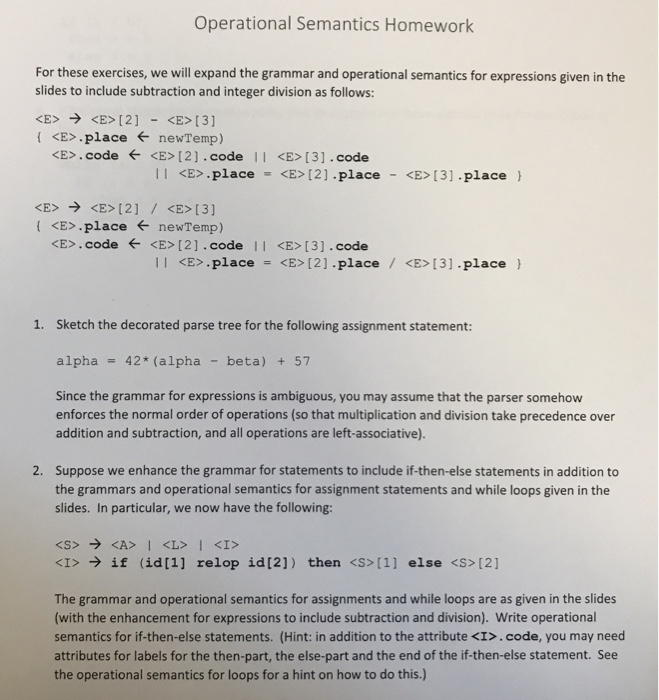
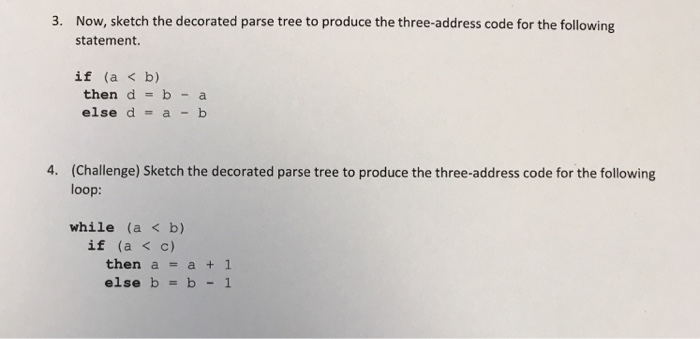
Operational Semantics Homework For these exercises, we will expand the grammar and operational semantics for expressions given in the slides to include subtraction and integer division as follows: [1] else [2] The grammar and operational semantics for assignments and while loops are as given in the slides (with the enhancement for expressions to include subtraction and division). Write operational semantics for if-then-else statements. (Hint: in addition to the attribute .code, you may need attributes for labels for the then-part, the else-part and the end of the if-then-else statement. See the operational semantics for loops for a hint on how to do this.) Now, sketch the decorated parse tree to produce the three-address code for the following statement. 3. if (a
Step by Step Solution
There are 3 Steps involved in it

Get step-by-step solutions from verified subject matter experts
 Study Help