



Question: Operations Management. Lead time (L) and Cycle length (Q/d). This question is from a bigger question. The solution is in red and blue. My question
Operations Management. Lead time (L) and Cycle length (Q/d). This question is from a bigger question. The solution is in red and blue. My question is about the solution.
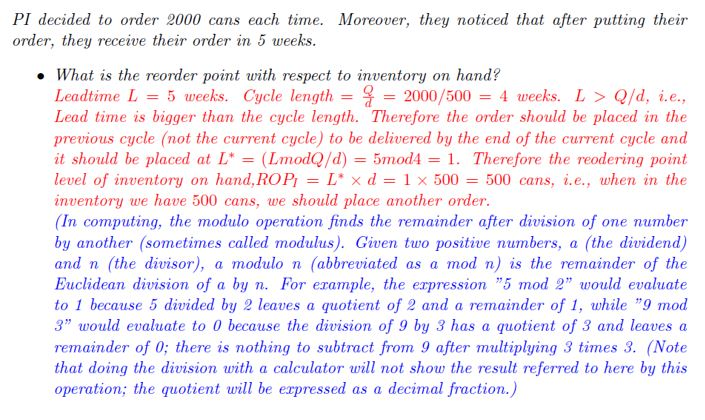
My question about the above question:
a)why is d=500? They receive the order in 5 weeks. Why do you do 5*100=500?
b)So
if L>Q/d --> this means the order should be placed in the previous cycle and to be delivered by end of the current cycle. and to calculate the Reorder point we use mod.
if L the order is placed in the current cycle. The reorder point is calculated with mod.
Do you know when the inventory is delivered for if L
PI decided to order 2000 cans each time. Moreover, they noticed that after putting their order, they receive their order in 5 weeks. What is the reorder point with respect to inventory on hand? Leadtime I = 5 weeks. Cycle length = 2 = 2000/500 = 4 weeks. L > Q/d, i.e., Lead time is bigger than the cycle length. Therefore the order should be placed in the previous cycle (not the current cycle) to be delivered by the end of the current cycle and it should be placed at L* = (LmodQ/d) = 5mod4 = 1. Therefore the reodering point level of inventory on hand, ROP, = L* xd = 1 x 500 = 500 cans, i.e., when in the inventory we have 500 cans, we should place another order. (In computing, the modulo operation finds the remainder after division of one number by another (sometimes called modulus). Given two positive numbers, a (the dividend) and n (the divisor), a modulo n (abbreviated as a mod n) is the remainder of the Euclidean division of a by n. For erample, the expression "5 mod 2" would evaluate to 1 because 5 divided by 2 leaves a quotient of 2 and a remainder of 1, while "9 mod 3" would evaluate to 0 because the division of 9 by 3 has a quotient of 3 and leaves a remainder of 0; there is nothing to subtract from 9 after multiplying 3 times 3. (Note that doing the division with a calculator will not show the result referred to here by this operation; the quotient will be expressed as a decimal fraction.) PI decided to order 2000 cans each time. Moreover, they noticed that after putting their order, they receive their order in 5 weeks. What is the reorder point with respect to inventory on hand? Leadtime I = 5 weeks. Cycle length = 2 = 2000/500 = 4 weeks. L > Q/d, i.e., Lead time is bigger than the cycle length. Therefore the order should be placed in the previous cycle (not the current cycle) to be delivered by the end of the current cycle and it should be placed at L* = (LmodQ/d) = 5mod4 = 1. Therefore the reodering point level of inventory on hand, ROP, = L* xd = 1 x 500 = 500 cans, i.e., when in the inventory we have 500 cans, we should place another order. (In computing, the modulo operation finds the remainder after division of one number by another (sometimes called modulus). Given two positive numbers, a (the dividend) and n (the divisor), a modulo n (abbreviated as a mod n) is the remainder of the Euclidean division of a by n. For erample, the expression "5 mod 2" would evaluate to 1 because 5 divided by 2 leaves a quotient of 2 and a remainder of 1, while "9 mod 3" would evaluate to 0 because the division of 9 by 3 has a quotient of 3 and leaves a remainder of 0; there is nothing to subtract from 9 after multiplying 3 times 3. (Note that doing the division with a calculator will not show the result referred to here by this operation; the quotient will be expressed as a decimal fraction.)
Step by Step Solution
There are 3 Steps involved in it

Get step-by-step solutions from verified subject matter experts